


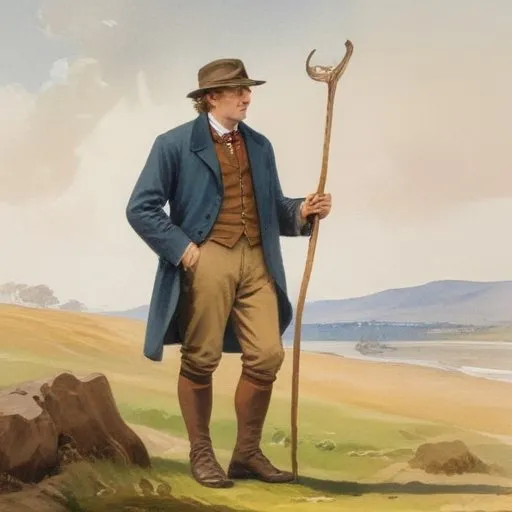
Irish genre painter capturing everyday life scenes with remarkable attention to detail, often focusing on the struggles and joys of the working class.
William Mulready, an Irish genre painter, is best known for his idyllic and romanticizing depictions of rural scenes, transporting viewers to a bygone era of tranquility and charm. His artwork is also celebrated for its role in creating Mulready stationery letter sheets, issued contemporaneously with the iconic Penny Black postage stamp.
Mulready was born on April 1, 1786, in Ennis, County Clare, Ireland. In 1792, his family relocated to London, where he received a solid education and was taught painting by renowned artists. At just 14 years old, he was accepted into the prestigious Royal Academy School, laying the foundation for a remarkable artistic career.
In 1802, Mulready married Elizabeth Varley, a talented landscape painter from a family of established artists. Her brothers, John Varley and Cornelius Varley, were accomplished artists in their own right. The couple had three children, Paul Augustus, William, and Michael, all of whom went on to become artists, continuing the family's creative legacy.
Despite his professional success, Mulready's personal life was marked by turmoil. His relationship with his wife deteriorated over the years, with allegations of infidelity and cruelty. The couple eventually separated, but Mulready's strong Catholic beliefs prevented him from pursuing a divorce. This tumultuous period in his life is documented in papers stored at the Victoria and Albert Museum.
Mulready's artistic career spanned several decades, during which he produced numerous remarkable works. His paintings often featured rustic landscapes, charming villages, and intimate domestic scenes, imbued with a sense of nostalgia and warmth. Some of his notable works include "The Sonnet" (1839), "The Fight Interrupted" (1824), and "The Angler" (1825).
Mulready's artwork not only reflected the romantic sensibilities of his era but also contributed to the development of the genre. His depictions of rural life and idyllic landscapes continue to inspire artists, writers, and designers to this day. His legacy can be seen in the nostalgic appeal of modern art, literature, and design, which often evoke a sense of longing for a simpler, more peaceful time.
Throughout his life, Mulready received numerous accolades for his artistic contributions. He was elected an Associate of the Royal Academy in 1803 and a full Royal Academician in 1815. His artwork is now held in high esteem, with many pieces on display at prominent museums, including the National Gallery in London and the Victoria and Albert Museum.
William Mulready's remarkable life and artistic career serve as a testament to the enduring power of romantic landscapes. His captivating paintings continue to enchant audiences, transporting them to a bygone era of simplicity, beauty, and charm. As a pioneer of genre painting, Mulready's legacy remains an integral part of art history, inspiring generations of artists, writers, and designers to come.
Born in 1793
A Romantic-era painter celebrated for dramatic, emotive landscapes and seascapes that evoke a sense of the sublime and the power of nature. His works often featured turbulent skies, rocky coastlines, and mythological themes.
Born in 1856
A renowned Irish artist celebrated for capturing the essence of Irish identity and landscapes through his impressionist paintings, particularly of the Irish countryside and its people.
54 Years Old
An openly gay journalist and actor, known for being the first to anchor a evening news program on a major network, and for his work on MSNBC and CNN.
