


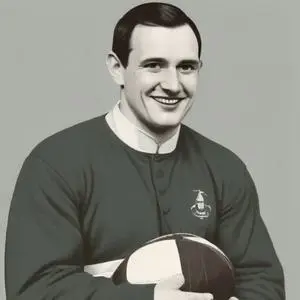
An English priest credited with inventing Rugby football, a full-contact team sport played with an oval-shaped ball. He's famous for picking up the ball during a soccer match, thus creating a new game.
William Webb Ellis, a name synonymous with the sport of rugby, is credited with inventing the game in 1823 while a pupil at Rugby School. The story goes that Ellis, defying the rules of traditional football, picked up the ball and ran with it, thus creating the rugby style of play that would go on to captivate the world.
Born on November 24, 1806, in Salford, Lancashire, Ellis was the youngest of three sons to James Ellis, a cornet in the 7th Dragoon Guards. After his father's untimely death in the Peninsular War, his mother, Ann, moved the family to Rugby, Warwickshire, to ensure that Ellis and his brother, Thomas, could receive an education at Rugby School.
Ellis attended Rugby School from 1816 to 1825, where he excelled as a scholar and cricketer. Although he was known to take unfair advantage on the cricket pitch, his sporting prowess would eventually lead to the creation of a new game.
The legendary story of Ellis picking up the ball and running with it during a school football match in 1823 has become an integral part of rugby folklore. While the story lacks concrete evidence, it has been passed down through generations, solidifying Ellis's place in the annals of rugby history.
Despite the controversy surrounding the origin of the game, Ellis's actions that day would go on to inspire a new style of play, one that emphasized physicality, teamwork, and strategy. The game of rugby was born, and it would soon spread like wildfire across the globe.
After leaving Rugby School, Ellis went on to study at Brasenose College, Oxford, where he graduated in 1829. He was ordained as a deacon in 1831 and later became a priest in 1832. Ellis served as a clergyman in various parishes, eventually becoming the rector of Llanelli in 1853.
Ellis's love for rugby never wavered, and he continued to promote the game throughout his life. He died on February 24, 1872, leaving behind a legacy that would continue to inspire generations to come.
In recognition of Ellis's contribution to the sport, the Webb Ellis Cup is presented to the winners of the Rugby World Cup. The cup is a testament to the enduring impact of Ellis's actions on that fateful day in 1823.
Today, rugby is played by millions around the world, and its global reach is a direct result of Ellis's pioneering spirit. As a clergyman, Ellis may have been an unlikely hero, but his innovative spirit and love for the game have left an indelible mark on the world of sports.
William Webb Ellis's remarkable story serves as a reminder that even the most unlikely individuals can leave a lasting impact on the world. As the sport of rugby continues to grow and evolve, Ellis's legacy remains an integral part of its rich history.
87 Years Old
A blues and jazz pianist, known for his distinctive playing style and contributions to the development of boogie-woogie music.
Born in 1835
Australian sports pioneer who co-created Australian Rules football and played cricket at the national level, leaving a lasting legacy in Australian sports history.
