


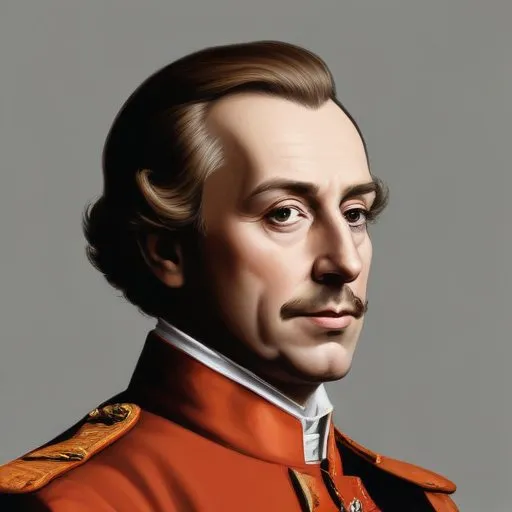
An English admiral who played a crucial role in the Hundred Years' War, leading several successful naval campaigns and serving as a trusted advisor to King Henry VI. He's also known for his involvement in the Treaty of Tours, which aimed to bring peace between England and France.
William de la Pole, 1st Duke of Suffolk, was a prominent English magnate, statesman, and military commander who rose to fame during the Hundred Years War, earning the nickname "Jackanapes" for his alleged low birth. However, his association with the royal government's failures, particularly in France, led to his downfall and tragic demise.
Born on October 16, 1396, in Cotton, Suffolk, William was the second son of Michael de la Pole, 2nd Earl of Suffolk, and Katherine de Stafford. His family's noble lineage and military heritage paved the way for his future success. Almost continually engaged in the wars in France, William was seriously wounded during the Siege of Harfleur in 1415, where his father died from dysentery. Later that year, his elder brother Michael, 3rd Earl of Suffolk, was killed at the Battle of Agincourt, and William succeeded as 4th earl.
William's military prowess and strategic thinking caught the attention of Henry VI of England, who made him a favourite and a leading figure in the English government. He became a dominant force in organizing the Treaty of Tours in 1444 and arranged the king's marriage to Margaret of Anjou. However, his diplomatic approach to the war in France was often at odds with the king's military aspirations, leading to growing criticism and resentment among the English nobility.
As the English government's failures mounted, Suffolk became the scapegoat for the nation's troubles. Accused of maladministration, he was forced into exile, but his journey was cut short when he was caught by an angry mob at sea. Subjected to a mock trial, Suffolk was beheaded, and his estates were forfeited to the Crown. His only son, John, would later inherit his titles and estates.
Suffolk's tumultuous career has been immortalized in William Shakespeare's Henry VI, Parts 1 and 2, where he is portrayed as a Machiavellian figure. Despite his questionable conduct, Suffolk's military campaigns and diplomatic efforts underscore his significance in English history. His legacy serves as a cautionary tale about the dangers of absolute power and the importance of accountability in government.
In the end, Suffolk's tragic demise serves as a reminder that even the most powerful among us can fall victim to the whims of fate and the cruelty of others. His story is a testament to the enduring power of history to shape our understanding of human nature and the dangers of unchecked ambition.
Born in 1408
A prominent nobleman and Lancastrian leader during the Wars of the Roses, he played a crucial role in the Battle of Barnet and was a key figure in the struggle for the English throne.
Born in 1133
King of England from 1154 to 1189, known for establishing a strong centralized government, reforming the English church, and his tumultuous relationships with Thomas Becket and his sons.
Born in 1430
Wife of King Henry VI of England, she played a significant role in the Wars of the Roses, leading the Lancastrian faction and fighting for her husband's claim to the throne.
