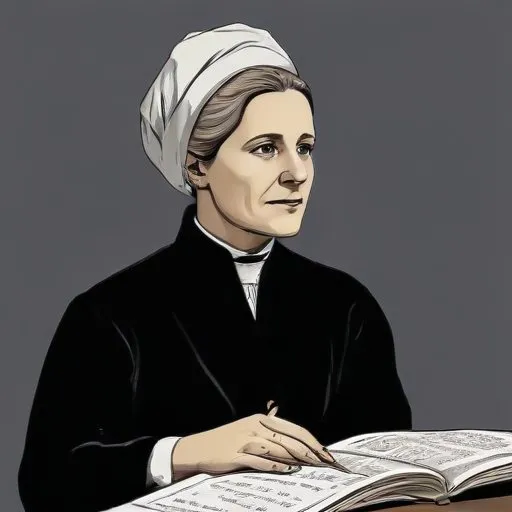
Williamina Fleming: A Trailblazing Astronomer of Exceptional Proportions
A Pioneer in Stellar Spectral Classification
Williamina Fleming is renowned for her groundbreaking contributions to the field of astronomy, particularly in the development of a common designation system for stars and the cataloging of over 10,000 stellar spectra. Her meticulous work at the Harvard College Observatory (HCO) led to the discovery of the Horsehead Nebula in 1888, a feat that solidified her position as a pioneer in the field of astronomy.
Early Life and Education
Born on May 15, 1857, in Dundee, Scotland, Williamina Paton Stevens was the daughter of Mary Walker and Robert Stevens, a carver and gilder. She was one of six children, and her younger sister, Johanna Stevens, would later join her at the HCO. Fleming's early education commenced at the age of 14, when she began working as a pupil-teacher.
Marriage and Emigration
In 1877, Fleming married James Orr Fleming, an accountant and widower, and the couple emigrated to Boston, Massachusetts, in 1878, when she was just 21 years old. However, her husband abandoned her and their young son, Edward P. Fleming, leaving Williamina to fend for herself.
Career at the Harvard College Observatory
After working as a maid in the home of Professor
Edward Charles Pickering, the director of the HCO, Fleming's talents were recognized, and she was hired in 1879 to conduct part-time administrative work at the observatory. In 1881, Pickering formally invited Fleming to join the HCO, where she was taught to analyze stellar spectra by Pickering himself. Fleming became one of the founding members of the Harvard Computers, an all-women team of human computers responsible for computing mathematical classifications and editing the observatory's publications.
The Henry Draper Catalogue
In 1886, Mary Anna Draper, the wealthy widow of astronomer
Henry Draper, established the Henry Draper Memorial to fund the HCO's research. Fleming played a crucial role in the compilation of the Henry Draper Catalogue, a comprehensive catalog of stellar spectra that has become a benchmark for astronomical research.
Spectacular Discoveries and Contributions
Fleming's contributions to astronomy are multifaceted and far-reaching. She:
- Cataloged over 10,000 stars
- Discovered 59 gaseous nebulae
- Identified over 310 variable stars
- Documented 10 novae and other astronomical phenomena
Legacy and Impact on Modern Astronomy
Williamina Fleming's pioneering work in stellar spectral classification has had a profound impact on modern astronomy. Her cataloging of stars and celestial objects has facilitated research in stellar evolution, galaxy formation, and cosmology. Fleming's legacy extends beyond her scientific contributions, inspiring generations of women to pursue careers in astronomy and STEM fields.
Awards and Honors
Fleming's groundbreaking work was recognized during her lifetime, and she received numerous awards and honors, including:
- Appointment as a curator of astronomical photographs at the HCO
- Election as a honorary member of the Royal Astronomical Society of Canada
Personal Milestones and Key Life Events
Fleming's life was marked by perseverance and resilience in the face of adversity. Some significant events in her life include:
- Emigration to the United States in 1878
- Abandonment by her husband in 1879
- Discovery of the Horsehead Nebula in 1888
Philosophical Contributions and Beliefs
Fleming's work embodies a deep understanding of the importance of precision, dedication, and collaboration in scientific research. Her contributions to astronomy have fostered a greater appreciation for the complexity and beauty of the universe.
Historical Context and Legacy
Williamina Fleming's remarkable story serves as a testament to the power of human ingenuity, perseverance, and determination. Her legacy continues to inspire and motivate astronomers, scientists, and scholars worldwide, ensuring that her contributions to astronomy remain an integral part of our understanding of the universe.
FAQ
What was Williamina Flemings most significant contribution to astronomy?
Williamina Flemings most significant contribution to astronomy was her discovery of over 59 gaseous nebulae, as well as her cataloging of thousands of stars and other celestial objects.
What were Williamina Flemings roles at the Harvard College Observatory?
Williamina Fleming worked at the Harvard College Observatory as a computer, cataloging and studying celestial objects, and as a curator of astronomical photographs. She was one of the first women to work at the observatory and played a crucial role in its operations.
How did Williamina Flemings work impact our understanding of the universe?
Williamina Flemings work impacted our understanding of the universe by providing valuable data on the nature and distribution of celestial objects, including stars, nebulae, and galaxies. Her discoveries helped to lay the foundation for modern astrophysics and cosmology.
What were Williamina Flemings views on women in science?
Williamina Fleming believed that women were capable of making significant contributions to science, and she worked to promote opportunities for women in astronomy. She was a trailblazer for women in science and paved the way for future generations of female astronomers.
What was Williamina Flemings legacy in astronomy?
Williamina Flemings legacy in astronomy is that of a pioneering female astronomer who made significant contributions to our understanding of the universe. She is remembered as a dedicated and talented scientist who helped to lay the foundation for modern astrophysics and cosmology.