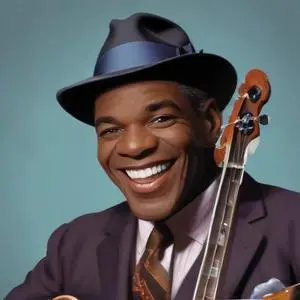
The Architect of Chicago Blues: Willie Dixon
A Legacy of Rhythm and Soul
Willie Dixon is widely regarded as one of the most influential blues musicians of all time, celebrated for his soulful voice, masterful songwriting, and instrumental prowess on both the upright bass and guitar. As the chief songwriter and producer for Chess Records, Dixon's creations have been covered by a diverse range of artists, from
Muddy Waters to The Rolling Stones, cementing his status as a driving force behind the evolution of Chicago blues.
Early Life and Musical Beginnings
Born on July 1, 1915, in Vicksburg, Mississippi, Willie Dixon grew up in a family of 14 children. His mother, Daisy, would often rhyme her words, a habit that young Willie would imitate, foreshadowing his future as a lyrical mastermind. At just four years old, Dixon sang his first song at Springfield Baptist Church, and by the age of seven, he was captivated by the sounds of pianist Little Brother Montgomery.
Prison Farms and Gospel Harmonies
During his teenage years, Dixon served time on prison farms in Mississippi, where he was first introduced to the blues. Later, he learned to sing harmony from local carpenter Theo Phelps, who led the Union Jubilee Singers, a gospel quintet. This unique blend of influences would shape Dixon's distinctive sound and style.
A Songwriting Genius
Dixon's most famous compositions include "Hoochie Coochie Man," "I Just Want to Make Love to You," "Little Red Rooster," "My Babe," "Spoonful," and "You Can't Judge a Book by the Cover." These songs, written during the peak years of Chess Records (1950-1965), were performed by Muddy Waters,
Howlin' Wolf,
Little Walter, and
Bo Diddley, and went on to influence a generation of musicians worldwide.
Kaleidoscope of Collaborations
Dixon's work extended beyond the blues, as he collaborated with icons like Little Walter,
Chuck Berry, and Bo Diddley in the late 1950s, bridging the gap between blues and rock 'n' roll. In the 1960s, his songs were adapted by numerous rock artists, including The Rolling Stones, Led Zeppelin, and Eric Clapton.
Awards and Accolades
Throughout his illustrious career, Dixon received numerous accolades, including a Grammy Award, induction into the Blues Hall of Fame, the Rock and Roll Hall of Fame, and the Songwriters Hall of Fame.
Philosophical Contributions and Beliefs
Dixon's music often reflected his deep-seated commitment to social justice and equality. His songs frequently addressed themes of love, freedom, and empowerment, resonating with audiences from diverse backgrounds.
Legacy and Impact
Willie Dixon's contributions to the world of music are immeasurable. As a songwriter, producer, and performer, he left an indelible mark on the blues and rock 'n' roll genres. His songs continue to inspire new generations of musicians, ensuring his legacy as one of the most influential figures in American music.
- Quote: "Blues is the roots, and everything else is the fruits."
- Fun Fact: Dixon was an accomplished boxer in his youth and was even offered a contract with the Chicago White Sox.
- Inspirational Story: Despite facing racism and adversity throughout his life, Dixon remained committed to his art, using his platform to promote unity and social justice.
Willie Dixon's remarkable life and career serve as a testament to the power of perseverance, creativity, and the blues. His music continues to tantalize our senses, inspiring us to explore the depths of human emotion and the rich cultural heritage of America's musical soul.
FAQ
What is Willie Dixons contribution to blues music?
Willie Dixon was a pioneering blues singer-songwriter, bass player, guitarist, and producer who made significant contributions to the development of Chicago blues. He wrote many classic blues songs, including Hoochie Coochie Man and Little Red Rooster, and played with iconic musicians like Muddy Waters and Howlin Wolf.
What is Willie Dixons musical legacy?
Willie Dixons musical legacy extends far beyond his own music. He was a mentor and influence to many famous blues and rock musicians, including Eric Clapton, Led Zeppelin, and The Rolling Stones. His songs have been covered by numerous artists, and he was inducted into the Blues Hall of Fame, Rock and Roll Hall of Fame, and Songwriters Hall of Fame.
What is Willie Dixons most famous song?
Willie Dixons most famous song is probably Hoochie Coochie Man, which has been covered by many artists, including Muddy Waters, Chuck Berry, and The Rolling Stones. The song has become a blues classic and a staple of rock music.
Who did Willie Dixon collaborate with?
Willie Dixon collaborated with many famous musicians, including Muddy Waters, Howlin Wolf, Little Walter, and Otis Rush. He also worked with rock musicians like Eric Clapton, Led Zeppelin, and The Rolling Stones, who were influenced by his music.
What awards did Willie Dixon win?
Willie Dixon won several awards, including multiple Grammy Awards, a National Medal of Arts, and inductions into the Blues Hall of Fame, Rock and Roll Hall of Fame, and Songwriters Hall of Fame.