


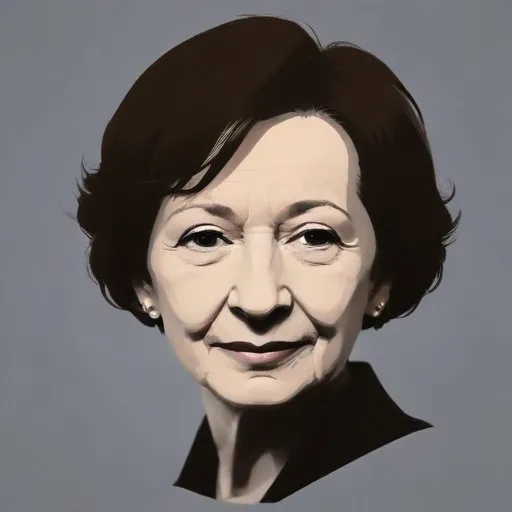
A Polish poet and translator who captured the human experience through subtle, introspective verse, earning her the Nobel Prize in Literature. Her poetry explores the complexities of life, love, and mortality.
Wisława Szymborska, a Polish poet, essayist, and translator, is renowned for her thought-provoking poetry that delves into the human experience, stripping away the veil of illusion to reveal the raw essence of life. Her poignant words, infused with irony and precision, earned her the prestigious Nobel Prize in Literature in 1996.
Born on July 2, 1923, in Prowent, Poland, Szymborska was the second daughter of Wincenty Szymborski and Anna (née Rottermund) Szymborska. Her father's association with Count Władysław Zamoyski, a Polish patriot and charitable patron, exposed her to a world of intellectual and artistic pursuits from an early age. After her father's death in 1924, her family moved to Toruń and later to Kraków, where she spent most of her life.
During World War II, Szymborska continued her education in underground classes, evading forced labor in Germany. She later worked as a railroad employee and began her artistic journey, creating illustrations for an English-language textbook. Her writing career took off in 1945 with the publication of her first poem, "Szukam słowa" ("Looking for words"), in the daily newspaper Dziennik Polski.
Szymborska's studies in Polish literature and sociology at Jagiellonian University in Kraków further honed her craft, and she became an integral part of the local writing scene. Her association with Czesław Miłosz, a fellow poet and Nobel laureate, had a profound impact on her work.
Szymborska's poetry is characterized by its nuanced exploration of human reality, often poking holes in the fabric of grand narratives. Her unique perspective on life, death, love, and the human condition resonated with readers worldwide. Her work is marked by a distinct lack of sentimentalism, instead opting for a direct and incisive approach to exploring the intricacies of existence.
Szymborska's contributions to literature have been recognized with numerous accolades, including:
Szymborska's work has been translated into multiple languages, including Arabic, Hebrew, Japanese, Persian, and Chinese, ensuring her poetry reaches a diverse global audience. Her legacy extends beyond literary circles, as her exploration of the human condition continues to inspire and provoke readers from all walks of life.
Wisława Szymborska's remarkable life and work serve as a testament to the transformative power of poetry, offering a glimpse into the complexities and beauty of human existence. Her poetry, infused with irony, precision, and a touch of enigma, continues to captivate readers, solidifying her place as one of the most important poets of the 20th century.
81 Years Old
A celebrated poet and essayist, known for exploring the human condition, morality, and the search for meaning in a post-war world. His lyrical and introspective style has captivated readers globally.
Born in 1896
A renowned Italian poet and translator, celebrated for his unique and expressive style that explores the human condition, earning him the Nobel Prize in Literature.
Born in 1914
A Mexican poet and diplomat who won the Nobel Prize in Literature in 1990 for his work that explores the intersection of poetry, philosophy, and politics. He's known for his lyrical and introspective style that explores the human condition.
