


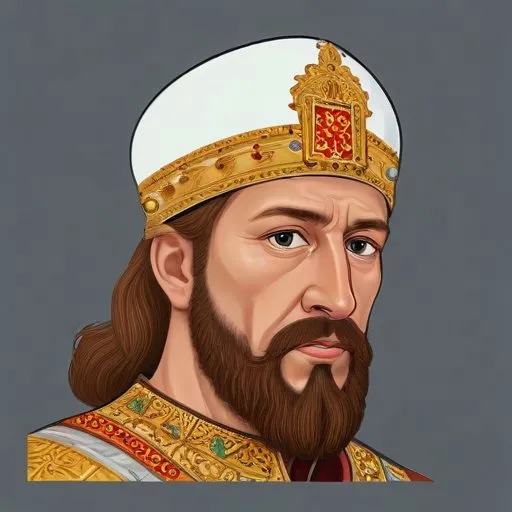
Grand Prince of Vladimir-Suzdal, ruling from 1238 to 1246, known for his military campaigns against the Mongols and his role in the medieval history of Russia.
Yaroslav's life was a complex web of alliances, battles, and power struggles, shaped by the turbulent times in which he lived. As the fourth son of Vsevolod the Big Nest and Maria Shvarnovna, he was destined for greatness, but his path to power was far from straightforward.
Yaroslav's early life was marked by a series of appointments to various princely positions, including Prince of Pereyaslav and Prince of Novgorod. In 1200, his father sent him to rule Pereiaslav, near the Kypchak steppes, where he would face the challenges of governing a frontier town.
The Mongol invasion of Russia in the early 13th century threatened the very existence of the Vladimir principality. Yaroslav collaborated with Batu Khan, hoping to spare his people from destruction. However, this decision would ultimately lead to his downfall.
In 1238, Yaroslav became the Grand Prince of Vladimir, but his reign was marked by controversy and bloodshed. He was eventually poisoned, allegedly by the Mongols, in 1246.
Yaroslav's legacy is a subject of ongoing debate among historians. Some view him as a pragmatic leader who made difficult choices to ensure the survival of his people, while others see him as a collaborator who betrayed his country.
Regardless of one's perspective, it is clear that Yaroslav II of Vladimir played a significant role in shaping the course of Russian history during a period of great upheaval.
Yaroslav's reign occurred during a period of great turmoil in Eastern Europe, marked by the Mongol invasions and the decline of the Kievan Rus' state. His legacy reflects the complexities of this era, and his decisions continue to be studied by historians today.
Ultimately, Yaroslav II of Vladimir remains a fascinating figure, whose life and reign offer a unique window into the medieval Russian world.
Born in 1186
A 14th-century Russian saint and writer, known for his literary works, particularly the "Tale of the Princes of Vladimir", which preserved ancient Russian folklore and legends.
Born in 1371
Grand Prince of Moscow who ruled from 1389 to 1425, known for strengthening Moscow's power and establishing it as the center of the Russian Orthodox Church.
Born in 1326
Grand Prince of Moscow who ruled from 1353 to 1359 and strengthened the city's economy and military, establishing it as a major power in Eastern Europe.
