


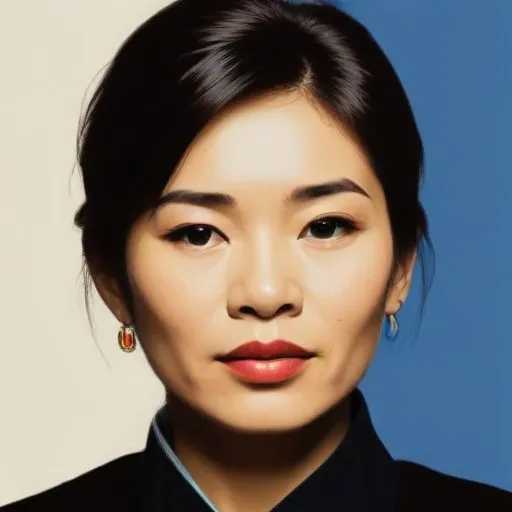
A Chinese-French painter who blended Eastern and Western styles, creating vibrant, abstract works that explored the relationship between color and emotion. His paintings are highly expressive and evoke a sense of dynamic energy.
Zao Wou-Ki was a renowned Chinese-French painter known for his bold, vibrant, and emotive works that blended traditional Chinese calligraphy with Western abstract expressionism. Born on February 1, 1920, in Beijing, China, Zao's artistic journey spanned over six decades, earning him a revered status in the art world.
Zao's fascination with art began at a young age, studying calligraphy and later enrolling in the Hangzhou School of Fine Arts. In 1935, he joined the China Academy of Art in Hangzhou, where he was mentored by esteemed artists Lin Fengmian, Fang Ganmin, and Wu Dayu.
In 1948, Zao immigrated to Paris, settling in Montparnasse, where he befriended Joan Miró and Pablo Picasso. His early exhibitions in France received critical acclaim, solidifying his reputation as a promising artist.
Zao's artistic style underwent significant transformations throughout his life. From traditional Chinese painting to abstract expressionism, his works reflected his experiences, emotions, and cultural fusion. In the 1950s, he experimented with pop art during his visit to the United States, producing a series of vibrant canvases.
Zao's personal life was marked by significant relationships and losses. He was married twice, first to composer Xie Jinglan, with whom he had a son, and later to actress and sculptor Chan May-Kan, who tragically took her own life in 1972 due to mental illness.
Zao's contributions to modern art are undeniable. He was an elected member of the Académie des Beaux-Arts in Paris and exhibited his works globally, including at the Musée d'Art Moderne de la Ville de Paris and the Metropolitan Museum of Art in New York. His paintings continue to inspire generations of artists, and his legacy extends beyond the art world, fostering greater cultural understanding and exchange between East and West.
Zao Wou-Ki's remarkable journey, marked by cultural exchange, artistic innovation, and personal resilience, continues to inspire and captivate art enthusiasts worldwide. His vibrant, expressive works remain a testament to the power of creativity and the boundless potential of the human spirit.
Born in 1881
A pioneering artist who transformed modern art with pioneering Cubist works, creating a new visual language that continues to inspire and influence art, design, and culture.
Born in 1869
A pioneering artist who revolutionized modern art with bold, expressive, and colorful works that blurred the lines between painting and sculpture, creating a new language of form and color.
Born in 1893
A renowned Spanish artist, famous for his vibrant, dreamlike paintings and sculptures that blended abstraction and surrealism, creating a unique visual language. His works often featured bold colors, biomorphic forms, and a sense of playfulness.
Born in 1904
A renowned surrealist master of bizarre, dream-like paintings and sculptures that blur reality and fantasy, known for iconic works like "The Persistence of Memory" and "The Elephants".
Born in 1896
French poet and author who founded Surrealism, a cultural movement that explored the subconscious and the world of dreams. He wrote novels, poems, and essays that continue to influence art and literature today.
Born in 1887
A dreamlike painter and poet who blended fantasy and reality, creating vibrant, emotive works that explored Jewish culture and the human experience.
Born in 1882
A pioneer of Cubism, creating fragmented forms and multiple perspectives in art, revolutionizing modern art movements.
Born in 1881
A pioneer of Cubism, this artist's bold, geometric works blended modernity with ancient forms, influencing generations of artists and designers.
