


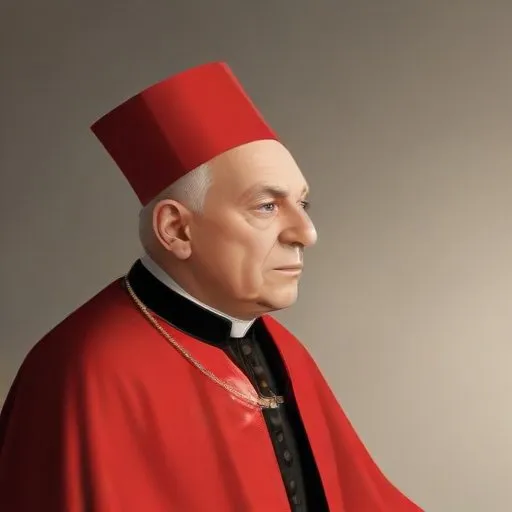
A prominent figure in 16th-century Poland, he played a crucial role in shaping the country's politics and Catholic Church, serving as a trusted advisor to multiple monarchs. He's most known for his diplomatic efforts and reforms that brought stability to the region.
Zbigniew Olenicki, a towering figure in Polish history, was a high-ranking Roman Catholic clergyman, diplomat, and statesman who left an indelible mark on the country's politics, religion, and culture. As the Bishop of Kraków from 1423 to 1455, he played a pivotal role in shaping the nation's destiny, earning him the distinction of being the first native Polish cardinal in 1439.
Born on December 5, 1389, Olenicki's early life was marked by his father's bravery and loyalty to the Polish king, Władysław II Jagiełło. As a secretary to the king, Olenicki fought alongside him in the Battle of Grunwald in 1410, showcasing his courage and dedication to the crown.
Olenicki's rapid rise to prominence was fueled by his exceptional diplomatic skills, earning him the trust of King Władysław II Jagiełło. He became a key advisor, helping the king navigate the complex web of alliances and conflicts that defined medieval Europe.
Olenicki's commitment to the Catholic Church was unwavering, and he played a crucial role in opposing the Hussite movement, which had gained significant support among the Polish nobility. His influence helped to counterbalance the Hussite threat, ensuring the Church's authority remained unchallenged.
As Bishop of Kraków, Olenicki worked tirelessly to promote Catholicism, fostering a sense of unity and stability in a region beset by conflict and turmoil. His leadership and vision helped to cement Kraków's status as a center of learning, culture, and spiritual growth.
Olenicki's diplomatic prowess earned him recognition beyond Poland's borders. In 1433, he was sent as a legate to the Council of Basel, where he worked to build bridges between feuding factions and promote peaceful resolution.
His ability to navigate the treacherous landscape of European politics was matched only by his skill in mediating domestic conflicts. Olenicki's deft handling of the conflict between Spytek of Melsztyn and the Polish crown averted a full-scale civil war, showcasing his talent for diplomacy and statesmanship.
Zbigniew Olenicki's remarkable life and achievements have left a lasting legacy in Poland. His commitment to the Catholic Church, his diplomatic acumen, and his statesmanship have inspired generations of Poles, cementing his place as one of the nation's most revered figures.
As the first native Polish cardinal, Olenicki paved the way for future generations of Polish clergy to occupy prominent positions within the Catholic Church. His influence extends beyond the Church, however, as his diplomatic efforts helped shape the course of Polish history, ensuring the nation's continued growth and prosperity.
Zbigniew Olenicki's remarkable life serves as a testament to the power of faith, diplomacy, and statesmanship. As a Renaissance man of Poland, he continues to inspire and influence generations, his legacy a beacon of hope and guidance in turbulent times.
Born in 1473
A Renaissance-era mathematician and astronomer who proposed the heliocentric model, where the Sun is at the center of our solar system, revolutionizing our understanding of the universe.
