


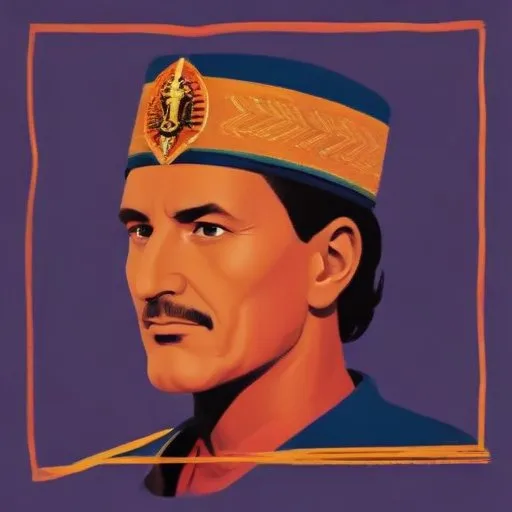
The first and only king of Albania, ruling from 1928 to 1939, known for modernizing and secularizing the country, and his authoritarian regime.
Zog I of Albania, also known as Ahmet Zogu, is remembered as the enigmatic leader who defied convention and modernized Albania, transforming it into a secular, parliamentary monarchy. Born on October 8, 1895, in Burgajet, Albania, Zog I's ascension to power marked a significant turning point in the country's history, as he championed Albanian independence and national identity.
Zog I's father, Xhemal Pasha Zogu, was a prominent local leader who played a key role in the Albanian National Awakening. Growing up in a family with strong political ties, Zog I was groomed to take on a leadership role from a young age. In 1922, he became the Minister of the Interior, leveraging his position to consolidate power and eventually declare himself King of Albania in 1928.
Zog I's reign was marked by a flurry of modernizing reforms, including the establishment of a new constitution, the introduction of a parliamentary system, and the secularization of education. He also encouraged the development of infrastructure, including roads, bridges, and public buildings, which helped to transform Albania's largely agrarian economy.
Zog I's foreign policy was shaped by his desire to maintain Albanian independence and sovereignty. He navigated the treacherous waters of European politics, forming alliances with Italy and later with the United Kingdom, to counter the threat of Yugoslavian and Greek expansionism. His diplomatic efforts earned Albania a seat at the League of Nations, further solidifying its position on the international stage.
Zog I's legacy is complex and multifaceted. While he is credited with modernizing Albania and championing its independence, his authoritarian tendencies and suppression of political opposition have been criticized by some historians. Nevertheless, his impact on Albanian history is undeniable, and he remains a revered figure in Albanian politics and society.
"I am not a king, I am the chief of the Albanian people, and I will not let anyone take away our freedom and independence."
Zog I's rule can be compared to that of other authoritarian leaders of the interwar period, such as Mussolini and Atatürk. Like them, he sought to modernize and consolidate power, often through repressive means. However, his commitment to Albanian independence and national identity set him apart from his contemporaries.
| 1895 | Born in Burgajet, Albania |
| 1922 | Becomes Minister of the Interior |
| 1928 | Declares himself King of Albania |
| 1938 | Marries Countess Géraldine Apponyi de Nagyappony |
| 1939 | Forced into exile following Italy's invasion of Albania |
Zog I's remarkable life and legacy continue to fascinate historians and scholars today, offering a unique window into the complexities of Albanian politics and society during the early 20th century.
Born in 1882
An Albanian-American bishop and politician who served as the 13th Prime Minister of Albania, known for his role in the country's independence movement and his literary contributions to Albanian culture.
Born in 1844
The founder of modern Albania, who declared the country's independence from the Ottoman Empire in 1912 and served as its first Prime Minister. He's known for his role in shaping Albania's early years and fighting for its sovereignty.
Born in 1725
Reigned from 1774 to 1789, this Ottoman sultan implemented reforms, strengthened the military, and fought wars with Russia and Austria, leaving a lasting impact on the empire's politics and economy.
Born in 1881
Founder of modern Turkey, leading the country's transition from the Ottoman Empire to a secular, democratic nation, and implementing sweeping reforms in education, law, and women's rights.
Born in 1883
Italian fascist revolutionary and politician who led the National Fascist Party and ruled Italy from 1922 to 1943, known for his authoritarian regime and aggressive military campaigns.
