


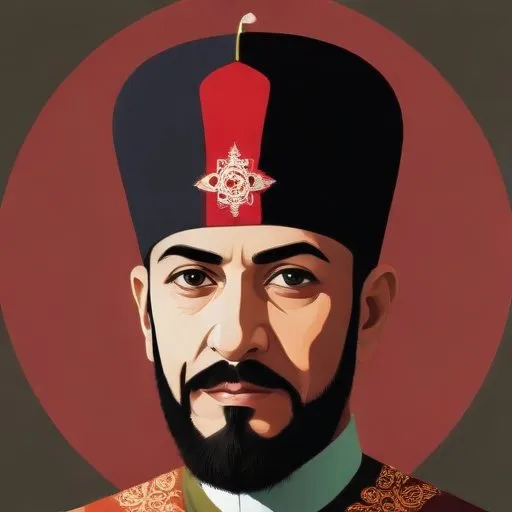
Reigned from 1774 to 1789, this Ottoman sultan implemented reforms, strengthened the military, and fought wars with Russia and Austria, leaving a lasting impact on the empire's politics and economy.
Abdul Hamid I, born on March 20, 1725, is remembered as the 27th Sultan of the Ottoman Empire, reigning from 1774 to 1789. He is known for his efforts to reform the Empire's armed forces, establishing a new artillery corps and the Imperial Naval Engineering School, which had a lasting impact on the Ottoman Navy.
Abdul Hamid was born in Constantinople to Sultan Ahmed III and his consort Rabia Şermi Kadın. He was a younger son and, as a potential heir to the throne, was imprisoned in comfort by his cousins and older brother, a customary practice at the time. During his imprisonment, which lasted until 1767, he received his early education from his mother, who taught him history and calligraphy.
Abdul Hamid ascended to the throne on January 21, 1774, following the death of his nephew Mustafa III. His reign was marked by a deep sense of religiosity and pacifism, which influenced his approach to state affairs. Despite his initial disinterest in governing, he sought to reform the Empire's armed forces, including the Janissary Corps and the navy.
Abdul Hamid's reforms had a lasting impact on the Ottoman Empire, paving the way for future modernization efforts. His establishment of the Imperial Naval Engineering School, in particular, played a significant role in the development of the Ottoman Navy, enabling it to compete with European navies.
Abdul Hamid I's reign was marked by a blend of religiosity, pacifism, and reform. Despite facing numerous challenges, including financial difficulties and military setbacks, he implemented significant reforms that had a lasting impact on the Ottoman Empire. His legacy serves as a testament to the importance of modernization and innovation in governance.
Born in 1326
The founder of the Ottoman Empire's expansionist era, known for conquering much of the Balkans and establishing the Ottoman state as a dominant power in the region.
Born in 1642
The Ottoman sultan who ruled from 1648 to 1687, known for his military campaigns that expanded the empire's borders, including the conquest of Crete and parts of Poland. He was also known for his cultural and architectural achievements, including the construction of several mosques and palaces.
Born in 1842
An Ottoman administrator, intellectual, art expert, and painter who pioneered Turkish archaeology and museum curation, and created iconic Orientalist paintings. He's a cultural bridge between East and West.
Born in 1861
The last Sultan of the Ottoman Empire, ruling from 1918 to 1922, known for his brief and tumultuous reign marked by the empire's collapse and eventual abolition.
Born in 1881
Founder of modern Turkey, leading the country's transition from the Ottoman Empire to a secular, democratic nation, and implementing sweeping reforms in education, law, and women's rights.
Born in 1881
Ottoman Empire's Minister of War and leader of the Young Turk revolution, known for his role in World War I and the Armenian Genocide.
