


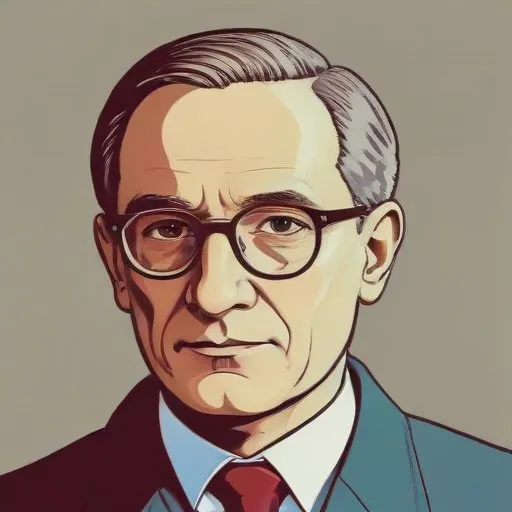
Founded the Polish Mathematical Society and played a crucial role in establishing mathematics as a major field of study in Poland, focusing on point-set topology and set theory.
Zygmunt Janiszewski is renowned for founding the Polish School of Mathematics and establishing the influential journal Fundamenta Mathematicae, which remains a benchmark for mathematical research to this day. His groundbreaking work in topology and surface theory has left an indelible mark on the field, shaping the course of mathematical inquiry for generations to come.
Born on July 12, 1888, in Warsaw, Poland, Janiszewski was the son of Czesław Janiszewski, a graduate of the University of Warsaw and director of the Société du Crédit Municipal in Warsaw. His mother, Julia Szulc-Chojnicka, instilled in him a passion for learning and mathematics. Janiszewski's academic journey took him to Zurich, Munich, and Göttingen, where he studied under some of the most prominent mathematicians of the time, including Heinrich Burkhardt, David Hilbert, Hermann Minkowski, and Ernst Zermelo.
Janiszewski's doctoral thesis, Sur les continus irréductibles entre deux points (On Irreducible Continuous Curves Between Two Points), supervised by Henri Lebesgue, marked a pivotal moment in his career. In 1913, he published On Cutting the Plane by Continua, a seminal work that propelled him to the forefront of surface theory and topology. His research laid the foundation for subsequent mathematicians to build upon, shaping the discipline's trajectory.
Janiszewski taught at the University of Lwów and later became a professor at the University of Warsaw. During World War I, he joined the Polish Legions of Józef Piłsudski, refusing to swear allegiance to the Austrian government. After leaving the Legions, he went into hiding, using the alias Zygmunt Wicherkiewicz, and directed a shelter for homeless children in Ewin, near Woszczowa.
In 1917, Janiszewski published O potrzebach matematyki w Polsce (On the Needs of Mathematics in Poland) in the journal Nauka Polska, thus initiating the Polish School of Mathematics. He also founded Fundamenta Mathematicae, which became a beacon for mathematical innovation and inquiry. Although the first issue was published posthumously, Janiszewski's vision for the journal continues to inspire mathematicians worldwide.
Janiszewski devoted his inherited family property to charity and education. He also donated prize money from his academic achievements to support worthy causes. His selflessness and dedication to the betterment of society reflect the dignity and character of this remarkable individual.
Zygmunt Janiszewski's groundbreaking work, selfless philanthropy, and devotion to education have left an indelible mark on the world of mathematics. As we continue to build upon his foundational research, we honor his memory and celebrate his contributions to the field. Janiszewski's remarkable journey serves as a testament to the power of human ingenuity and the importance of pursuing knowledge for the betterment of society.
Born in 1882
A Polish mathematician and academic who made significant contributions to set theory, topology, and fractal geometry, particularly with the discovery of the Sierpinski triangle and carpet.
Born in 1896
A renowned mathematician and logician who developed the Kuratowski's closure-complement problem and made significant contributions to topology and set theory. His work has far-reaching implications for modern mathematics and computer science.
Born in 1887
A renowned mathematician and educator who made significant contributions to various mathematical fields, including geometry, probability, and game theory, and is also known for his humorous and accessible writing style.
Born in 1758
A Belarusian-Polish poet, playwright, and politician who played a key role in the Polish national revival and is best known for his patriotic writings and involvement in the country's struggle for independence.
