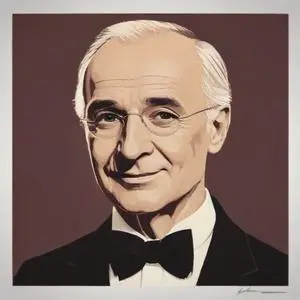
Henri Lebesgue: The French Mathematician Who Revolutionized Integration Theory
Legacy of Integration
Henri Lebesgue is renowned for his groundbreaking contributions to mathematics, particularly in the field of integration theory. His pioneering work led to the development of the Lebesgue integral, a fundamental concept that has far-reaching implications in modern mathematics, physics, and engineering. Lebesgue's integral is a generalization of the 17th-century concept of integration, allowing for the calculation of areas and volumes of complex shapes with unprecedented precision.
Early Life and Education
Born on June 28, 1875, in Beauvais, Oise, France, Lebesgue was raised in a family of modest means. His father, a typesetter, and his mother, a school teacher, encouraged his early interest in mathematics. Following his father's untimely death, Lebesgue's mother worked tirelessly to support his education, recognizing his exceptional talent in mathematics. He attended the Collège de Beauvais, Lycée Saint-Louis, and Lycée Louis-le-Grand in Paris, before being accepted into the prestigious École Normale Supérieure in 1894.
Academic Career
Lebesgue's academic career was marked by a series of esteemed appointments and achievements. He earned his degree from the École Normale Supérieure in 1897 and subsequently worked in the library, where he was exposed to the research of
René-Louis Baire on discontinuity. While working on his graduate studies at the Sorbonne, Lebesgue was influenced by the works of Émile Borel on measure theory and
Camille Jordan on the Jordan measure. In 1899, he took up a teaching position at the Lycée Central in Nancy, where he continued to develop his doctoral thesis.
Doctoral Thesis and the Lebesgue Integral
In 1902, Lebesgue submitted his seminal thesis, "Integral, Length, Area," to the Sorbonne, under the guidance of Émile Borel. This work introduced the Lebesgue integral, a novel approach to integration that replaced the Riemann integral. The Lebesgue integral has since become a cornerstone of modern mathematics, enabling the calculation of integrals for a wider range of functions and providing a more comprehensive understanding of mathematical analysis.
Personal Life and Later Years
Lebesgue married the sister of one of his fellow students and had two children, Suzanne and Jacques. Throughout his life, he remained dedicated to his work, publishing numerous papers and treatises on mathematics. Lebesgue's later years were marked by international recognition, with his work gaining widespread acceptance and application in various fields. He passed away on July 26, 1941, leaving behind a legacy that continues to shape modern mathematics.
Impact and Influence
Lebesgue's contributions have had a profound impact on modern mathematics, physics, and engineering. His work on integration theory has far-reaching implications in fields such as:
- Real analysis
- Functional analysis
- Measure theory
- Probability theory
- Physics (quantum mechanics and relativity)
- Engineering (signal processing and control theory)
Lebesgue's legacy extends beyond his mathematical contributions, inspiring generations of mathematicians and scientists to build upon his work.
Quotes and Memorable Sayings
"I have tried to generalize the definitions of the integral so as to make them more suitable for the needs of modern mathematics." - Henri Lebesgue
This quote reflects Lebesgue's commitment to advancing mathematical understanding and his vision for a more comprehensive and unified theory of integration.
Historical Context and Legacy
Henri Lebesgue's work must be viewed within the context of the late 19th and early 20th centuries, a period marked by significant advances in mathematics and physics. His contributions built upon the foundational works of mathematicians such as Riemann, Borel, and Jordan, and paved the way for later developments in mathematics and physics. Today, Lebesgue's integral remains an essential tool in modern mathematical analysis, a testament to his enduring legacy in the world of mathematics.
FAQ
What is Henri Lebesgue known for in mathematics?
Henri Lebesgue is known for his fundamental contributions to the development of modern mathematics, particularly in the fields of measure theory, integration, and topology.
What is the Lebesgue measure?
The Lebesgue measure is a mathematical concept developed by Henri Lebesgue that provides a way to assign a numerical value to the size of sets in a mathematical space.
When was Henri Lebesgue born?
Henri Lebesgue was born on June 28, 1875, in Beauvais, France.
What is Henri Lebesgues work on the Riemann integral?
Henri Lebesgues work on the Riemann integral led to the development of the Lebesgue integral, a more powerful and flexible way of defining the integral of a function.
What is Henri Lebesgues legacy in mathematics?
Henri Lebesgues work has had a profound impact on the development of modern mathematics, influencing fields such as analysis, probability theory, and functional analysis.