


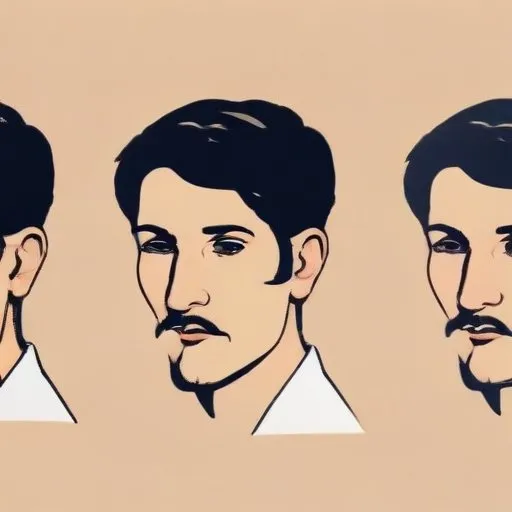
A French painter celebrated for his vibrant, Art Nouveau-inspired posters and illustrations, often featuring seductive women and fantastical creatures.
Douard-Henri Avril, better known by his pseudonym Paul Avril, was a French painter and commercial artist who created a stir in the art world with his provocative illustrations of erotic literature. Born in 1849, Avril's artistic talents were only rivalled by his reputation for explicit and often controversial works that were only accessible to a select few.
Avril was born in Algiers to a military family, with his father serving as a colonel of the gendarmerie. It was only natural that Avril would follow in his father's footsteps, enlisting in the military and fighting in the Franco-Prussian War. His bravery in battle earned him the Legion of Honour in 1871, but it was his injuries that ultimately led to his retirement from the military in 1872.
Avril's artistic pursuits began in earnest after his military career, studying at the prestigious École des Beaux-Arts in Paris from 1874 to 1878. It was during this period that he honed his skills as an illustrator, eventually landing a job with the illustrated newsmagazine Le Monde illustré in 1882. His talent and reputation as a commercial illustrator soon spread, earning him commissions to illustrate the works of prominent authors and galante literature – a genre of erotic fiction popular during the time.
To distance himself from his more respectable work, Avril adopted the pseudonym Paul Avril, a name that would become synonymous with erotic literature. His illustrations for authors like Théophile Gautier and others were highly sought after, but it was his work on underground erotic literature that cemented his notoriety. These rare and exclusive publications, often limited to only 100 copies, were reserved for a select few – collectors and connoisseurs who appreciated the explicit nature of Avril's art.
Despite the controversy surrounding his work, Avril's artistic contributions cannot be overstated. His ability to push boundaries and challenge social norms through his art has influenced generations of artists and writers. Avril's legacy extends beyond the erotic literature he illustrated, with his work continuing to inspire and provoke audiences today.
Biographical information on Avril's personal life is scarce, partly due to his use of a pseudonym and the provocative nature of his work. What is known is that he remained private, preferring to keep his personal life separate from his artistic pursuits. Controversy, however, has long surrounded Avril's work, with many regarding it as obscene and inappropriate for the time.
Avril was awarded the Legion of Honour in 1871 for his bravery during the Franco-Prussian War.
Douard-Henri Avril passed away on July 28, 1928, at the age of 79, in Le Raincy, near Paris. His legacy as a pioneering illustrator of erotic literature continues to fascinate and inspire audiences today.
Born in 1732
A prolific Rococo painter and etcher, renowned for his delicate, whimsical, and often erotic works that capture the carefree spirit of 18th-century French aristocracy. His art often featured lush landscapes, gentle colors, and playful scenes of love and leisure.
Born in 1703
A prominent artist of the Rococo style, known for his delicate and ornate paintings, often depicting mythological and pastoral scenes, as well as designing sets for the Paris Opera.
Born in 1684
A French painter who created delicate, dreamy, and intimate scenes of everyday life, often blending reality and fantasy, and is considered a pioneer of the Rococo style.
Born in 1748
A French painter and illustrator who revolutionized Neoclassicism with his realistic and emotive works, creating iconic pieces like "Oath of the Horatii" and "Napoleon Crossing the Alps".
Born in 1791
A Romantic-era master of dramatic and emotionally charged art, known for his powerful depictions of horses and the human experience.
Born in 1798
A Romantic-era master of expressive brushstrokes and vivid color, creating iconic works that captured the drama and emotion of historical and literary scenes.
