


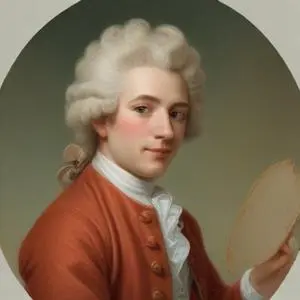
A French painter who created delicate, dreamy, and intimate scenes of everyday life, often blending reality and fantasy, and is considered a pioneer of the Rococo style.
Jean-Antoine Watteau, a French painter, is renowned for being the originator of the Rococo style, a distinct art movement that emerged in 18th-century Europe. His works are characterized by their delicate, playful, and ornate depictions of aristocratic life, landscapes, and mythology, earning him the title of "the father of Rococo."
Watteau was born on October 10, 1684, in Valenciennes, France, to a family of tanners. Despite his humble beginnings, he demonstrated a natural talent for art from an early age. At around 18 years old, Watteau traveled to Paris, where he trained under the tutelage of Claude Gillot, a painter and set designer.
Watteau's unique style soon gained popularity among the aristocracy, who commissioned him to create works that reflected their extravagant lifestyle. His paintings often featured lush landscapes, lavish costumes, and delicate colors, setting the tone for the Rococo era. Notable works from this period include Pierrot (c. 1718-1719) and The Embarkation for Cythera (1717).
Watteau's Rococo style had a profound impact on the development of European art and architecture. His works inspired a generation of artists, including François Boucher and Jean-Honoré Fragonard, who continued to refine the Rococo style. Moreover, Watteau's emphasis on decoration and ornamentation influenced the design of furniture, textiles, and other decorative arts.
Watteau's most notable works include:
While Watteau's art often appeared lighthearted and carefree, it was underpinned by a deep understanding of human nature and the social conventions of his time. His works often subtly poked fun at the excesses of the aristocracy, suggesting that he held a somewhat critical view of the lavish lifestyle he frequently depicted.
In 1712, Watteau was accepted into the Académie Royale de Peinture et de Sculpture, a prestigious art institution in Paris. This recognition cemented his position as a leading artist of his time. Watteau died on July 18, 1721, at the age of 36, due to complications from tuberculosis.
Jean-Antoine Watteau's innovative style and artistic contributions continue to influence artists, designers, and art enthusiasts to this day. His Rococo paintings remain a testament to the excesses and extravagance of 18th-century Europe, while also offering a window into the Era of Enlightenment and the emergence of modernity.
Born in 1703
A prominent artist of the Rococo style, known for his delicate and ornate paintings, often depicting mythological and pastoral scenes, as well as designing sets for the Paris Opera.
Born in 1732
A prolific Rococo painter and etcher, renowned for his delicate, whimsical, and often erotic works that capture the carefree spirit of 18th-century French aristocracy. His art often featured lush landscapes, gentle colors, and playful scenes of love and leisure.
Born in 1577
A renowned Flemish painter and diplomat, famous for his vivid and emotive Baroque-style masterpieces, particularly his lush nudes and dramatic altarpieces.
Born in 1606
A master of light and shadow, this 17th-century artist is renowned for his emotionally charged and deeply human portraits, landscapes, and biblical scenes that continue to captivate art lovers worldwide.
