


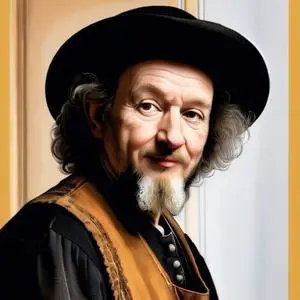
A master of light and shadow, this 17th-century artist is renowned for his emotionally charged and deeply human portraits, landscapes, and biblical scenes that continue to captivate art lovers worldwide.
Rembrandt Harmenszoon van Rijn, a Dutch Golden Age painter, printmaker, and draughtsman, is widely regarded as one of the greatest visual artists in the history of art. His profound influence on the art world is evident in his vast array of works, comprising approximately 300 paintings, 300 etchings, and 2,000 drawings, showcasing his mastery of styles and subject matter.
Rembrandt was born on July 15, 1606, in Leiden, Netherlands, to a family of moderate means. His father, Harmen Gerritszoon van Rijn, was a miller, and his mother, Neeltgen Willemsdochter van Zuijtbrouck, was a baker's daughter. This middle-class upbringing allowed Rembrandt to pursue his artistic passion from a young age.
Rembrandt's artistic journey began in 1620, when he enrolled in the University of Leiden to study literature. However, he soon shifted his focus to art, apprenticing with the painter Jacob van Swanenburgh and later with Pieter Lastman in Amsterdam. Rembrandt's exposure to the works of the Italian Old Masters and Dutch and Flemish artists who had studied in Italy significantly influenced his style.
Rembrandt's talent and innovation quickly earned him recognition, and by the age of 22, he had established himself as a portrait painter in Leiden. His breakthrough came with the painting "The Stoning of Saint Stephen" (1625), which showcased his dramatic use of light and shadow.
Throughout his career, Rembrandt continued to experiment with various techniques, including etching, which allowed him to explore a range of themes and subjects. His etchings, such as "The Hundred Guilder Print" (1640s-1650s), are considered some of his most remarkable works.
Rembrandt's personal life was marked by tragedy and financial hardship. His wife, Saskia van Uylenburgh, died in 1642, leaving him with their young son, Titus. Later, Rembrandt faced bankruptcy and was forced to sell many of his possessions, including his beloved etchings.
Despite these challenges, Rembrandt continued to produce remarkable works, often incorporating his personal struggles into his art. His later years were spent in quiet contemplation, as he continued to teach and mentor young artists.
Rembrandt's artistic legacy is immeasurable. He inspired generations of artists, including Vincent van Gogh, Pablo Picasso, and Salvador Dalí, among many others. His emphasis on light and shadow, as well as his mastery of etching, have had a profound impact on the development of Western art.
In the 19th century, Rembrandt's works experienced a resurgence in popularity, solidifying his status as a preeminent artist. Today, his paintings, etchings, and drawings continue to captivate audiences worldwide, serving as a testament to the power of art to transcend time and touch the human spirit.
Born in 1632
A master of capturing intimate, serene domestic scenes, particularly of women, in exquisite detail and soft, luminous light. His works evoke a sense of quiet contemplation and everyday beauty.
Born in 1577
A renowned Flemish painter and diplomat, famous for his vivid and emotive Baroque-style masterpieces, particularly his lush nudes and dramatic altarpieces.
Born in 1599
A renowned Spanish painter and educator, known for his masterful use of chiaroscuro and his iconic portraits of royalty, particularly the Spanish royal family.
Born in 1612
A 17th-century Dutch painter who specialized in landscapes and was one of the first European artists to travel to Brazil, capturing its exotic scenery on canvas. His works offer a unique glimpse into the country's colonial past.
