


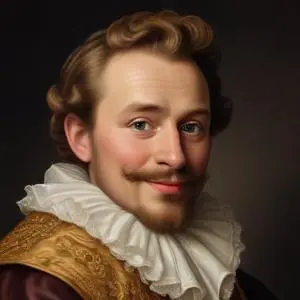
A renowned Flemish painter and diplomat, famous for his vivid and emotive Baroque-style masterpieces, particularly his lush nudes and dramatic altarpieces.
If you've ever marveled at the dramatic, sweeping brushstrokes and vivid colors of 17th-century Baroque art, you can thank Peter Paul Rubens, the Flemish master who defined the style. With a catalog of over 1,400 works, Rubens is renowned for his highly charged compositions that brought classical and Christian history to life with unparalleled sensuality and movement.
Born on June 28, 1577, in Siegen, Germany, to refugee parents from Antwerp, Rubens was raised in a family that valued education and the arts. This upbringing would serve him well, as he went on to become not only a prolific artist but also a classically educated humanist scholar and diplomat. He was knighted by both Philip IV of Spain and Charles I of England, a testament to his esteemed reputation across Europe.
Rubens' artistic style was revolutionary for his time. He masterfully blended Counter-Reformation ideals with classical and Christian themes, creating dynamic, emotive paintings that captivated audiences. His innovative use of color, light, and shadow brought depth and sensuality to his works, which included altarpieces, portraits, landscapes, and history paintings of mythological and allegorical subjects.
At the height of his career, Rubens oversaw a large workshop in Antwerp that churned out paintings popular with nobility and art collectors throughout Europe. His designs for tapestries, frontispieces, and cartoons for Flemish tapestry workshops further solidified his reputation as a master of his craft.
Rubens' contributions to art and culture extend far beyond his lifetime. His designs for tapestries and prints helped spread the Genoese palace style in Northern Europe, while his book, Palazzi di Genova (1622), remains an influential architectural guide. His artistic innovations paved the way for future generations of artists, including Rembrandt and Van Dyck.
With a catalog of over 1,400 works, Rubens' artistic output is a testament to his tireless creativity and dedication to his craft. Today, his paintings can be found in museums and galleries around the world, including the Louvre, the Prado, and the National Gallery in London. Rubens' influence on art, architecture, and culture continues to inspire and educate, solidifying his place as one of the greatest artists of all time.
Rubens' remarkable life and artistic achievements continue to captivate and inspire audiences today. As we marvel at his works, we are reminded of the power of art to transcend time and touch the human spirit.
Born in 1606
A master of light and shadow, this 17th-century artist is renowned for his emotionally charged and deeply human portraits, landscapes, and biblical scenes that continue to captivate art lovers worldwide.
Born in 1599
A renowned Spanish painter and educator, known for his masterful use of chiaroscuro and his iconic portraits of royalty, particularly the Spanish royal family.
Born in 1471
A Renaissance master of intricate woodcuts and engravings, known for precise and detailed depictions of nature and human form, influencing art and mathematics for centuries.
Born in 1475
Renaissance master of iconic works like the ceiling of the Sistine Chapel, creating breathtakingly beautiful and emotionally powerful art that continues to inspire and awe.
