


In the shadowy recesses of 1930s Germany, a clandestine meeting took place that would change the course of history. Adolf Hitler, the charismatic leader of the Nazi Party, convened with the country's most influential industrialists to secure the financing needed to propel his party to electoral victory.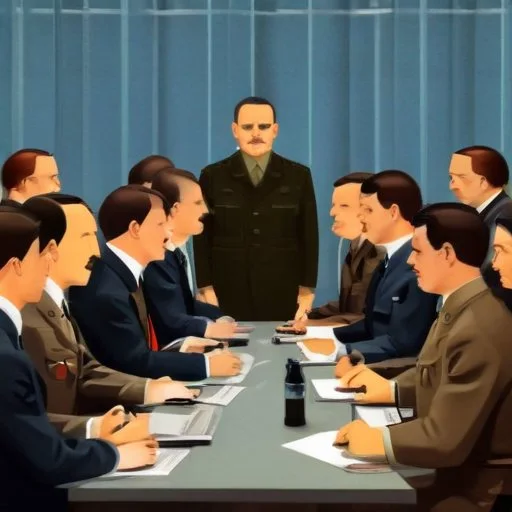
The year was 1932, and the Nazi Party was on the cusp of a major breakthrough. With the German economy in disarray and the Weimar Republic reeling, Hitler saw an opportunity to capitalize on the widespread discontent. He knew that to seize power, he needed the backing of the country's powerful industrial elite.
To that end, Hitler orchestrated a series of clandestine meetings with prominent industrialists, including the likes of Gustav Krupp, Franz von Papen, and Hjalmar Schacht. These titans of industry were won over by Hitler's persuasive rhetoric and his promise to restore Germany's economic and military prowess.
The terms of the agreement were straightforward: the industrialists would provide the necessary financing to fuel the Nazi Party's election campaign, and in return, Hitler would guarantee their interests would be protected and promoted once he came to power. It was a Faustian bargain, one that would have far-reaching consequences for Germany and the world.
Hitler's negotiating skills were on full display during these meetings. He played on the industrialists' fears of communism and their desire for economic stability, convincing them that a Nazi victory was the only way to safeguard their interests.
With the industrialists' backing, the Nazi Party launched a lavish election campaign, replete with spectacle and propaganda. Hitler crisscrossed the country, delivering impassioned speeches and wooing the masses with his promises of national revival.
The campaign was a masterclass in manipulation, with the Nazis expertly exploiting the fears and prejudices of the German people. Their message resonated with a electorate desperate for change, and on July 31, 1932, the Nazi Party emerged victorious, securing 37.3% of the vote and becoming the largest party in the Reichstag.
The true extent of the Nazi Party's debt to the industrialists would only become clear in the years that followed. Hitler's regime would go on to implement policies that favored the interests of big business, while crushing dissent and opposition.
The meeting between Hitler and the industrialists serves as a stark reminder of the corrupting influence of power and the dangers of unchecked ambition. It is a testament to the enduring allure of authoritarianism and the ease with which democratic systems can be subverted.
"The broad masses of a population are more amenable to the appeal of rhetoric than to any other sort of argument." - Adolf Hitler, Mein Kampf
Gustav Krupp, the patriarch of the Krupp family, was one of the most influential industrialists in Germany during the 1930s. His company, Krupp AG, was a behemoth in the steel industry, and his support was crucial to Hitler's election campaign.
Krupp's involvement with Hitler was not immediate. Initially, he was skeptical of the Nazi Party's ideology, but as the party's popularity grew, he saw an opportunity to advance his business interests. He eventually became one of Hitler's most trusted allies, providing significant financial backing to the Nazi Party.
Krupp's relationship with Hitler was one of convenience, but it ultimately contributed to the demise of German democracy.

Hitler's secret deal with the industrialists bears striking similarities to Benito Mussolini's rise to power in Italy. Both dictators leveraged the support of influential business leaders to consolidate their grip on power.
Like Hitler, Mussolini courted Italian industrialists, promising to protect their interests and crush the communist threat. In return, they provided him with the necessary financial backing to seize control of the government.
Both examples demonstrate how authoritarian leaders can exploit the fears and interests of powerful elites to achieve their goals.
Hitler's pact with the industrialists had far-reaching consequences for the German economy. The Nazi Party's policies favored big business, leading to a significant increase in industrial production and a decrease in unemployment.
However, this growth came at a cost. The Nazi regime's emphasis on militarization and rearmament led to a massive increase in government spending, which ultimately contributed to Germany's economic instability.
The deal also had a devastating impact on small businesses and the working class, who were forced to bear the brunt of the Nazi regime's austerity measures.

Hitler's secret deal with the industrialists took place against the backdrop of a tumultuous geopolitical landscape. The global economy was still reeling from the Great Depression, and the Treaty of Versailles had left Germany feeling humiliated and embittered.
In this environment, Hitler's promise to restore German greatness and protect business interests resonated with industrialists and the broader population. The Nazi Party's rise to power was, in part, a response to the perceived failures of the Weimar Republic and the threats posed by communism and liberalism.
The deal also had implications for international relations, as Hitler's regime began to reassert Germany's influence on the world stage.
Historians have long debated the significance of Hitler's secret deal with the industrialists. Some have argued that it was a decisive moment in the Nazi Party's rise to power, while others have seen it as a symptom of deeper structural issues in the Weimar Republic.
Marxist historians have emphasized the role of economic interests in shaping Hitler's policies, while liberal historians have highlighted the importance of individual agency and ideology.
Despite these differing interpretations, there is broad consensus that Hitler's deal with the industrialists marked a critical turning point in modern German history.