


In 1905, a 26-year-old Albert Einstein, then a patent clerk in Bern, Switzerland, submitted a paper that would shake the foundations of physics, forever changing our understanding of space, time, and gravity. His seminal work, "On the Electrodynamics of Moving Bodies," introduced the concept of special relativity, challenging long-held assumptions and paving the way for a fundamental shift in scientific understanding.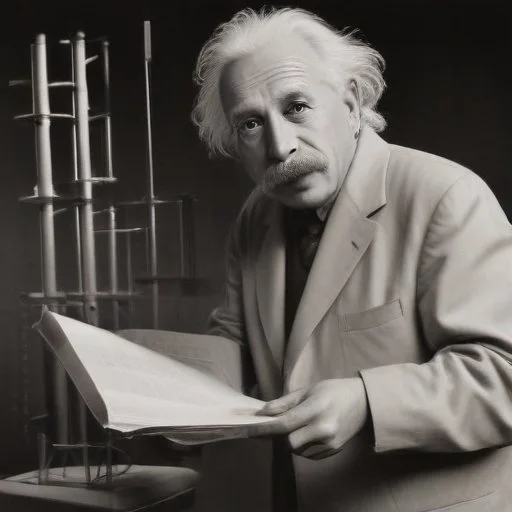
In this groundbreaking paper, Einstein proposed that the laws of physics are the same for all observers in uniform motion relative to one another. He challenged the traditional notion of absolute time and space, instead introducing the concept of spacetime, where time and space are inextricably linked. This revolutionary idea led to a paradigm shift in the scientific community, opening doors to new areas of research and exploration.
Einstein's work on special relativity marked the beginning of modern physics, laying the foundation for some of the most influential scientific theories of the 20th century. His concept of spacetime became the cornerstone of modern astrophysics, cosmology, and theoretical physics, influencing the work of scientists such as Stephen Hawking, Roger Penrose, and Werner Heisenberg.
Einstein's introduction of special relativity has had a profound impact on our understanding of the universe, influencing fields such as:
Albert Einstein's groundbreaking paper on special relativity not only revolutionized physics but also left an indelible mark on human knowledge, inspiring generations of scientists, engineers, and thinkers to push the boundaries of human understanding.
Albert Einstein's early life was marked by a passion for learning and a disregard for authority. Born in Munich, Germany in 1879, Einstein grew up in a middle-class Jewish family and was an average student in school. However, he was fascinated by science and mathematics, and spent much of his free time reading and thinking about these subjects. This curiosity and independence of thought would serve him well in his later career as a physicist.
Einstein's move to Switzerland in 1902, where he worked as a patent clerk, was a turning point in his life. It was during this period that he developed his famous theory of special relativity, and began to make a name for himself in the scientific community.

In the decades leading up to Einstein's groundbreaking paper, the scientific community was grappling with the implications of Maxwell's equations, which had revealed the speed of light to be a constant. However, this revelation had created a puzzle: how could the laws of physics be the same for all observers, regardless of their relative motion?
Scientists such as Hendrik Lorentz and Henri Poincaré had attempted to solve this problem by proposing the existence of a hypothetical "ether" that would serve as a fixed reference point for all observers. However, their solutions were incomplete and unsatisfying, leaving the door open for a fresh approach.
Einstein's theory of special relativity not only revolutionized the field of physics, but also had a profound impact on popular culture. The idea that time and space were not fixed, but rather relative to the observer, challenged traditional notions of reality and sparked a wave of interest in science and technology.
In the years following Einstein's paper, relativity became a cultural phenomenon, inspiring works of literature, art, and music. From the writings of H.G. Wells to the music of Philip Glass, relativity became a symbol of modernity and intellectual curiosity.

The development of special relativity had significant implications for the development of new technologies, including GPS systems, high-speed transportation, and advanced materials science. By providing a new understanding of the nature of space and time, Einstein's theory enabled scientists and engineers to design and build systems that could operate at previously unimaginable speeds and scales.
In the decades following Einstein's paper, a new generation of scientists and engineers drew on his ideas to develop revolutionary new technologies, from the atomic bomb to the internet.
Historians of science have long debated the significance of Einstein's theory of special relativity, with some arguing that it marked a fundamental break with traditional notions of space and time, while others have seen it as a continuation of earlier lines of inquiry.
Some historians, such as Gerald Holton, have argued that Einstein's theory was a response to the crisis of classical physics, which had been unable to account for the behavior of high-speed particles. Others, such as Thomas Kuhn, have seen Einstein's work as a paradigm shift, marking the transition from classical to modern physics.