


On December 15-16, 1864, the Battle of Nashville marked a turning point in the American Civil War, as the Union Army of the Cumberland, led by General George Thomas, delivered a crushing defeat to the Confederate Army of Tennessee, commanded by General John Bell Hood. This two-day battle would prove to be the final nail in the coffin of the Confederacy, as the Rebel army was shattered, leaving it unable to mount a viable resistance for the remainder of the war.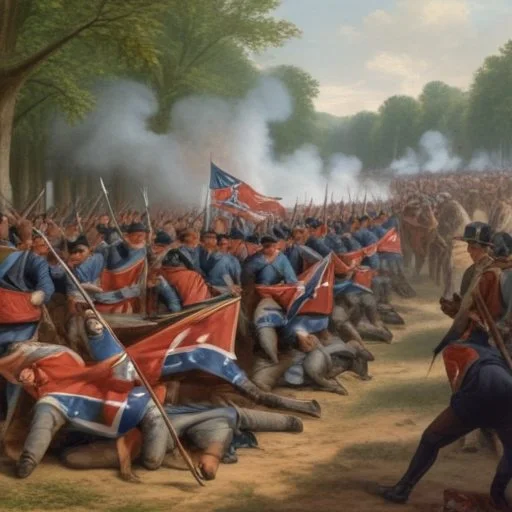
The fall of Atlanta in September 1864 had dealt a severe blow to the Confederacy, and General Hood's Army of Tennessee was tasked with diverting Union attention away from the vital city. Hood's ambitious plan was to retake Nashville, the capital of Tennessee, and push north into Kentucky, hoping to force the Union to redirect troops from Atlanta. However, General Thomas, known as the "Rock of Chickamauga," had other plans.
On December 15, 1864, Hood's army, numbering around 23,000 men, launched a surprise attack on Thomas's army, which was encamped south of Nashville. The Confederate assault was initially successful, pushing the Union lines back. However, Thomas, anticipating the Rebel attack, had carefully positioned his troops to absorb the blow. As the day wore on, the Union lines held firm, and by nightfall, Hood's army was stalled.
The next morning, December 16, Thomas launched a counterattack, spearheaded by Wilson's cavalry. The Union horsemen swept around the Confederate flank, capturing key artillery positions and sending the Rebel army into disarray. As the day progressed, the Confederates were pushed back, their lines crumbling under the relentless Union pressure. By the end of the battle, Hood's army was in full retreat, leaving behind thousands of casualties and abandoning large quantities of supplies.
The Battle of Nashville was a crushing defeat for the Confederacy, marking the effective destruction of the Army of Tennessee as a fighting force. The Rebel army suffered over 6,000 casualties, including many senior officers, while the Union losses were relatively light, at around 3,000. The defeat sealed the fate of the Confederacy, paving the way for the eventual surrender of General Robert E. Lee at Appomattox in April 1865.
The Battle of Nashville had a profound impact on the war-weary citizens of Tennessee, who had endured years of conflict and occupation. The Union victory brought a sense of relief and hope, as the city of Nashville began to rebuild and recover. The battle also marked a turning point in the war, as the Confederacy's last vestiges of resistance began to crumble.
Sergeant James Scott, a Union infantryman, recalled the chaos of the battle: "The Rebels came at us like a tornado, but we held our ground. When our cavalry charged, it was like a stampede of wild horses. I saw Rebels running for their lives, abandoning their guns and ammunition."
The Battle of Nashville marked the beginning of the end of the Confederacy. As the Union army closed in on Richmond, the Rebel capital, General Lee's army was forced to retreat, ultimately leading to his surrender at Appomattox. The battle also paved the way for the Reconstruction era, as Tennessee and other former Confederate states began the long process of rebuilding and reconciliation.
The Battle of Nashville remains one of the most significant and often overlooked battles of the American Civil War. It was a turning point in the conflict, marking the final defeat of the Confederacy and paving the way for the eventual reunification of the United States.
The Battle of Nashville was not just a decisive Union victory, but also a testament to the strategic genius of General George Thomas. Thomas's cautious approach, earned him the nickname "The Rock of Chickamauga", was often criticized by his contemporaries, but it proved to be a winning formula at Nashville. By carefully positioning his troops and awaiting the Confederate attack, Thomas was able to absorb the initial blow and then launch a devastating counterattack that shattered the Rebel army.
One of the key factors that contributed to Thomas's success was his ability to read the battlefield and adapt to changing circumstances. As the Confederate attack unfolded, Thomas skillfully shifted his troops to reinforce the weak points in his line, ensuring that his army remained cohesive and effective. This flexibility, combined with his unwavering commitment to holding Nashville, ultimately proved to be too much for the Confederate army to overcome.

General John Bell Hood, the commander of the Confederate Army of Tennessee, was a complex and enigmatic figure. A skilled tactician, Hood was known for his bravery and aggressive approach to warfare, but he was also prone to reckless decisions that often put his army at risk. Despite his limitations, Hood remains one of the most fascinating and tragic figures of the Civil War, a man whose bravery and loyalty were ultimately undone by his own flaws.
Hood's leadership style was marked by a tendency to gamble, often relying on bold, high-risk maneuvers to achieve his objectives. This approach had sometimes yielded spectacular results, such as the Confederate victory at Chickamauga, but it had also led to disastrous defeats, like the one at Nashville. Despite his mistakes, Hood remained a respected and admired figure among his troops, who saw him as a courageous and dedicated leader.
The Battle of Nashville had a profound impact on the city of Nashville and the state of Tennessee as a whole. For years, Nashville had been a crucial supply depot and transportation hub for the Confederacy, and the city had suffered greatly under the strain of war. The Union victory brought a sense of relief and hope to the city's residents, who had endured years of occupation and conflict.
The battle also marked a turning point in the cultural and social history of Tennessee. As the Confederacy collapsed, the state began to rebuild and redefine itself, embracing a new era of Reconstruction and reconciliation. The Battle of Nashville was a symbol of this transformation, a testament to the power of freedom and unity in the face of adversity.

The Battle of Nashville was not just a local conflict, but a crucial episode in the larger struggle for control of the Western Theater. The Confederate Army of Tennessee, which had been defeated at Atlanta, was attempting to regain the initiative by striking at the Union army's supply lines and communication networks. By defeating Hood's army, General Thomas was able to secure the Union's grip on the region and pave the way for the eventual capture of Richmond and the collapse of the Confederacy.
The battle was also significant because it marked a shift in the balance of power in the Western Theater. With the Confederate army in disarray, the Union was able to redirect its attention to the southeastern states, where it would ultimately force the surrender of General Lee's army at Appomattox. The Battle of Nashville was thus a crucial step in the Union's ultimate victory, a testament to the strategic importance of the Western Theater.
The Battle of Nashville had significant economic implications for the city and the region. The destruction of the Confederate army and the capture of Nashville by the Union army led to a massive influx of federal troops and supplies, which helped to stimulate the local economy. The city's infrastructure, which had been damaged during the war, was rebuilt and expanded, and Nashville began to emerge as a major commercial center.
The battle also had a profound impact on the regional economy. With the Confederacy in ruins, the Union was able to establish a new economic order in the South, one that was more integrated into the national economy. The Battle of Nashville thus marked a turning point in the economic history of the region, as the South began to transition from a primarily agrarian economy to a more industrialized and interconnected one.