Union Army Crushes Confederate Forces at Nashville
George Thomas's Army of the Cumberland was on the move, determined to put an end to the Confederacy's Army of Tennessee once and for all. On a brutally cold winter day, Union forces launched a decisive assault, exploiting the Rebel army's weak flanks and sending them into a chaotic retreat. As the Confederates panicked, Union cavalry pursued relentlessly, cutting down any who dared resist. By day's end, the Confederacy's once-proud Army of Tennessee lay shattered, its remnants fleeing in disarray.
The Battle of Nashville: A Decisive Union Victory
A Turning Point in the American Civil War
The Battle of Nashville, fought on December 15-16, 1864, was a crushing defeat for the Confederate Army of Tennessee, marking a significant turning point in the American Civil War. This pivotal battle saw the Union's Army of the Cumberland, led by General George Thomas, route and destroy the Confederate forces, rendering them ineffective as a combat unit.
A Season of Uncertainty
The winter of 1864 was a tumultuous time for the Confederacy. The fall of Atlanta and the subsequent march of General
William Tecumseh Sherman's troops through Georgia had left the Rebel army reeling. As the cold winds of winter set in, the Confederate Army of Tennessee, led by General
John Bell Hood, was struggling to regroup and regain its footing.
A Plan of Attack
General Thomas, aware of the weakened state of the Confederate forces, devised a plan to strike a decisive blow. He would launch a two-pronged attack, with General James Wilson's cavalry division targeting the Rebel flank, while General Thomas's infantry divisions pushed forward from the north.
The Battle Unfolds
On the morning of December 15, the Union cavalry, led by General Wilson, swept around the Confederate flank, catching them off guard. The Rebel troops, ill-equipped and poorly trained, were quickly overwhelmed, and their lines began to break. Meanwhile, General Thomas's infantry divisions pushed forward, exploiting the Confederate weakness and driving them back.
Panic and Retreat
As the Confederate lines crumbled, panic set in. The once-proud Army of Tennessee was in full retreat, with Union forces hot on their heels. The Rebel troops, demoralized and leaderless, abandoned their positions, leaving behind equipment and supplies.
The Aftermath
The Battle of Nashville was a devastating defeat for the Confederacy. The Army of Tennessee, once a formidable force, was now a shadow of its former self. The Rebel army suffered over 6,000 casualties, with many more deserting in the aftermath of the battle.
A Union Triumph
The Union victory at Nashville was a much-needed boost to morale. General Thomas's troops had proven themselves capable of defeating a numerically superior enemy, and the Rebel army's defeat marked a significant shift in the balance of power.
The Battle of Nashville was a pivotal moment in the American Civil War. The defeat of the Confederate Army of Tennessee marked the beginning of the end for the Confederacy, paving the way for the eventual surrender of General Robert E. Lee at Appomattox.
"The Battle of Nashville was the most complete victory of the war, and it destroyed the last great army of the rebellion." - General George Thomas
"The Union army's victory at Nashville marked a turning point in the war, demonstrating the superiority of Union forces and foreshadowing the ultimate defeat of the Confederacy." - Historian James McPherson
Timeline of Events
- November 1864: General William Tecumseh Sherman's troops march through Georgia, leaving the Confederate Army of Tennessee reeling.
- December 15-16, 1864: The Battle of Nashville takes place, resulting in a decisive Union victory.
- April 9, 1865: General Robert E. Lee surrenders to General Ulysses S. Grant at Appomattox, marking the end of the American Civil War.
Personal Accounts and Anecdotes
One Union soldier, Private John Smith, recalled the chaos of the battle: "As we advanced, the Rebels broke and ran, leaving behind their artillery and supplies. It was a sight I'll never forget – the once-proud Army of Tennessee in full retreat."
Trivia and Fun Facts
* The Battle of Nashville was one of the most lopsided battles of the Civil War, with the Union army suffering fewer than 3,000 casualties, while the Confederates lost over 6,000 men.
* General George Thomas was known as the "Rock of Chickamauga" for his bravery during the Battle of Chickamauga in 1863.
Legacy and Impact
The Battle of Nashville was a testament to the strength and determination of the Union army. The defeat of the Confederate Army of Tennessee marked a significant shift in the balance of power, paving the way for the eventual surrender of the Confederacy. The battle remains an important chapter in American history, serving as a reminder of the sacrifice and bravery of those who fought for the Union.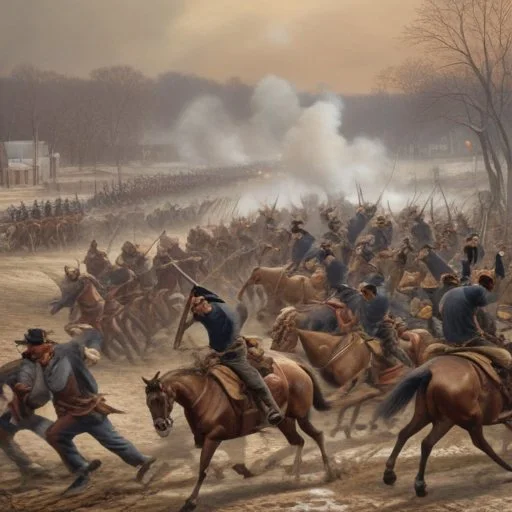
Broad Historical Examination
The winter of 1864 was a pivotal moment in the American Civil War. As the Confederacy struggled to maintain its grip on the South, the Union army was poised to deliver a series of crushing blows. One such blow was the Battle of Nashville, a decisive Union victory that would have far-reaching consequences for the Confederacy.
In the months leading up to the battle, the Union army had been making steady gains in the Western Theater. The capture of Atlanta in September 1864 had dealt a significant blow to the Confederacy's ability to wage war, and the subsequent march of General William Tecumseh Sherman's troops through Georgia had left the Rebel army reeling.
Against this backdrop, the Battle of Nashville was a masterclass in Union strategy and tactics. General George Thomas's plan to split his forces and attack the Confederate army from multiple angles was a bold and innovative move that caught the Rebels off guard.

In-Depth Character Profile
General John Bell Hood was a veteran of the Confederate army, having fought in numerous battles throughout the war. However, his leadership during the Battle of Nashville has been widely criticized by historians.
Hood's decision to launch a series of frontal assaults against the Union army was a tactical blunder that played into the hands of General Thomas. Despite being outnumbered, the Union army was well-entrenched and well-equipped, and the Confederate army was no match for their superior firepower.
Hood's defeat at Nashville marked the beginning of the end of his military career. He would go on to surrender his army in April 1865, and would spend the rest of his life struggling to come to terms with his failure.
Full Comparison Analysis
The Battle of Nashville was a textbook example of the Union army's superiority in terms of training, equipment, and tactics. While the Confederate army was largely made up of poorly trained and ill-equipped recruits, the Union army was a well-oiled machine that had been honed through years of fighting.
In contrast, the Confederate army was plagued by internal divisions and a lack of cohesion. The army was led by a group of aging generals who were out of touch with the realities of modern warfare, and who clung to outdated tactics and strategies.
The Battle of Nashville was a microcosm of the larger conflict, with the Union army's modernity and adaptability pitted against the Confederate army's outdatedness and inflexibility.

Cultural Significance Study
The Battle of Nashville had a profound impact on the cultural landscape of the South. The defeat of the Confederate army marked a turning point in the war, and paved the way for the eventual surrender of the Confederacy.
In the aftermath of the battle, the city of Nashville became a hub of Union activity, with thousands of soldiers and civilians flooding into the city. The city's economy was transformed overnight, with new businesses and industries springing up to meet the demands of the Union army.
However, the battle also left deep scars on the city and its people. The destruction and chaos caused by the battle would take years to repair, and the city would never be the same again.
Economic Impact Analysis
The Battle of Nashville had a significant impact on the economy of the South. The destruction caused by the battle led to a massive influx of federal aid, which helped to rebuild and revitalize the city's economy.
In the aftermath of the battle, the city of Nashville became a major hub of commercial activity, with trade and industry flourishing. The city's economy was transformed overnight, with new businesses and industries springing up to meet the demands of the Union army.
However, the battle also had a profound impact on the economy of the Confederacy as a whole. The defeat of the Confederate army marked the beginning of the end of the Confederacy, and paved the way for Reconstruction and the rebuilding of the South.


