


On a chilly November evening in 1863, John Hunt Morgan, the notorious Confederate cavalry leader, and several of his men pulled off one of the most daring prison breaks in American history, tunneling their way out of the Ohio Penitentiary and making their way back to the South. This daring escape, which would become known as the "Great Ohio Penitentiary Escape," was a testament to the cunning and bravery of Morgan and his men, and a beacon of hope for the struggling Confederacy.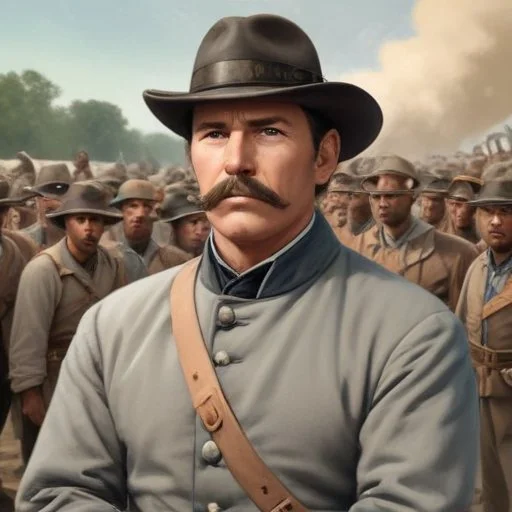
In the summer of 1863, John Hunt Morgan and his cavalry unit had been wreaking havoc on Union forces in Ohio, Indiana, and Kentucky, earning him the nickname "The Thunderbolt of the Confederacy." However, on July 26, 1863, Morgan and his men were captured near Salineville, Ohio, and taken prisoner. They were eventually transported to the Ohio Penitentiary in Columbus, where they were held in damp and dismal conditions.
Morgan, determined to escape and rejoin the Confederate army, began to formulate a plan. He and his men, including Captain Thomas Hines, Captain Ralph Sheldon, and Lieutenant Charles Huffman, began to dig a tunnel, using nothing but a makeshift tool fashioned from a stolen spoon. They worked tirelessly, often for hours on end, hiding their progress from the prison guards by covering the hole with a rug.
On the evening of November 27, 1863, Morgan and his men made their move. They entered the tunnel, which had taken them several weeks to dig, and began to make their way out of the prison. The tunnel was narrow and cramped, and the men had to crawl on their bellies to avoid detection. As they emerged on the other side of the prison wall, they split into small groups, each making their way to predetermined rendezvous points.
Morgan and his men traveled through the night, using the stars to guide them. They crossed rivers, traversed forests, and navigated through rural towns, all the while avoiding detection by Union patrols. Along the way, they encountered sympathetic civilians who provided them with food, clothing, and shelter. After several days of travel, they finally reached the safety of Confederate territory, where they were greeted as heroes.
According to Captain Thomas Hines, one of the escapees, "We were all in high spirits, and our hearts were full of hope and determination. We knew that we had to escape, not just for ourselves, but for the sake of our families and our country."
The Great Ohio Penitentiary Escape of 1863 remains one of the most daring and audacious prison breaks in American history. It is a testament to the bravery, cunning, and determination of John Hunt Morgan and his men, and a reminder of the sacrifices made by those who fought on both sides of the American Civil War.
The Great Ohio Penitentiary Escape of 1863 was not an isolated incident. In the summer of 1863, Morgan's raid into Ohio was part of a larger Confederate strategy to disrupt Union supply lines and create chaos behind enemy lines. Morgan's cavalry unit had been wreaking havoc on Union forces in Ohio, Indiana, and Kentucky, earning him the nickname "The Thunderbolt of the Confederacy." This campaign was a key component of the Confederate Heartland Offensive, a series of battles and raids aimed at striking at the heart of the Union.
The success of Morgan's raid and subsequent escape highlighted the weaknesses of the Union army's defenses in the region and forced them to re-evaluate their strategies. The Union army responded by increasing their presence in the region and implementing new counter-insurgency tactics to combat Morgan's style of guerrilla warfare.
John Hunt Morgan was a complex figure, known for his bravery, cunning, and charisma. Born in 1825 in Huntsville, Alabama, Morgan came from a wealthy and influential family. He was educated at Transylvania University and later studied law. However, it was his military career that brought him fame and notoriety. Morgan saw action in the Mexican-American War and later joined the Confederate Army, where he quickly rose through the ranks.
Morgan's men idolized him, and he was known for his ability to inspire loyalty and devotion in his troops. He was also known for his sense of humor and his ability to think on his feet, often coming up with clever disguises and ruses to evade capture.
The Great Ohio Penitentiary Escape of 1863 shares some parallels with other famous prison breaks in history. One notable example is the escape of Frank Morris from Alcatraz Federal Penitentiary in 1962. Like Morgan, Morris used a tunnel to escape, and his disappearance was only discovered after he was long gone.
Another example is the escape of French Resistance fighter André Devigny from Montluc Prison in 1943. Devigny used a similar technique of digging a tunnel, and his escape was seen as a major morale booster for the French Resistance.
These comparisons highlight the cunning and resourcefulness of prisoners throughout history, who have consistently found ways to escape and evade their captors.
The Great Ohio Penitentiary Escape of 1863 took place against the backdrop of a larger geopolitical context. The American Civil War was raging, with the Union and Confederacy locked in a bitter struggle for control of the nation. The war was fought on multiple fronts, with battles taking place in the Eastern Theater, the Western Theater, and the Trans-Mississippi Theater.
The Confederacy was struggling to gain momentum, having suffered a series of setbacks in the summer of 1863, including the defeat at Gettysburg. The escape of Morgan and his men was a much-needed boost to Confederate morale, and it highlighted the ongoing struggle between the Union and Confederacy.
Historians have long debated the significance of the Great Ohio Penitentiary Escape of 1863. Some have argued that it was a minor sideshow, a daring but ultimately inconsequential escapade. Others have seen it as a powerful symbol of Confederate defiance and a testament to the bravery and cunning of Morgan and his men.
One thing is certain: the escape has endured as a fascinating tale of adventure and escape, captivating historians and the general public alike. It has been the subject of numerous books, articles, and films, and continues to be a source of fascination for those interested in the American Civil War.