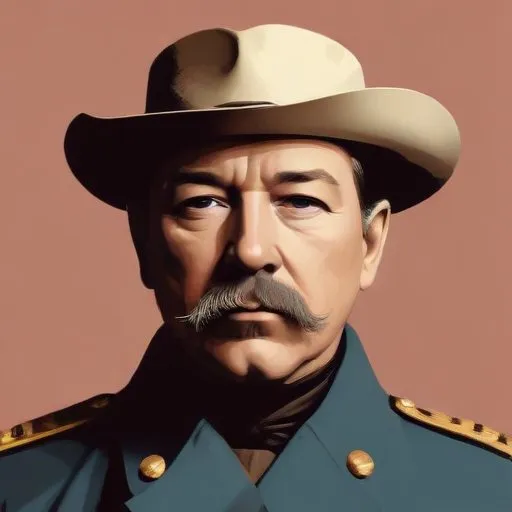
John Hunt Morgan: The Notorious Confederate Raider
A Life of Battle and Bravery
John Hunt Morgan was a Confederate general in the American Civil War, renowned for his daring raids and unconventional warfare tactics. He is best known for his 1,000-mile cavalry raid into Indiana and Ohio, the northernmost point ever reached by uniformed Confederates, and his audacious escape from prison.
Early Life and Career
Born on June 1, 1825, in Huntsville, Alabama, Morgan was the eldest of ten children to Calvin and Henrietta Hunt Morgan. His maternal grandfather,
John Wesley Hunt, was a prominent landowner and businessman in Kentucky, and one of the first millionaires west of the Allegheny Mountains. Morgan's family moved to Lexington, Kentucky, where he grew up surrounded by the influences of his prominent family.
Rise to Prominence
In April 1862, Morgan raised the 2nd Kentucky Cavalry Regiment and fought at the Battle of Shiloh. He then launched a costly raid in Kentucky, which encouraged General
Braxton Bragg's invasion of the state. Morgan's tactical genius and bravery earned him recognition and promotion to brigadier general.
Morgan's Raid: A Daring Feat
In July 1863, Morgan set out on a 1,000-mile raid into Indiana and Ohio, taking hundreds of prisoners and destroying Union supplies and infrastructure. Although he was eventually intercepted by U.S. Army gunboats, Morgan's raid remains one of the most daring and successful cavalry operations of the Civil War.
Prison Break and Redemption
After his capture, Morgan escaped from prison and continued to fight for the Confederacy. However, his credibility had been damaged, and he was restricted to minor operations. Morgan's last battle was in Greeneville, Tennessee, where he was killed on September 4, 1864.
Legacy and Honors
John Hunt Morgan's legacy is cemented in American history as a daring and innovative military leader. Various schools and a memorial are dedicated to him, and his name has become synonymous with bravery and cunning.
Personal Milestones
- Morgan was the brother-in-law of Confederate general A. P. Hill.
- He was an uncle of geneticist Thomas Hunt Morgan.
- Morgan's first cousin, twice removed, Abijah Hunt, was killed in a duel with Mississippi Governor George Poindexter in 1811.
Trivia and Fun Facts
- Morgan never used his middle name "Hunt" during the war; it was a post-war appellation.
- His grandfather, John Wesley Hunt, was the first millionaire west of the Allegheny Mountains.
Morgan's life was a testament to his unwavering dedication to the Confederate cause and his unrelenting spirit in the face of adversity. His daring raids and escape from prison have cemented his place in American history as one of the most intriguing and courageous figures of the Civil War era.
FAQ
What was John Hunt Morgans role in the American Civil War?
John Hunt Morgan was a Confederate general during the American Civil War, known for his raids behind Union lines, including his famous raid into Ohio. He was a notable cavalry commander and played a significant role in several battles.
What is John Hunt Morgans most famous exploit?
John Hunt Morgans most famous exploit was his raid into Ohio in 1863, where he led a group of Confederate cavalrymen on a daring raid, capturing thousands of Union soldiers and causing significant disruption to Union supply lines.
How did John Hunt Morgan die?
John Hunt Morgan was killed in action on September 4, 1864, during a raid on Greenville, Tennessee. He was shot by a Union soldier and died shortly thereafter.
What was John Hunt Morgans early life like?
John Hunt Morgan was born on June 1, 1825, in Huntsville, Alabama. He grew up in a wealthy family and attended Transylvania University before joining the Mexican-American War as a cavalry officer.
Is John Hunt Morgan remembered as a hero or villain?
John Hunt Morgan is remembered as a complex figure, both a hero to many Southerners for his bravery and cunning as a Confederate general, and a villain to many Northerners for his raids and disruptions to civilian life.