


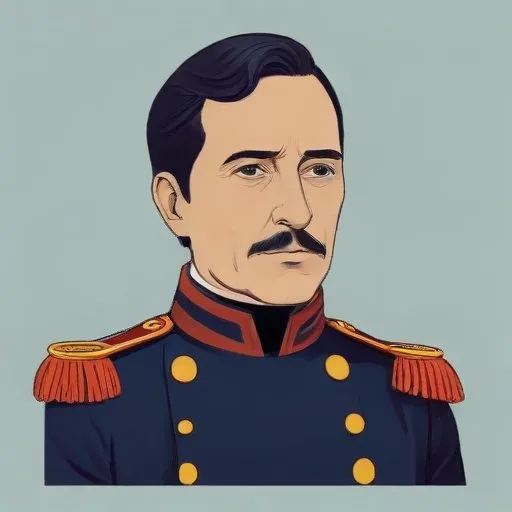
A Confederate general who played a pivotal role in the American Civil War, particularly during the Battle of Fort Sumter, and is often credited with starting the war.
Pierre Gustave Toutant Beauregard, more commonly known as P. G. T. Beauregard, is infamous for being the Confederate general who sparked the American Civil War by firing the first shot at Fort Sumter on April 12, 1861.
Born on May 28, 1818, in St. Bernard Parish, Louisiana, Beauregard was trained in military and civil engineering at the United States Military Academy, West Point. He graduated in 1838, second in his class, and went on to serve with distinction as an engineer officer in the Mexican-American War.
Following a brief appointment as superintendent of the U.S. Military Academy in 1861, Beauregard resigned from the United States Army and became the first brigadier general in the Confederate States Army. He commanded the defenses of Charleston, South Carolina, at the start of the Civil War.
Beauregard's military career was marked by several key battles and campaigns:
Beauregard's professional relationships with President Jefferson Davis and other senior generals and officials were often strained, which limited his influence over Confederate strategy.
In April 1865, Beauregard, along with his commander General Joseph E. Johnston, convinced Davis and the remaining cabinet members that the war needed to end. Johnston surrendered most of the remaining armies of the Confederacy, including Beauregard and his men, to Major General William Tecumseh Sherman.
Beauregard's legacy is complex and multifaceted. While he is often remembered as the general who fired the first shot of the Civil War, his military career was marked by both victories and defeats. His defense of Petersburg and Charleston showcased his tactical skills, but his poor relationships with his superiors limited his impact on the war's outcome.
Beauregard's legacy extends beyond the Civil War. He was a pioneer in the development of railroads in the South, and his post-war writings on military strategy and tactics remain influential in military circles to this day.
"It is well that war is so terrible, otherwise we should grow too fond of it." - P. G. T. Beauregard
Beauregard's quote highlights the complexity of war and the need to maintain a critical perspective on military action.
Born in 1807
Led the Confederate States Army during the American Civil War, surrendering to Union forces at Appomattox, marking the war's effective end.
Born in 1822
Led the Union Army to victory in the Civil War and later became President, known for issuing the Emancipation Proclamation and strengthening federal authority.
Born in 1808
The President of the Confederate States of America during the American Civil War, leading the secessionist movement and fighting to preserve slavery. He's infamous for his role in the Civil War and its aftermath.
Born in 1824
A Confederate general during the American Civil War, he's renowned for his unconventional tactics and bravery, earning him a legendary status among military historians.
Born in 1821
A Confederate general during the American Civil War, later serving as a diplomat and ambassador to Turkey, known for his military strategies and post-war reconciliation efforts.
Born in 1825
A Confederate general during the American Civil War, known for his bravery and tactical skills, leading troops in several key battles, including the Battle of Chancellorsville.
Born in 1816
A Confederate general during the American Civil War, he led several battles and was known for his tenacity and tactical prowess. He later became a lawyer and wrote about his war experiences.
Born in 1831
A Confederate general during the American Civil War, known for his bravery and aggressive tactics, but also criticized for his reckless decisions that led to devastating defeats.
