


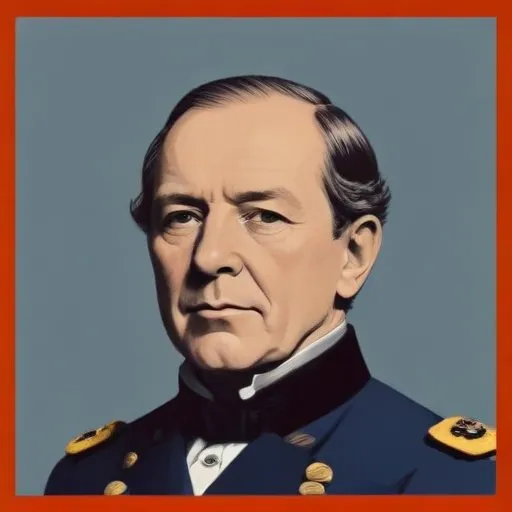
A Confederate general during the American Civil War, he surrendered to Sherman, ending the war, and later served as a US Congressman.
Joseph E. Johnston was a renowned American career army officer who served in the United States Army during the Mexican-American War and the Seminole Wars, and later became one of the most senior general officers in the Confederate States Army. He is best known for his significant contributions to the American Civil War, where he played a crucial role in several key battles, including the First Battle of Bull Run and the Atlanta Campaign.
Johnston was born on February 3, 1807, in Farmville, Virginia. He graduated from the United States Military Academy at West Point, New York, in 1829, alongside fellow prominent generals such as Robert E. Lee. He went on to serve in various military campaigns, including the Mexican-American War and the Seminole Wars, eventually achieving the rank of brigadier general as Quartermaster General of the U.S. Army by 1860.
When Virginia seceded from the United States, Johnston joined the Confederate States Army, becoming one of its most senior general officers. He played a significant role in several battles, including the First Battle of Bull Run, where he was the senior Confederate commander, although the victory is often credited to his subordinate, P. G. T. Beauregard.
Johnston defended the Confederate capital of Richmond, Virginia, during the 1862 Peninsula Campaign, but was forced to withdraw under pressure from U.S. Maj. Gen. George B. McClellan's superior force. He suffered a severe wound at the Battle of Seven Pines and was replaced by Robert E. Lee.
In 1863, Johnston was placed in command of the Department of the West, and in 1864, he commanded the Army of Tennessee against U.S. Maj. Gen. William Tecumseh Sherman in the Atlanta Campaign. In the war's final days, Johnston was returned to command of the few remaining forces in the Carolinas Campaign.
After the war, Johnston went on to serve as an executive in the railroad and insurance businesses. He was elected as a Democrat to the United States House of Representatives, serving a single term. He also held various other positions, including vice president and president of the Aztec Club of 1847, an organization of Mexican-American War veterans.
U.S. Army generals Ulysses S. Grant and William Tecumseh Sherman, who had fought against Johnston during the war, praised his actions and became friends with him afterward.
Johnston's legacy is marked by his bravery and strategic military prowess. He is remembered as one of the most skilled and respected generals of the American Civil War. Johnston passed away on March 21, 1891, leaving behind a rich legacy of military service and public office.
Joseph E. Johnston's remarkable military career and public service have left an indelible mark on American history, earning him a revered place among the nation's most distinguished military leaders.
Born in 1807
Led the Confederate States Army during the American Civil War, surrendering to Union forces at Appomattox, marking the war's effective end.
Born in 1822
Led the Union Army to victory in the Civil War and later became President, known for issuing the Emancipation Proclamation and strengthening federal authority.
Born in 1820
A renowned Union general during the American Civil War, he's infamous for his scorched earth tactics and march through the Confederacy, leaving destruction in his wake.
Born in 1808
The President of the Confederate States of America during the American Civil War, leading the secessionist movement and fighting to preserve slavery. He's infamous for his role in the Civil War and its aftermath.
Born in 1824
A Confederate general during the American Civil War, he's renowned for his unconventional tactics and bravery, earning him a legendary status among military historians.
Born in 1825
A Confederate general during the American Civil War, known for his bravery and tactical skills, leading troops in several key battles, including the Battle of Chancellorsville.
Born in 1821
A Confederate general during the American Civil War, later serving as a diplomat and ambassador to Turkey, known for his military strategies and post-war reconciliation efforts.
