


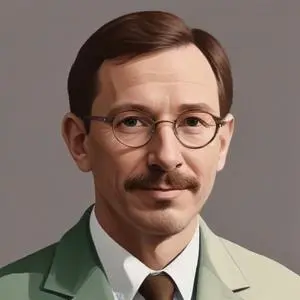
Pioneering geneticist who discovered the role of chromosomes in heredity and developed the modern theory of genetics, earning a Nobel Prize in Physiology or Medicine in 1933.
Thomas Hunt Morgan, the Nobel laureate, was an American evolutionary biologist, geneticist, and embryologist who revolutionized the field of genetics with his groundbreaking discoveries on the role of chromosomes in heredity. It was his pioneering work that established the modern science of genetics, earning him the Nobel Prize in Physiology or Medicine in 1933.
Morgan was born on September 25, 1866, in Lexington, Kentucky, to Charlton Hunt Morgan and Ellen Key Howard Morgan. His family had a rich history, with his great-grandfather, John Wesley Hunt, being one of the first millionaires west of the Allegheny Mountains. Morgan's mother was a descendant of Francis Scott Key, the author of the Star Spangled Banner, and John Eager Howard, a governor and senator from Maryland.
Morgan's early interest in science led him to attend the State College of Kentucky, where he began his studies at the age of 16. He later transferred to Johns Hopkins University, where he earned his Ph.D. in zoology in 1890.
Following the rediscovery of Mendelian inheritance in 1900, Morgan became fascinated with the genetic characteristics of the fruit fly Drosophila melanogaster. In his famous Fly Room at Columbia University's Schermerhorn Hall, Morgan demonstrated that genes are carried on chromosomes and are the mechanical basis of heredity.
This pioneering work laid the foundation for modern genetics and earned Morgan international recognition. His Fly Room became a hub for genetic research, attracting prominent scientists from around the world.
Morgan's contributions to genetics are immense. He wrote 22 books and 370 scientific papers, making him one of the most prolific scientists of his time. His work established Drosophila as a major model organism in contemporary genetics.
The Division of Biology he established at the California Institute of Technology produced seven Nobel Prize winners, cementing his legacy as a pioneer in the field of genetics.
Morgan's passion for genetics was matched only by his love for music. He was an accomplished violinist and often played chamber music with his colleagues.
In 1915, Morgan was one of the founders of the Genetics Society of America, and he served as its president from 1925 to 1926.
Thomas Hunt Morgan's groundbreaking work in genetics left an indelible mark on the scientific community. His legacy continues to inspire scientists and researchers around the world, and his contributions remain a testament to the power of human curiosity and ingenuity.
Born in 1900
A pioneer in evolutionary biology, he integrated genetics and evolution, revolutionizing our understanding of species adaptation and diversity. His work laid the foundation for modern evolutionary theory.
Born in 1912
German racing driver who won the 1927 German Grand Prix and was one of the first drivers to compete in the European Championship.
Born in 1889
Pioneering geneticist who discovered the chromosomal basis of heredity and developed the first genetic maps, revolutionizing our understanding of inheritance.
Born in 1875
Developed the Punnett square, a graphical representation of genetic inheritance, and made significant contributions to the field of genetics, particularly in understanding heredity and evolution.
