


The Confederate Army of Northern Virginia, battered and worn, withdrew from the blood-soaked fields of Gettysburg, Pennsylvania, marking the end of the Confederacy's last invasion of the North. This pivotal moment in the American Civil War, fought from July 1 to 3, 1863, would prove to be a decisive Union victory, shifting the tide of the conflict and altering the course of American history.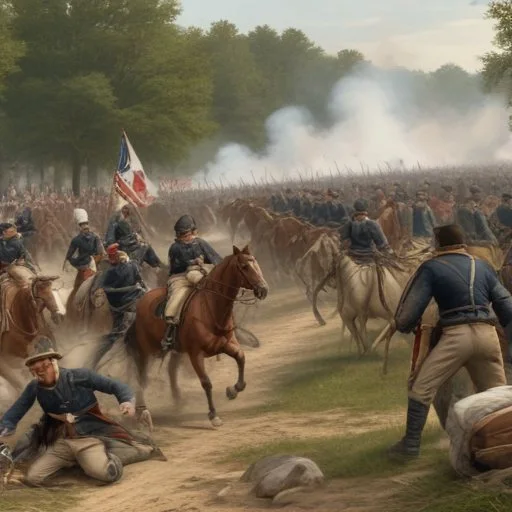
General Robert E. Lee, commander of the Confederate Army, had launched the invasion of the North in hopes of securing a decisive victory on Union territory. He sought to counter the growing momentum of the Union Army and ease the pressure on the besieged city of Vicksburg. The battle would be a test of wills, with the Confederacy's best soldiers pitted against the Union's finest.
The battle raged across the rolling hills and fields of Gettysburg, with both sides suffering heavy casualties. On the first day, Confederate forces pushed the Union lines back through the town, but failed to secure a decisive victory. The second day saw brutal fighting on the Union flanks, but the Confederacy's gains were limited. On the third and final day, the Confederacy launched a desperate assault, known as Pickett's Charge, which was repelled with devastating losses.
As the Confederate Army withdrew from the battlefield, the true extent of their losses became apparent. Over 28,000 soldiers had been killed, wounded, or captured, a staggering 30% of Lee's army. The road back to Virginia would be long and arduous, with the Union Army nipping at their heels. The Confederacy's last invasion of the North had ended in defeat, and with it, their hopes of securing foreign recognition and aid.
The retreat from Gettysburg marked a critical turning point in the war. The Union Army, buoyed by their victory, would go on to win a string of successes, including the capture of Vicksburg and the Battle of Chattanooga. The Confederacy, on the other hand, would never fully recover from the losses they suffered at Gettysburg. The tide of the war had shifted irrevocably in favor of the Union.
The retreat from Gettysburg would be remembered as a pivotal moment in American history, a turning point in the struggle for unity and freedom. The battle would be immortalized in literature, art, and music, and would serve as a powerful symbol of the devastating cost of war.
As the Union Army watched the Confederates disappear into the distance, they knew that the war was far from over. But they also knew that the tide of history had shifted, and that the ultimate victory would be theirs. The retreat from Gettysburg would be a beacon of hope, illuminating the long and difficult road to Appomattox.
The Battle of Gettysburg also had a profound impact on American culture. On November 19, 1863, President Abraham Lincoln delivered the Gettysburg Address, a speech that redefined the purpose of the war and honored the fallen soldiers. The speech's message of unity, equality, and liberty resonated with the American people, and it became a beacon of hope during a time of great turmoil.
The Gettysburg Address has since become an iconic piece of American literature, with phrases like "government of the people, by the people, for the people" and "that we here highly resolve that these dead shall not have died in vain" etched into the nation's consciousness. It has been recited, memorized, and studied by generations of Americans, and its message continues to inspire and unite the country.
Historians have long debated the significance of the Battle of Gettysburg, with some arguing that it was a decisive turning point in the war, while others claim that it was merely a bloody stalemate.
One school of thought, led by historians like James McPherson, sees Gettysburg as a crushing blow to the Confederacy's ability to wage war. They argue that the battle marked a shift in momentum in favor of the Union, paving the way for eventual victory.
Others, like Edward Bonekemper, have argued that Gettysburg was not a decisive victory, citing the high casualties suffered by both sides and the failure of the Union Army to pursue and destroy the Confederate forces.
The Battle of Gettysburg had far-reaching implications beyond the American Civil War. The defeat of the Confederacy's invasion of the North sent a clear message to European powers that the Union was a force to be reckoned with.
The British and French governments, which had been considering recognition of the Confederacy, began to rethink their position. The Battle of Gettysburg, combined with the Emancipation Proclamation, made it increasingly difficult for European powers to justify supporting a slave-holding nation.
In the end, the Union's victory at Gettysburg helped to isolate the Confederacy diplomatically, paving the way for a Union victory in the war.
While General Robert E. Lee gets much of the attention for his bold strategy at Gettysburg, General George Meade, the commander of the Union Army, played a crucial role in the battle's outcome.
A career military officer, Meade was a cautious and meticulous commander who carefully prepared his defenses on the high ground outside of Gettysburg. His decision to hold back the Union cavalry and focus on infantry defenses proved decisive, as it allowed the Union forces to hold off the Confederate attacks.
Despite his crucial role in the battle, Meade remains a relatively unknown figure in American history, overshadowed by more charismatic leaders like Lee and Grant.
The Battle of Gettysburg was one of the costliest battles of the American Civil War, with estimates suggesting that the three-day battle resulted in over $200 million in damages (approximately $3.5 billion in today's dollars).
The battle devastated the town of Gettysburg, leaving many buildings destroyed or damaged. The local economy was also severely impacted, as the battle disrupted trade and commerce in the region.
In the long term, the Union's victory at Gettysburg helped to preserve the economic unity of the United States, paving the way for a period of rapid industrialization and growth in the late 19th century.