


The Siege of Vicksburg, a pivotal battle fought during the Vicksburg campaign, marked a crucial turning point in the American Civil War. It was here that Union forces, under the command of General Ulysses S. Grant, successfully captured the Confederate stronghold on the Mississippi River, splitting the rebel territory in two and paving the way for the ultimate defeat of the Confederacy.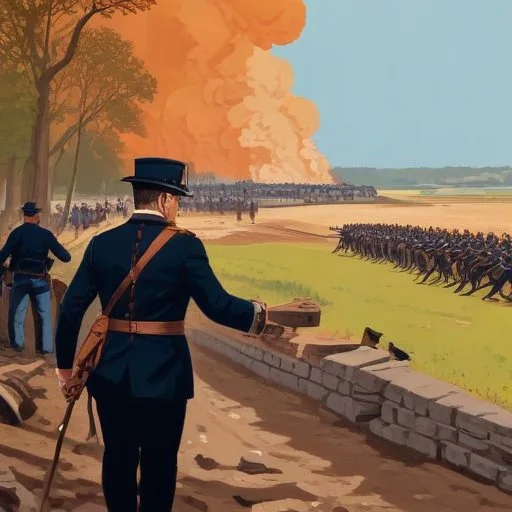
In the spring of 1863, Grant's Army of the Tennessee had been struggling to gain a foothold in the war-torn South. After a series of setbacks, Grant set his sights on Vicksburg, a heavily fortified city perched on the bluffs of the Mississippi River. Control of the river was crucial, as it provided a vital lifeline for the Confederacy, connecting the rebel states of Texas, Louisiana, and Arkansas to the rest of the South.
The Siege of Vicksburg was a resounding Union victory, yielding significant strategic and psychological benefits. The capture of the Mississippi River split the Confederacy in two, crippling the rebel army's ability to communicate and resupply. The fall of Vicksburg also marked a shift in momentum, as the Union army gained control of the western theater of the war.
The Siege of Vicksburg had profound cultural and social implications, both during and after the war. The battle marked a turning point in the conflict, demonstrating the Union army's determination and resolve. The fall of Vicksburg also paved the way for the eventual abolition of slavery, as the war effort increasingly focused on ending the institution of slavery.
"The fate of the Confederacy was sealed when Vicksburg fell." - Ulysses S. Grant
In his memoirs, Grant remembered the siege of Vicksburg as one of the most trying periods of the war. Despite the Union army's ultimately successful campaign, Grant recalled the suffering and hardship endured by his soldiers, as well as the stoic determination of the Confederate defenders.
The Siege of Vicksburg set the stage for the final phase of the American Civil War. The capture of the Mississippi River enabled the Union army to launch a series of successful campaigns in the western theater, ultimately paving the way for the defeat of the Confederacy. The fall of Vicksburg also marked a shift in Grant's career, as he emerged as a leading figure in the Union war effort.
The Siege of Vicksburg was a masterclass in military strategy, with Grant employing a innovative approach to besieging the city. By using a combination of trenches, earthworks, and artillery, Grant's army was able to slowly but surely tighten its grip on the Confederate stronghold. The Union army's use of cannons and mortars to bombard the city was particularly effective, as it allowed them to weaken the Confederate defenses without having to launch a costly and bloody frontal assault.
One of the most fascinating aspects of the Siege of Vicksburg was the role played by African American troops. For the first time in the war, African American soldiers were used in a major combat operation, and they played a crucial role in the Union victory. The bravery and determination of these troops helped to pave the way for the eventual abolition of slavery.
John C. Pemberton: The Reluctant Confederate
John C. Pemberton, the Confederate General in charge of the Vicksburg garrison, is often portrayed as a reluctant and ineffective leader. However, a closer examination of his life and career reveals a more complex and nuanced figure. Born in Pennsylvania, Pemberton was a career army officer who had served in the Mexican-American War and had risen to the rank of Colonel by the outbreak of the Civil War.
Despite his Northern roots, Pemberton felt a strong sense of loyalty to the South, and he eventually joined the Confederate army. However, his time in command of the Vicksburg garrison was marked by a series of setbacks and reverses, which ultimately led to the fall of the city.
The Siege of Vicksburg had a profound cultural impact on both the North and the South. In the North, the victory was seen as a major turning point in the war, and it sparked widespread celebrations and parades. The fall of Vicksburg was also seen as a major blow to the morale of the Confederate army, and it helped to shift the momentum of the war in favor of the Union.
In the South, the defeat was seen as a major disaster, and it led to widespread despair and demoralization. The fall of Vicksburg was also seen as a symbol of the Confederacy's decline and eventual defeat.
The Siege of Vicksburg is often compared to other famous sieges in history, such as the Siege of Troy or the Siege of Stalingrad. While these comparisons are interesting, they can also be misleading, as each siege has its own unique characteristics and context.
One of the most interesting comparisons is with the Siege of Petersburg, which took place several months after the Siege of Vicksburg. While both sieges were fought during the American Civil War, they were fought under very different circumstances and had very different outcomes.
The Siege of Vicksburg took place against the backdrop of a rapidly changing geopolitical landscape. The Confederacy was struggling to survive, and the loss of Vicksburg was a major blow to its ability to wage war.
The fall of Vicksburg also had significant implications for the balance of power in the region. With the Mississippi River now under Union control, the Confederacy was split in two, making it much harder for the rebel states to communicate and coordinate their efforts.