


The American Civil War raged on, and the Union forces, led by General Ulysses S. Grant, were determined to capture the strategic stronghold of Vicksburg. In a series of clever maneuvers, Grant's army cornered the Confederate forces under General Joseph E. Johnston in Jackson, Mississippi, setting the stage for the Battle of Jackson, a crucial Union victory that would pave the way for the ultimate capture of Vicksburg.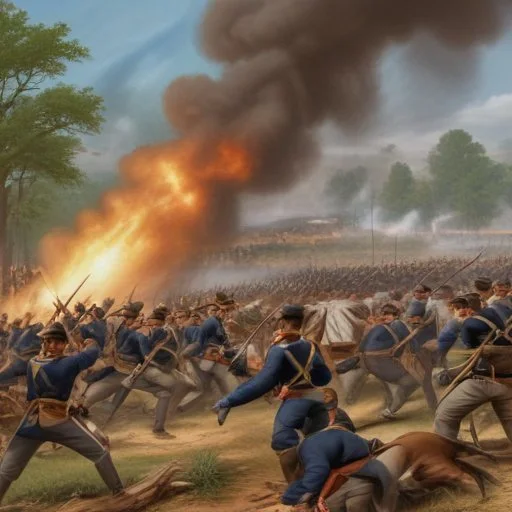
TheBattle of Jackson was a brutal and intense conflict that left the city in shambles. The once-thriving capital of Mississippi was now a scene of destruction, with buildings reduced to rubble, streets littered with debris, and the sounds of artillery and gunfire still echoing in the air. The Confederates, outmaneuvered and outnumbered, were forced to retreat, leaving behind a trail of devastation.
General Ulysses S. Grant, the Union commander, was the architect of the Vicksburg campaign. Grant's strategic mind and ability to adapt to changing circumstances were crucial in cornering the Confederate forces.
General Joseph E. Johnston, the Confederate commander, was tasked with defending Jackson. Despite being outnumbered and outgunned, Johnston's men fought valiantly, but ultimately, they were no match for Grant's forces.
In the weeks leading up to the Battle of Jackson, Grant's army had been making a series of clever maneuvers, designed to trap the Confederate forces. Here is a brief timeline of the events:
Jackson, Mississippi, was a city torn apart by the war. The city's residents, many of whom were devoted to the Confederacy, were forced to flee their homes as the Union forces approached. The city's infrastructure was destroyed, and the once-thriving economy was left in shambles.
The Battle of Jackson also had a profound impact on the city's African American population. Many escaped slaves joined the Union forces, seeing the war as an opportunity to gain their freedom.
The Battle of Jackson was a decisive Union victory, one that paved the way for the ultimate capture of Vicksburg. The fall of Vicksburg, in turn, split the Confederacy in two, giving the Union control of the Mississippi River and cutting off the Confederate supply lines.
The Battle of Jackson also marked a turning point in Grant's career, cementing his reputation as a skilled military strategist and earning him the respect of his peers and the admiration of the American public.
Today, the Battle of Jackson is remembered as a pivotal moment in the American Civil War. The city of Jackson, once a symbol of Confederate defiance, is now a thriving metropolis, proud of its rich history and cultural heritage.
The battle's legacy extends far beyond the city limits, however. The Battle of Jackson serves as a powerful reminder of the devastating consequences of war and the importance of preserving our nation's history.
In the months leading up to the Battle of Jackson, General Grant's Union forces had been engaged in a series of smaller skirmishes and battles, slowly but surely pushing the Confederate forces back towards the state capital. One of the most significant of these battles was the Battle of Raymond, fought on May 12, 1863, just a few days before the Battle of Jackson. Although the Battle of Raymond was a relatively small engagement, it marked an important turning point in the campaign, as it forced the Confederates to retreat towards Jackson and ultimately led to the capture of the city.
The Confederate forces, led by General Johnston, had been using the city's defenses to their advantage, but Grant's clever maneuvers and clever use of artillery had finally forced them to abandon their positions and retreat. As the Union forces entered the city, they were met with scenes of destruction and chaos, as the Confederates had set fire to many of the city's buildings and infrastructure in an attempt to slow the Union advance.
Despite the chaos and destruction, Grant's forces pressed on, pursuing the Confederate forces as they retreated towards Vicksburg. The Battle of Jackson was a crucial Union victory, and it marked a significant turning point in the Vicksburg campaign.

General Joseph E. Johnston, the commander of the Confederate forces during the Battle of Jackson, was a career military officer who had served in the United States Army before seceding to join the Confederacy. Born in Virginia in 1807, Johnston was a distant cousin of President Jefferson Davis, and had always been drawn to a life of military service.
Despite his relatively advanced age at the time of the Battle of Jackson, Johnston was still a capable and determined commander, who was deeply committed to the Confederate cause. However, his forces were vastly outnumbered and outgunned, and he was ultimately forced to retreat in the face of Grant's superior numbers.
Johnston's performance during the Battle of Jackson has been the subject of some controversy among historians, with some arguing that he should have held out longer and fought more aggressively, while others believe that he made the best decisions he could with the resources he had available.
The Battle of Jackson had a profound impact on the city's cultural and social fabric. The city's residents, many of whom were fiercely loyal to the Confederacy, were forced to flee their homes as the Union forces approached, leaving behind a trail of destruction and chaos.
The battle also had significant implications for the city's African American population, many of whom saw the Union victory as an opportunity to gain their freedom. Hundreds of escaped slaves flocked to the Union lines, seeking protection and safety behind the Union army's guns.
In the aftermath of the battle, the city was occupied by Union forces, who worked to rebuild and restore order to the city. The city's residents were forced to adapt to a new reality, as the Union army took control of the city's government and infrastructure.
The Battle of Jackson had significant economic implications for the city and the state of Mississippi as a whole. The destruction caused by the battle left the city's infrastructure in shambles, and many businesses and homes were destroyed or damaged.
The city's economy, which had already been struggling due to the war, was dealt a severe blow by the battle. Trade and commerce ground to a halt, as the city's transportation infrastructure was destroyed or severely damaged.
However, in the aftermath of the battle, the Union army worked to rebuild and restore the city's economy, investing heavily in infrastructure and providing aid to the city's residents. This effort helped to lay the foundations for the city's post-war reconstruction.
One of the most significant artifacts to emerge from the Battle of Jackson is a series of letters written by General Grant to his wife, Julia. These letters, which are now housed at the Library of Congress, provide a unique window into Grant's thoughts and feelings during the campaign.
In one letter, dated May 15, 1863, Grant writes to Julia: "I am confident that we will take Vicksburg within a week. The rebels are in full retreat, and our army is in hot pursuit."
These letters are a valuable historical resource, offering a personal and intimate perspective on one of the most significant battles of the Civil War.