


In the midst of World War I, as Europe was torn apart by the ravages of conflict, President Woodrow Wilson of the United States stood apart from the belligerents, calling for a peace without victory. On January 22, 1917, Wilson addressed the United States Senate, delivering a poignant plea to lay down arms and forge a negotiated peace.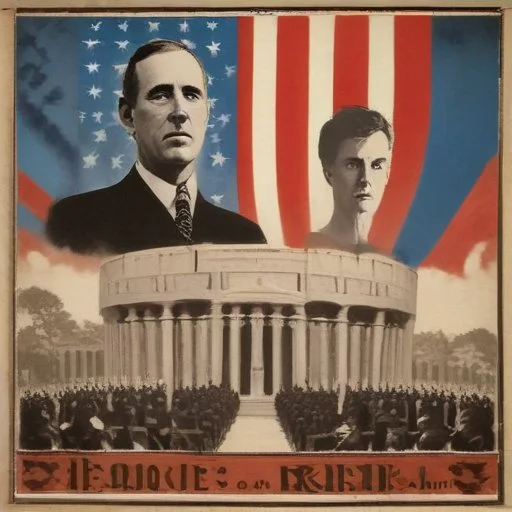
At the heart of Wilson's appeal lay a deep-seated conviction that the United States had a moral obligation to promote peace and stability in a world torn asunder by war. As the leader of a neutral nation, Wilson saw an opportunity to broker a peace deal that would spare countless lives and prevent the further devastation of Europe.
The Great War, as it came to be known, had been raging for over two years, with little signs of abating. The conflict had already claimed millions of lives, left cities in ruins, and brought entire nations to the brink of collapse. Against this backdrop of unprecedented destruction, Wilson's call for peace seemed a beacon of hope in a world gone mad.
Despite his initial commitment to neutrality, Wilson's resolve was soon tested by Germany's resumption of unrestricted submarine warfare and the sinking of the passenger ship Lusitania, which claimed the lives of 128 American citizens. As public opinion shifted in favor of intervention, Wilson's stance began to evolve, eventually leading to the United States' declaration of war on Germany on April 6, 1917.
Although Wilson's plea for peace ultimately failed to prevent American entry into the war, his commitment to the principles of diplomacy and international cooperation left an indelible mark on the world stage. The Fourteen Points, a set of principles outlined by Wilson in a speech to Congress on January 8, 1918, would go on to shape the course of international relations in the decades to come.
Wilson's leadership during this tumultuous period was marked by a deep sense of conviction and a willingness to challenge the status quo. His commitment to promoting peace and stability continues to inspire generations of world leaders and diplomats, serving as a powerful reminder of the importance of diplomacy in the pursuit of a more peaceful world.
Woodrow Wilson's plea for peace has been subject to varying interpretations by historians. Some have viewed it as a genuine attempt to broker a negotiated peace, while others have seen it as a clever move to buy time for the United States to prepare for its own entry into the war. More recent scholarship has highlighted the significance of Wilson's speech in the broader context of American exceptionalism, arguing that it reflected a long-standing American belief in its role as a moral arbiter in international relations.
Regardless of interpretation, Wilson's speech has remained a crucial episode in the historiography of World War I, with many historians acknowledging its impact on the trajectory of the war and the subsequent peace negotiations.

In the months leading up to Wilson's speech, the geopolitical landscape of Europe was undergoing significant shifts. The Russians had recently withdrawn from the war, and the Germans were making gains on the Eastern Front. Meanwhile, the Allies were struggling to find a way to break the stalemate on the Western Front.
In this context, Wilson's call for a peace without victory can be seen as an attempt to capitalize on the shifting balance of power in Europe. By proposing a negotiated peace, Wilson was attempting to exploit the divisions within the German government and to forestall the possibility of a German victory.
Woodrow Wilson was a man of strong convictions and a fierce determination to shape the course of world events. As the 28th President of the United States, he brought a unique blend of academic rigor and political savvy to the White House.
Wilson's commitment to the principles of democracy and international cooperation was deeply rooted in his own sense of morality and his belief in the importance of American leadership on the world stage.
Despite his idealism, Wilson was also a realist who recognized the harsh realities of geopolitics and the need for pragmatism in the pursuit of peace.

In January 1917, German Foreign Minister Arthur Zimmermann sent a coded telegram to the German ambassador in Mexico, instructing him to propose an alliance with the Mexican government in the event of a war with the United States.
This telegram, intercepted by British intelligence and passed on to the Wilson administration, played a significant role in galvanizing American public opinion against Germany and in favor of intervention.
The Zimmermann Telegram is a fascinating artifact of the era, offering a unique window into the diplomatic intrigues and strategic calculus of the Great War.
The resumption of unrestricted submarine warfare by Germany in 1917 was a technological game-changer in the Great War. The German U-boat fleet posed a significant threat to Allied shipping and challenged the traditional rules of naval warfare.
The response to this threat led to significant advances in naval technology, including the development of convoys, sonar, and depth charges.
The U-boat threat also had a profound impact on the course of the war, forcing the United States to re-examine its neutrality and eventually leading to its entry into the conflict.