


In the sweltering heat of August 1777, the rolling hills of Walloomsac, New York, bore witness to a battle that would alter the trajectory of the American Revolution. The Battle of Bennington, fought on August 16, 1777, marked a resounding victory for the Continental Army, led by General John Stark, over the British and Brunswick troops commanded by Friedrich Baum.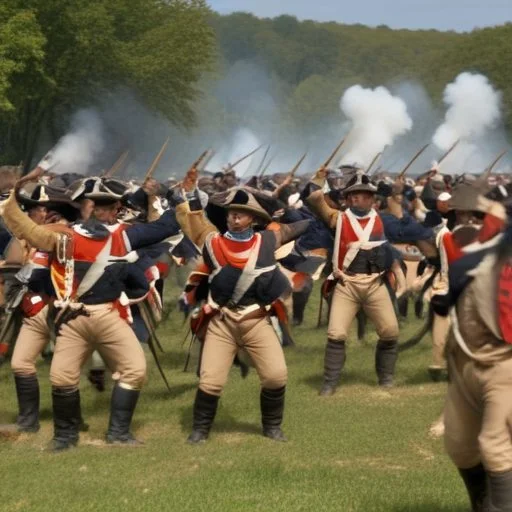
General John Stark, a seasoned military leader, had been tasked with defending the strategic location of Bennington, which controlled access to the Hudson River Valley. Baum's forces, comprising German mercenaries and British regulars, had been dispatched to disrupt supply lines and weaken the Continental Army's grip on the region.
The battle unfolded in a series of rapid-fire skirmishes, with Stark's men launching a series of lightning-fast attacks against Baum's forces.
| Time | Event |
|---|---|
| Mid-morning, August 16 | Stark's men launch a surprise attack on Baum's troops, catching them off guard. |
| Early afternoon, August 16 | Baum's forces attempt to regroup, but Stark's men press their advantage, pushing the British and Brunswick troops back. |
| Late afternoon, August 16 | British and Brunswick troops flee the battlefield, leaving behind scores of dead and wounded. |
The Continental Army's crushing victory at Bennington had far-reaching consequences, boosting morale and demonstrating the fighting prowess of American forces.
"There are your enemies, boys! We must beat them!" - General John Stark, rallying his troops before the battle
One of the most poignant accounts of the battle comes from Private Josiah Whitney, who wrote in his diary: "The enemy was in disorder, and we pursued them for near a mile, killing and taking many prisoners. It was a glorious sight to see the British colours struck, and their proud troops flying before us."
The triumph at Bennington paved the way for future victories, buoying American spirits and influencing the outcome of the war. The Continental Army's success also helped to secure crucial French support, which proved instrumental in ultimately defeating the British.
In the words of General Stark, "The battle of Bennington was a glorious victory... It convinced the people of the ability of our army to beat the British, and gave us a spirit which never afterwards flagged."
The Battle of Bennington has been the subject of much historiographical debate, with various interpretations of its significance and impact on the American Revolution. Some historians have argued that the battle was a decisive victory, marking a turning point in the war and demonstrating the Continental Army's ability to defeat the British. Others have downplayed its importance, suggesting that it was a relatively small engagement with limited consequences.
One area of contention is the question of whether the battle was a tactical or strategic victory. Some historians have argued that the Continental Army's success was largely due to its ability to exploit the weaknesses of the British forces, such as their lack of reconnaissance and intelligence. Others have suggested that the battle was more of a strategic victory, demonstrating the Continental Army's ability to coordinate and execute a complex plan.
Despite these debates, the Battle of Bennington remains an important event in American history, and its legacy continues to be felt today. As a symbol of American determination and resilience, it has inspired countless generations of Americans, and its impact continues to be studied and debated by historians and scholars.

Friedrich Baum, the commander of the British and Brunswick troops, is often portrayed as the villain of the Battle of Bennington. However, a closer examination of his life and career reveals a more nuanced and complex figure. Born in 1740 in Germany, Baum was a seasoned military leader who had fought in several campaigns before being sent to America.
Baum's experiences in America were marked by a series of disappointments and setbacks. Despite his best efforts, he was unable to stem the tide of American resistance, and his forces were repeatedly defeated by the Continental Army. The Battle of Bennington was the final blow, and Baum himself was captured and held prisoner for several months.
Despite his defeat, Baum remained loyal to the British crown, and he continued to serve in the British army until the end of the war. After the war, he returned to Germany, where he lived out the rest of his life in relative obscurity.
The Battle of Bennington is often compared to other battles of the American Revolution, such as the Battle of Saratoga or the Battle of Trenton. However, a closer examination of the battle reveals some striking differences. Unlike these other battles, the Battle of Bennington was fought on American soil, and it was largely a battle between American forces.
In contrast to the Battles of Saratoga and Trenton, which were fought against British regulars, the Battle of Bennington was fought against a force composed largely of German mercenaries. This difference had significant implications for the Continental Army's strategy and tactics, as German mercenaries were known for their discipline and ferocity.
Despite these differences, the Battle of Bennington shares some commonalities with other battles of the American Revolution. Like these battles, it was marked by a strong sense of patriotism and determination on the part of the Continental Army, as well as a willingness to adapt and improvise in the face of adversity.
The Battle of Bennington was fought in the context of a larger geopolitical struggle between Britain and its American colonies. The British government, seeking to maintain its authority and control over the colonies, had imposed a series of taxes and regulations that were deeply unpopular with many Americans.
In response to these measures, many Americans had begun to organize and resist, forming militias and other groups to challenge British authority. The Continental Army, led by General John Stark, was one such group, and its victory at the Battle of Bennington marked a significant blow to British power and prestige.
The battle also had implications for the European balance of power, as it demonstrated the weakness of the British military and the strength of the American resistance. This had significant implications for French foreign policy, as the French government saw an opportunity to weaken its rival and ally itself with the Americans.
The Battle of Bennington had significant economic implications for the British government and the American colonies. The cost of the war effort, including the defeat at Bennington, placed a heavy burden on the British treasury, and contributed to a growing sense of financial strain and instability.
In contrast, the Continental Army's victory at Bennington boosted American morale and confidence, leading to an increase in enlistment numbers and popular support for the war effort. This had significant economic implications, as it allowed the Continental Army to continue fighting and eventually secure American independence.
The battle also had implications for trade and commerce, as it disrupted British supply lines and trade networks. This had significant implications for the American economy, which was heavily reliant on trade and commerce with Britain and other European nations.