


In the annals of American history, few events resonate as profoundly as the surrender of British General John Burgoyne's army at Saratoga, New York, on October 17, 1777. This pivotal moment marked a decisive shift in the balance of power, tilting the scales in favor of the Continental Army and setting in motion a chain of events that would ultimately secure American independence.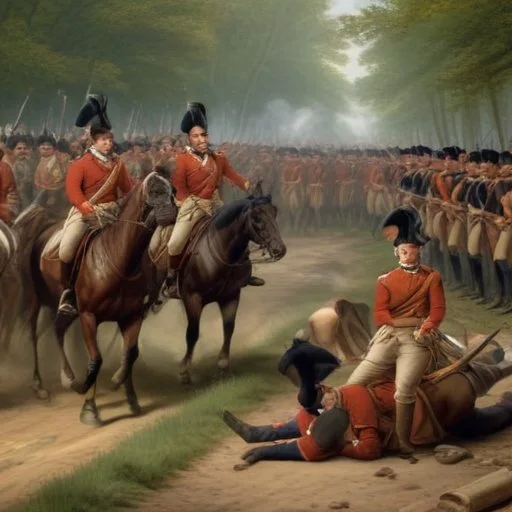
Born into a life of privilege, John Burgoyne was a member of Parliament and a seasoned military officer with a flair for the dramatic. His plan to crush the Continental Army, dubbed the "Saratoga Campaign," was bold in its scope and ambition. Burgoyne envisioned a triumphant march south from Canada, cutting off New England from the rest of the colonies and forcing a negotiated surrender. However, his arrogance and underestimation of the Continental Army would prove to be his downfall.
As Burgoyne's army marched south, General Horatio Gates, commander of the Continental Army, devised a cunning plan to ensnare the British forces. Gates cleverly deployed his troops across the strategic Bemis Heights, a series of rolling hills near Saratoga, creating a bottleneck that would funnel the British into a killing zone. Meanwhile, American troops under the command of General Benedict Arnold and General Enoch Poor were positioned to attack the British flanks, further exacerbating the enemy's plight.
The first salvo in the Battle of Saratoga was fired on September 19, 1777, when British troops clashed with American forces at Freeman's Farm. Although the British emerged victorious, they suffered heavy casualties, and Burgoyne's army was now diminished and demoralized. The Continental Army, on the other hand, had demonstrated its tenacity and resolve, setting the stage for the ensuing battles.
On October 7, 1777, the Continental Army launched a decisive attack on the British forces, pushing them back and capturing key strongpoints. With his army in disarray and provisions dwindling, Burgoyne realized the futility of further resistance. On October 17, 1777, he led his troops out of their encampment, ceremoniously laying down their arms in surrender.
The repercussions of Burgoyne's defeat were far-reaching and profound. The news of the victory electrified the American public, bolstering morale and galvanizing support for the Continental Army. France, impressed by the colonists' tenacity, formally allied itself with the Americans, providing vital financial and military aid. The eventual defeat of the British at Yorktown in 1781 was, in many ways, a direct consequence of the Continental Army's triumph at Saratoga.
In the aftermath of his defeat, Burgoyne returned to England, where he faced ridicule and scorn. However, he remained unrepentant, defending his decisions and attributing his defeat to bad luck and circumstance. Despite his flaws, Burgoyne's surrender at Saratoga serves as a testament to the indomitable spirit of the Continental Army and the unwavering commitment of the American people to their cause.
In conclusion, the surrender of British General John Burgoyne's army at Saratoga, New York, on October 17, 1777, marked a pivotal turning point in the American Revolutionary War. This triumphant victory galvanized American morale, secured French allegiance, and paved the way for the ultimate defeat of the British, forever changing the course of American history.
While John Burgoyne is often in the spotlight, General Horatio Gates, the commander of the Continental Army, played a crucial role in the Battle of Saratoga. A seasoned military officer, Gates was instrumental in devising the clever plan that trapped the British forces and led to their surrender. His leadership and strategic thinking were key to the Continental Army's victory.
Gates' military career was marked by steady advancement, but he struggled to gain recognition. Despite his significant contributions to the Continental Army, he was often overshadowed by more charismatic leaders like Washington and Arnold. However, his triumph at Saratoga cemented his place in American history as a brilliant military strategist.

The Saratoga Campaign, launched by John Burgoyne in June 1777, was a bold attempt to crush the Continental Army and secure British control over the colonies. However, the campaign's roots can be traced back to the British government's decision to impose taxes on the colonies, sparking the American Revolution.
In the aftermath of the Battle of Saratoga, the Continental Army's victory galvanized American morale and secured French allegiance. The eventual defeat of the British at Yorktown in 1781 was, in many ways, a direct consequence of the Continental Army's triumph at Saratoga. The Saratoga Campaign serves as a reminder of the complex interplay of politics, strategy, and chance that shapes the course of human events.
The Battle of Saratoga has left an indelible mark on American culture, inspiring countless works of art, literature, and music. From James Fenimore Cooper's novel The Spy to the iconic painting "Surrender of Burgoyne" by John Trumbull, the battle has been immortalized in various forms of creative expression.
In addition, Saratoga has become a symbol of American patriotism, with the battle's anniversary, October 17, celebrated as a national holiday in New York State. The battle's cultural legacy serves as a testament to the power of history to inspire and shape our collective identity.

The Battle of Saratoga shares parallels with other pivotal battles throughout history, where a single event altered the trajectory of a conflict. From the Battle of Gaugamela, which marked the rise of the Persian Empire, to the Battle of Stalingrad, which turned the tide of World War II, these turning points often hinge on a combination of strategic brilliance, geographic advantage, and a dash of luck.
Saratoga's significance can be seen in its similarities to other battles, yet its unique circumstances – the Continental Army's tenacity, the British underestimation of the colonists, and the decisive intervention of French allies – set it apart as a defining moment in American history.
The Battle of Saratoga did not occur in isolation; it was part of a broader struggle for independence that spanned the Atlantic. The American Revolution was shaped by global tensions, as European powers vied for influence and control over the colonies.
The Continental Army's victory at Saratoga emboldened European sympathizers, who saw an opportunity to weaken British power and promote democratic ideals. The French alliance, secured in part due to Saratoga, marked a significant shift in the balance of power, with far-reaching implications for European politics and the future of colonialism.