


The Battle of Gravelines, fought on July 29, 1588, is renowned for being the decisive naval engagement of the Anglo-Spanish War, where English naval forces under the command of Lord Charles Howard and Sir Francis Drake thwarted the Spanish Armada's ambitions to overthrow Queen Elizabeth I.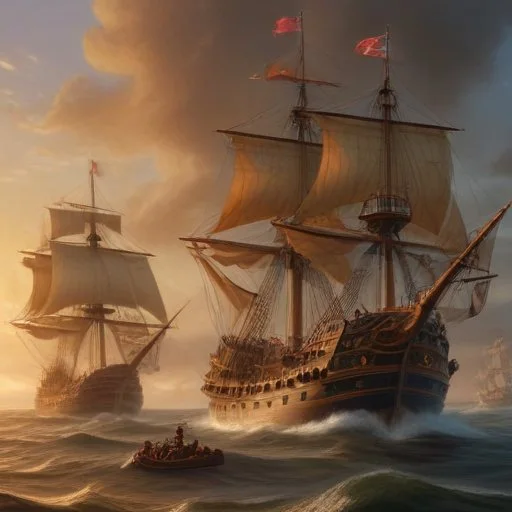
This monumental battle is remembered for its cunning tactics, valiant heroism, and the English navy's unwavering resolve, which collectively crushed the Spanish fleet's dominance and altered the course of history.
The Anglo-Spanish War, sparked by English privateering and Spanish trade interests, had been simmering for decades. In 1588, King Philip II of Spain, determined to overthrow Elizabeth I and claim the English throne, amassed a formidable fleet, known as the Invincible Armada, to invade England.
In July 1588, the Spanish Armada, consisting of 130 ships and over 25,000 men, set sail for England. Meanwhile, the English navy, comprising 90 ships and around 16,000 men, prepared to defend their shores.
The Battle of Gravelines proved a resounding victory for the English, with the Spanish Armada suffering significant losses, including:
This decisive victory not only thwarted Spain's invasion plans but also cemented England's status as a major maritime power, paving the way for its future colonial and naval dominance.
The Battle of Gravelines has been immortalized in literature, art, and popular culture, inspiring works such as:
"There is plenty of time to win the battle, but none to lose it." – Sir Francis Drake
The Battle of Gravelines shares parallels with other pivotal naval engagements, such as:
These comparisons highlight the timeless importance of adaptability, strategic thinking, and bravery in naval warfare.
Sir Francis Drake's personal bravery during the battle is legendary, with accounts describing him as:
The Battle of Gravelines had a profound impact on the future of naval warfare, as it:
The bravery, cunning, and determination exhibited during the Battle of Gravelines continue to inspire generations, serving as a testament to the indomitable spirit of those who dared to shape the course of history.
The Spanish Armada's invasion plans were not solely driven by King Philip II's desire to overthrow Queen Elizabeth I. The Armada was also intended to put an end to English privateering, which had been disrupting Spanish trade and commerce for decades. England's privateers, such as Sir Francis Drake, had been successfully raiding Spanish ships and colonies, causing significant economic losses.
In addition, the Spanish Armada's invasion was also motivated by a desire to restore Catholicism in England, which had been largely abolished by Elizabeth I. The Spanish monarch saw this as an opportunity to reinstate Catholicism and bring England back under the authority of the Catholic Church.

Sir Francis Drake's Early Life
Sir Francis Drake was born in 1540 in Devon, England. Little is known about his early life, but it is believed that he began his naval career at a young age. Drake's cousin, John Hawkins, was a prominent shipowner and privateer, and it is thought that Drake sailed with him on several voyages.
Drake's early experiences at sea likely shaped his later success as a naval commander. His years of privateering and naval warfare gave him the skills and knowledge necessary to take on the Spanish Armada.
The Battle of Gravelines shares similarities with other naval battles throughout history. One such battle is the Battle of Salamis, fought in 480 BCE between the Persian Empire and a coalition of Greek city-states. Like the Battle of Gravelines, the Battle of Salamis was a decisive naval victory for the underdog forces.
In both battles, the underdog forces employed clever tactics to outmaneuver their more powerful opponents. The Greeks used their smaller, faster ships to outflank the Persian fleet, while the English used their smaller, more maneuverable ships to attack the Spanish Armada.

The Battle of Gravelines had a profound impact on English literature and art. The battle inspired numerous works, including William Shakespeare's play Henry VIII, which references the battle.
In addition, the battle has been immortalized in numerous paintings and engravings. Many of these works depict Sir Francis Drake and Lord Charles Howard as heroes, highlighting their bravery and cunning.
The historiography of the Battle of Gravelines is complex and multifaceted. Historians have debated the significance of the battle, with some arguing that it was a decisive victory for the English, while others see it as a minor skirmish in the larger context of the Anglo-Spanish War.
Recent historical accounts have emphasized the importance of the battle in shaping England's identity as a major maritime power. The battle is seen as a turning point in English history, marking the beginning of England's rise to dominance on the world stage.