


Apollo 6, launched on April 4, 1968, marked a pivotal moment in the Apollo program, as NASA pushed the limits of its Saturn V rocket in a high-stakes, uncrewed mission. This daring endeavor proved the rocket's capability to carry astronauts safely to the moon, setting the stage for the historic Apollo 11 lunar landing just a year later.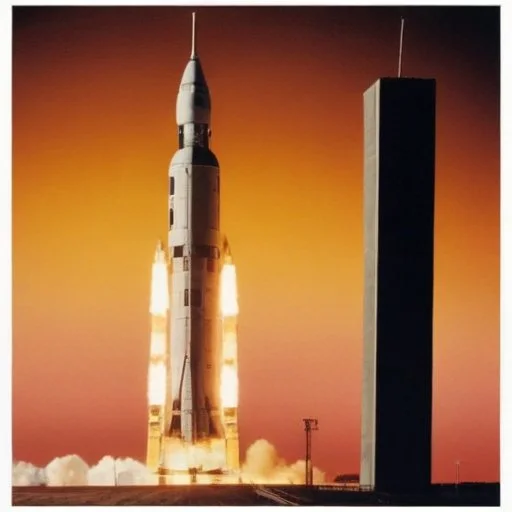
In the midst of the Cold War, the Apollo program was seen as a symbol of American ingenuity and determination. With the Soviet Union's successful launch of Sputnik in 1957, the United States was driven to demonstrate its own space exploration capabilities. The Apollo program, initiated in 1961, aimed to land humans on the moon before the end of the decade. Apollo 6 played a crucial role in achieving this goal.
Standing at an impressive 36 stories tall, the Saturn V rocket was a behemoth of engineering. Its five massive F-1 engines, capable of producing a combined 1.5 million pounds of thrust, made it the most powerful rocket in the world at the time. Apollo 6 was designed to push the Saturn V to its limits, simulating the intense conditions of a lunar mission.
At 12:00 PM Eastern Standard Time on April 4, 1968, the Saturn V rocket ignited its engines, producing a deafening roar that shook the launchpad. The rocket soared into the sky, leaving a trail of fire and smoke in its wake. The mission's success was met with jubilation from the NASA team, knowing that this achievement brought them one step closer to reaching the moon.
The success of Apollo 6 paved the way for the first manned mission, Apollo 7, just six months later. The mission's findings and data were instrumental in refining the Saturn V's design, ultimately enabling the safe and successful landing of Apollo 11 on the moon's surface in July 1969.
George Mueller, NASA's Associate Administrator for Manned Space Flight, played a crucial role in overseeing the Apollo program. Wernher von Braun, the legendary rocket scientist, led the team that developed the Saturn V rocket. These visionaries, along with thousands of dedicated engineers and technicians, worked tirelessly to make the Apollo program a reality.
| Date | Event |
|---|---|
| April 4, 1968 | Apollo 6 launch |
| October 1968 | Apollo 7 launch (first manned mission) |
| July 1969 | Apollo 11 lunar landing |
Apollo 6's success was a testament to human ingenuity and the power of collaboration. This mission marked a significant milestone in the Apollo program, demonstrating the capability to push the boundaries of space exploration. As we continue to venture into the unknown, the legacy of Apollo 6 serves as a beacon of inspiration, reminding us that even the most daunting challenges can be overcome with determination and innovation.
Wernher von Braun, the brilliant engineer behind the Saturn V rocket, was a complex figure with a controversial past. Born in 1912 in Wirsitz, Germany, von Braun was fascinated by rocketry from an early age. He went on to study mechanical engineering and later joined the German military, where he developed the V-2 rocket for Nazi Germany during World War II. After the war, von Braun was recruited by the United States Army and eventually became a naturalized citizen. His work on the Saturn V rocket was instrumental in the success of the Apollo program.

The Apollo 6 mission was not only a technological achievement but also a reflection of American exceptionalism. The mission's success was seen as a demonstration of American ingenuity and determination, reinforcing the country's position as a global leader. The mission's themes of exploration, innovation, and adventure resonated with the American public, capturing the nation's imagination and inspiring a new generation of scientists and engineers.
The Apollo 6 mission paved the way for significant technological advancements in the field of space exploration. The mission's success led to the development of more powerful and efficient rocket engines, improved guidance and control systems, and enhanced communication systems. The technological innovations spawned by the Apollo program have had far-reaching impacts on fields such as computer science, materials engineering, and medicine.

The Apollo 6 mission was, in part, a response to the political pressures of the Cold War. The Soviet Union's launch of Sputnik in 1957 had sparked a sense of urgency in the United States, and the Apollo program was seen as a way to demonstrate American technological superiority. The mission's success was a vital step in maintaining U.S. prestige and influence on the global stage.
Historians have long debated the significance of the Apollo 6 mission, with some viewing it as a crucial stepping stone to the moon landing and others seeing it as a routine test flight. However, a closer examination of the mission's context and outcomes reveals a more nuanced picture. By examining the mission through the lens of historiography, we can gain a deeper understanding of the complex social, political, and technological forces that shaped the Apollo program.