


The Battle of Chacabuco stands as a testament to the unwavering spirit of the Argentine-Chilean patriots who dared to challenge the mighty Spanish Empire. On February 12, 1817, this pivotal battle marked a turning point in the struggle for independence, as the brave men led by José de San Martín and Bernardo O'Higgins emerged victorious against the Spanish troops, paving the way for Chile's liberation.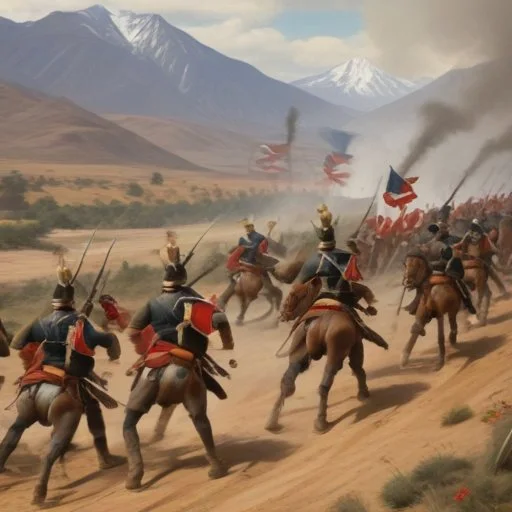
In the early 19th century, the Spanish Empire's grip on South America began to falter. As the winds of independence swept across the continent, Argentina and Chile, bound by a shared desire for freedom, forged an unbreakable alliance. The liberation army, comprising Argentine and Chilean patriots, was formed, with San Martín and O'Higgins at the helm.
The unforgiving Andes Mountains stood as a formidable barrier between the liberation army and their objective. Braving treacherous terrain, harsh weather, and scarcity of supplies, the soldiers embarked on a perilous journey, driven by their unwavering commitment to freedom. This arduous trek, which would have daunted even the most seasoned explorers, only strengthened the patriots' resolve.
On February 12, 1817, the liberation army clashed with the Spanish troops in the Battle of Chacabuco. Despite being outnumbered, the patriots' unyielding determination and strategic prowess enabled them to outmaneuver their adversaries. The Spanish lines were breached, and their forces were forced to retreat. The Battle of Chacabuco was a resounding victory for the Argentine-Chilean alliance, marking a significant milestone in their struggle for independence.
The triumph at Chacabuco sent shockwaves across the region, inspiring hope and galvanizing support for the liberation movement. The Spanish Empire's grip on Chile began to loosen, and the path was cleared for the country's eventual independence. The victory also cemented the bonds between Argentina and Chile, forging a lasting alliance that would endure for generations to come.
"We have freed the people of Chile, but we have not freed ourselves. The struggle continues until we are all free." - José de San Martín
The Battle of Chacabuco reverberates through history, leaving an indelible mark on the course of South American independence. This momentous victory inspired a wave of liberation movements across the continent, shaping the destiny of nations. Today, the bravery and sacrifice of the Argentine-Chilean patriots continue to inspire generations, serving as a beacon of hope and freedom.
José de San Martín, the Argentine general, and Bernardo O'Higgins, the Chilean patriot, formed an unbreakable bond as they led the liberation army to victory. San Martín's tactical prowess and O'Higgins's unwavering commitment to Chile's independence made them a formidable team.
Sir Francis Drake, the British naval officer, once described San Martín as "the greatest of all the South American generals." O'Higgins, on the other hand, was known for his bravery in the face of adversity, earning him the respect of his soldiers and the fear of his enemies.
Together, they shared a vision of a free and united South America, and their partnership became the cornerstone of the Argentine-Chilean alliance.
The early 19th century was a tumultuous period in South American history, marked by rebellions, wars, and shifting alliances. The Spanish Empire, weakened by Napoleon's invasion of Spain, struggled to maintain its grip on its colonies.
The independence movements in Argentina and Chile were part of a broader wave of resistance sweeping across the continent. The Battle of Chacabuco was a crucial victory in this struggle, as it marked a turning point in the fight against Spanish rule.
The battle also had far-reaching implications for the global balance of power, as it signaled the decline of Spanish dominance and the rise of new nations in South America.
The Argentine and Chilean forces that fought in the Battle of Chacabuco shared a common goal, but they differed significantly in terms of their composition, training, and tactics. The Argentine army, led by San Martín, was a more disciplined and professional force, with a strong cavalry contingent.
In contrast, the Chilean forces, led by O'Higgins, were largely made up of irregular militia and guerrilla fighters. Despite their differences, both armies demonstrated remarkable bravery and adaptability in the face of adversity.
A comparative analysis of the two armies reveals that their unique strengths and weaknesses were crucial to the eventual victory at Chacabuco.
The Battle of Chacabuco had significant economic implications for Chile and Argentina. The victory marked the beginning of a new era of economic freedom, as the two countries began to chart their own courses and develop their own industries.
The ends of Spanish rule also led to an influx of foreign investment, as European powers and the United States began to take an interest in the region's natural resources and emerging markets.
Today, Chile and Argentina are major economic players in South America, and their growth and development are a testament to the enduring legacy of the Battle of Chacabuco.
Historians have long debated the significance of the Battle of Chacabuco, with some viewing it as a crucial turning point in the struggle for independence and others seeing it as a lesser-known battle in a broader conflict.
Some interpretations emphasize the role of San Martín and O'Higgins as heroic leaders, while others highlight the contributions of lesser-known patriots and ordinary soldiers.
Despite these differing perspectives, most historians agree that the Battle of Chacabuco was a pivotal event in the history of South America, with far-reaching consequences for the region's politics, economy, and culture.