


In one of the most daring and impressive military feats in South American history, Grand Marshal Las Heras led an army across the treacherous Andes Mountains to join forces with liberator José de San Martín, paving the way for Chile's liberation from Spanish rule.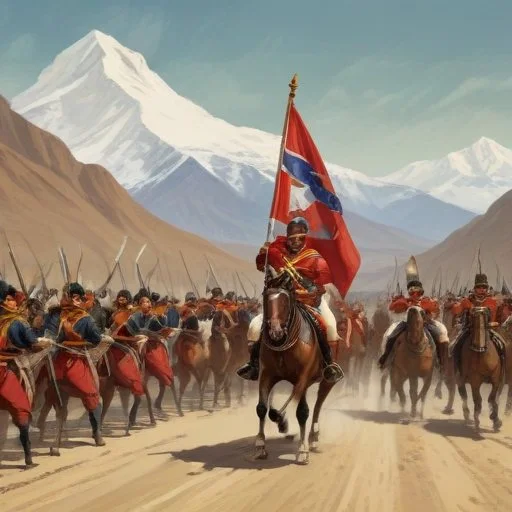
The Andes Mountains, known for their snow-capped peaks, raging rivers, and unpredictable weather conditions, presented a formidable obstacle for Las Heras' army. Yet, through meticulous planning, perseverance, and sheer determination, they successfully navigated the challenging terrain, arriving in Chile ready to face the Spanish forces.
Two prominent figures played a crucial role in this historic event: Grand Marshal Las Heras, a seasoned Argentine military leader, and José de San Martín, the liberator of Chile, Argentina, and Peru. Their combined military expertise, strategic thinking, and unwavering commitment to the cause of independence made them an unstoppable force.
The success of Las Heras' Andes crossing and the subsequent joint effort with San Martín's forces led to the liberation of Chile from Spanish rule, a pivotal moment in South American history. This triumph paved the way for the eventual independence of other Spanish colonies in the region.
The bravery and perseverance exhibited by Las Heras' army inspired a sense of national pride and unity in Chile, fostering a cultural identity that continues to shape the country today. The event also reinforced the importance of cooperation and collaboration in the pursuit of freedom and independence.
The daring Andes crossing by Las Heras' army and their subsequent victory alongside San Martín's forces cemented their places as heroes in Chilean history. This remarkable feat continues to inspire generations, serving as a testament to the power of determination, cooperation, and sacrifice in the pursuit of freedom and independence.
From a historiographical standpoint, the Andes crossing by Las Heras' army represents a pivotal moment in the Latin American wars of independence. This event marks a shift in the balance of power, as the Spanish colonies began to assert their autonomy and fight for self-governance.
The crossing can be seen as a symbol of the region's desire for freedom and self-determination, as well as the willingness of its people to take bold action to achieve their goals.
In the context of Chilean history, the Andes crossing serves as a unifying force, bringing together disparate groups and factions under the banner of independence.

Grand Marshal Las Heras was a man of exceptional leadership skills, able to inspire his troops and make strategic decisions in the face of overwhelming adversity.
His determination and perseverance in the face of the treacherous Andes terrain are a testament to his unwavering commitment to the cause of independence.
Las Heras' leadership style was characterized by his ability to adapt to changing circumstances, as evidenced by his willingness to adjust his plans in response to the harsh weather conditions.
The Andes crossing has had a profound impact on Chilean culture, serving as a symbol of national pride and identity.
The bravery and sacrifice of Las Heras' army have been immortalized in literature, art, and music, ensuring that their legacy continues to inspire future generations.
The event has also reinforced the importance of cooperation and collaboration in Chilean society, promoting a sense of unity and shared purpose.
The Andes crossing took place against the backdrop of a rapidly changing geopolitical landscape, as European powers vied for influence in the Americas.
The Spanish Empire, once the dominant force in the region, was beginning to show signs of weakness, creating an opportunity for local leaders to assert their independence.
The crossing was also influenced by the rivalries and alliances between European powers, as well as the competing interests of different colonial powers in the region.
Primary sources, such as diaries, letters, and military records, provide valuable insights into the experiences of Las Heras' army during the Andes crossing.
The discovery of previously unknown documents, such as the memoirs of a young soldier, have shed new light on the logistical challenges faced by the army.
Artifacts, including uniforms, weapons, and equipment, offer a tangible connection to the past, allowing historians to reconstruct the daily lives of the soldiers.