


The Battle of Bouvines is remembered as a pivotal moment in European history, marking the decisive defeat of the combined forces of the Holy Roman Empire, England, and Flanders at the hands of Philip II of France. This monumental victory cemented Philip's reputation as a cunning military strategist and signaled the beginning of the end of John of England's sprawling Angevin Empire.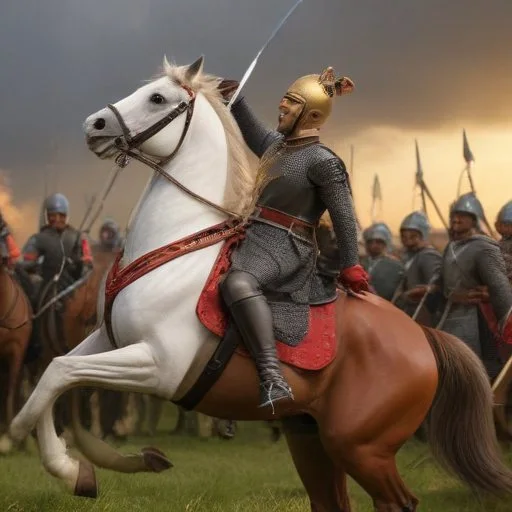
Philip II, also known as Philip Augustus, was a master of politics and warfare. He had inherited a kingdom in disarray from his father, Louis VII, but through cunning diplomacy and strategic alliances, he had managed to strengthen his position and expand his territories. The Battle of Bouvines was the culmination of years of careful planning and would prove to be the crowning achievement of his military career.
In the years leading up to the battle, tensions had been simmering between Philip II and John of England, who ruled over the Angevin Empire, a vast territory that stretched from England to southern France. The two monarchs had clashed over issues of territory, trade, and power, and it was only a matter of time before their differences boiled over into conflict.
The Battle of Bouvines took place on July 27, 1214, near the town of Bouvines in northern France. Philip II's army, bolstered by a contingent of mercenary knights, faced off against the combined forces of John of England, the Holy Roman Empire, and Flanders. Despite being outnumbered, Philip's troops held their ground, employing novel tactics such as the use of pikemen and archers to devastating effect.
The consequences of the battle were severe. John of England's army was decimated, and his hopes of expanding his empire were dealt a crushing blow. The Holy Roman Empire and Flanders suffered significant losses, and their alliance with John was severely weakened. Philip II, on the other hand, emerged victorious, his reputation as a military leader and statesman cemented.
In the wake of the battle, John of England's empire began to fracture, with many of his vassals defecting to Philip II's side. The Holy Roman Empire and Flanders were forced to renegotiate their alliances, and the balance of power in Western Europe shifted decisively in favor of France. Philip II would go on to rule for another 15 years, solidifying his position as the dominant power in the region.
The Battle of Bouvines was a turning point in European history, a testament to the power of strategic thinking and military prowess. As we look back on this pivotal moment, we are reminded of the enduring legacy of Philip II and the significance of this battle in shaping the course of Western civilization.
The Battle of Bouvines took place during a time of great geopolitical upheaval in Western Europe. The Holy Roman Empire, under the rule of Otto IV, was facing challenges from multiple fronts, including the rival claims of Frederick II of the Kingdom of Sicily. Meanwhile, the Angevin Empire, led by John of England, was struggling to maintain its vast territories across France and England. This complex web of alliances and rivalries created a fertile ground for conflict, and the Battle of Bouvines was the culmination of these tensions.
Philip II of France, aware of the fragmentation of his enemies, seized the opportunity to assert his dominance over the region. His decisive victory at Bouvines sent shockwaves throughout Europe, redrawing the balance of power and cementing France's position as a major player in the medieval world.

John of England: The King Who Lost an Empire
John of England, also known as John Lackland, was a member of the House of Plantagenet and the youngest son of Henry II. Despite inheriting a vast empire from his brother, Richard the Lionheart, John's reign was marked by a series of military defeats and political blunders.
His aggressive expansionist policies and disputes with the Holy Roman Empire and Flanders ultimately led to the disastrous Battle of Bouvines. John's defeat at Bouvines marked the beginning of the end of the Angevin Empire, and he spent the remainder of his reign struggling to maintain control over his dwindling territories.
Historians have long debated the significance of the Battle of Bouvines, with some viewing it as a turning point in the development of medieval Europe. The battle has been seen as a triumph of French nationalism, with Philip II's victory marking the emergence of France as a dominant power in Western Europe.
Others have stressed the importance of Bouvines in the context of the Angevin Empire's decline, highlighting the battle as a key moment in the fragmentation of John's territories. Regardless of interpretation, the Battle of Bouvines remains a pivotal event in medieval history, inviting continued study and analysis from historians.

The Battle of Bouvines has drawn comparisons with other significant military conflicts of the medieval period, including the Battle of Hastings and the Battle of Agincourt. Like these battles, Bouvines was a decisive clash of arms that had far-reaching consequences for the balance of power in Western Europe.
However, Bouvines stands out for its unique combination of mercenary knights, pikemen, and archers, showcasing Philip II's innovative military tactics. The battle also marked a shift towards a more centralized state, with Philip II's victory cementing his authority over the French nobility.
The economic impact of the Battle of Bouvines was significant, with the French monarchy benefiting from the spoils of war. The defeat of the Angevin Empire led to the confiscation of John's territories, including the lucrative duchy of Normandy.
The subsequent shift in trade patterns and commerce benefited the French economy, with Philip II's government reaping the rewards of its military success. The battle also led to the growth of a new class of merchants and traders, who capitalized on the increased trade opportunities between France and the rest of Europe.