


The Battle of Carabobo, fought on June 24, 1821, is touted as the decisive battle in the war of independence of Venezuela from Spain, marking a pivotal moment in the country's struggle for self-determination. This blood-soaked skirmish on the sun-drenched fields of Carabobo would etch its place in history as the clincher in a six-year war, paving the way for Venezuela's triumphant emergence as a sovereign nation.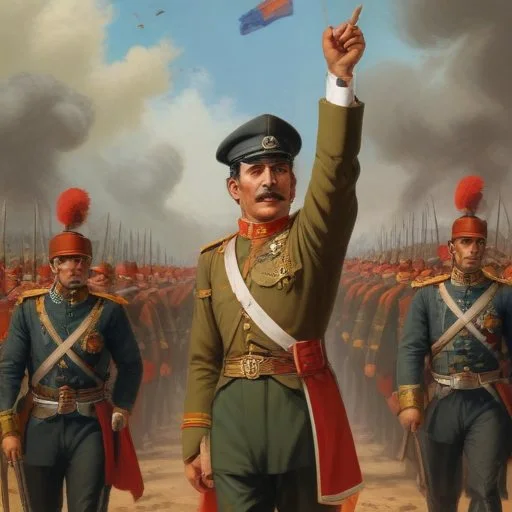
In the early 19th century, Venezuela was a Spanish colony simmering with discontent. The winds of revolution had long been blowing across the Americas, and Venezuela was no exception. The country's Creole elite, weary of Spanish rule, began to conspire against their colonial overlords. Simón Bolívar, a young and charismatic leader, emerged as the standard-bearer of the independence movement.
Bolívar, the brilliant strategist, stood at the helm of the Venezuelan forces, his tactical prowess honed through years of battles against the Spanish. Opposing him was the Spanish commander, Miguel de la Torre, a seasoned veteran of colonial wars. The stage was set for a clash of titans, with the fate of Venezuela hanging precariously in the balance.
The Venezuelan forces, comprising a motley crew of recruited soldiers, local militias, and British volunteers, numbered around 6,000. Bolívar's plan was to feign a retreat, luring the Spanish army into a fatal trap. The ruse worked, and the Spanish commander, confident in his numerical superiority, took the bait. As the Spanish army pursued the Venezuelan forces, they suddenly found themselves encircled, their lines broken, and their escape routes blocked.
The Venezuelan forces, sensing victory, surged forward with renewed ferocity. The Spanish lines crumbled, and La Torre's army was routed. The once-mighty Spanish colonial forces were now in full flight, leaving behind their fallen comrades and the shattered remnants of their army.
The Battle of Carabobo was a decisive victory, but the war was far from over. Bolívar's forces went on to capture Caracas, and the Spanish were eventually forced to surrender. On September 7, 1821, Venezuela declared its independence, paving the way for the rest of South America to follow suit.
The Battle of Carabobo inspired a wave of similar movements across South America, as country after country threw off the yoke of Spanish colonialism. Bolívar's triumph became a beacon of hope, illuminating the path to freedom for nations struggling to assert their independence.
The Battle of Carabobo was more than just a military victory – it was a declaration of Venezuela's independence, and a testament to the indomitable spirit of its people. As the country celebrates its freedom, it remembers the bravery and sacrifice of those who fought for it, and honors the legacy of Simón Bolívar, the Liberator.
Born on July 24, 1783, in Caracas, Venezuela, Simón Bolívar was the son of a wealthy Creole family. His early life was marked by privilege and education, with Bolívar studying in Spain and France during his teenage years. It was during this time that he was exposed to the ideas of the Enlightenment, which would later shape his vision for a unified and independent South America.
Bolívar's return to Venezuela in 1807 marked the beginning of his involvement in the independence movement. He was influenced by the writings of European thinkers such as Jean-Jacques Rousseau and Immanuel Kant, and he began to see the Spanish colonial system as outdated and oppressive.
Bolívar's leadership qualities were evident from an early age. He was charismatic, intelligent, and persuasive, able to inspire loyalty and dedication in those who followed him. These traits would serve him well as he embarked on his military campaigns to liberate South America from Spanish rule.

The Battle of Carabobo took place during a time of significant geopolitical upheaval in the Americas. The Latin American wars of independence were in full swing, with many countries fighting for their freedom from Spanish and Portuguese colonial rule.
The Venezuelan independence movement was part of a broader regional struggle for self-determination. Bolívar's ultimate goal was to create a unified South American state, which he believed would be stronger and more prosperous than individual nation-states.
The Spanish, on the other hand, were determined to maintain their colonial empire and resist the growing tide of independence movements. The Battle of Carabobo was a crucial test of strength between the Venezuelan patriots and the Spanish colonial forces, with the outcome determining the fate of the region.
The Battle of Carabobo had a profound impact on Venezuelan culture, shaping the country's identity and sense of nationhood. The battle is remembered as a symbol of resistance against colonial oppression and a testament to the bravery and sacrifice of the Venezuelan people.
The battle also had a significant impact on the arts, with many Venezuelan writers, poets, and musicians drawing inspiration from the event. The battle has been immortalized in literature, music, and art, cementing its place in the country's cultural heritage.
Today, the Battle of Carabobo is celebrated as a national holiday in Venezuela, with parades, processions, and other festivities honoring the heroes of the battle.

The Battle of Carabobo was the culmination of a series of military campaigns fought by Bolívar's forces in 1821. The year began with a series of skirmishes and battles against the Spanish, as Bolívar's army pushed southwards from New Granada (modern-day Colombia).
In March 1821, Bolívar's forces defeated the Spanish at the Battle of Carapecua, capturing the city of Valencia and paving the way for a march on Caracas. The Spanish, however, regrouped and launched a counterattack, forcing Bolívar to retreat to the Andes.
It was during this period of retrenchment that Bolívar planned the daring strategy that would lead to the Battle of Carabobo. By luring the Spanish into a trap, Bolívar's forces would gain the upper hand and secure a decisive victory.
The Battle of Carabobo had significant political ramifications, both in Venezuela and across South America. The defeat of the Spanish marked the end of colonial rule in Venezuela, paving the way for the country's independence and the emergence of a new nation-state.
The battle also had a profound impact on the region, as other South American countries took inspiration from Venezuela's example. The Chilean and Argentine independence movements, in particular, were galvanized by Bolívar's victory, and the region began to coalesce around the idea of a unified, independent South America.
In the years following the battle, Bolívar would go on to play a key role in shaping the political landscape of South America, helping to create the Gran Colombia, a short-lived union of Venezuela, Colombia, Ecuador, and Panama.