


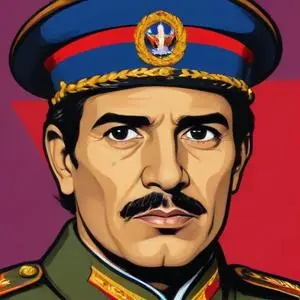
Led the Latin American wars of independence against Spanish rule, unifying several countries under the Gran Colombia republic. He's revered as a national hero and symbol of freedom.
Simón Bolívar, known colloquially as El Libertador, is renowned for leading the fight for independence against the Spanish Empire, liberating six countries in South America: Colombia, Venezuela, Ecuador, Peru, Panama, and Bolivia. This Venezuelan military and political leader is revered as a hero, a champion of freedom, and a unifying force in the region.
Born on July 24, 1783, in Caracas, Venezuela, Bolívar was part of a wealthy family of American-born Spaniards, known as criollos. Losing both parents at a young age, he was educated abroad, as was common for upper-class families during that time. His experiences in Spain from 1800 to 1802 introduced him to Enlightenment philosophy, which would later shape his vision for a unified and free South America.
In 1805, Bolívar embarked on a Grand Tour that took him to Rome, where he swore to end Spanish rule in the Americas. Upon his return to Venezuela in 1807, he began promoting independence to other wealthy creoles, sparking a chain of events that would change the course of history.
Bolívar's military career began in 1810 as a militia officer in the Venezuelan War of Independence. He fought bravely against Royalist forces, leading to the establishment of the first and second Venezuelan republics, as well as the United Provinces of New Granada. After being forced into exile on Jamaica, Bolívar received military support from Haitian revolutionary leader Alexandre Pétion, who had promised to abolish slavery in Spanish America.
Bolívar's unwavering commitment to freedom and unity has left an indelible mark on modern society. He is celebrated as a symbol of independence, a champion of human rights, and a beacon of hope for oppressed nations. His vision for a unified South America has inspired generations of leaders and continues to influence regional politics.
"A united South America will be a powerful force, capable of confronting the great powers of the world." — Simón Bolívar
Bolívar married María Teresa Rodríguez del Toro y Alaysa in 1802, but her untimely death in 1803 due to yellow fever led him to dedicate his life to the cause of independence. His experiences abroad, particularly in Spain and Haiti, shaped his worldview and informed his approach to politics and warfare.
Bolívar was deeply influenced by Enlightenment philosophies, which emphasized reason, democracy, and individual rights. He believed in the importance of unity and cooperation among nations, advocating for a federal system of government that would promote regional stability and progress.
While Bolívar is widely revered as a hero, his legacy has also been subject to controversy and debate. Critics have argued that his authoritarian tendencies and centralization of power undermined democratic principles, while others have questioned his decision to execute those who opposed him.
Bolívar's life and achievements must be understood within the context of the Spanish American wars of independence, a tumultuous period marked by widespread upheaval and social change. His unwavering commitment to freedom and unity has inspired generations of leaders, earning him a place among the most influential figures in Latin American history.
Today, Bolívar's legacy continues to inspire and influence leaders, scholars, and citizens across the region, serving as a powerful reminder of the importance of unity, freedom, and human rights.
72 Years Old
The charismatic leader who transformed Venezuela through socialist reforms and anti-imperialist rhetoric, leaving a lasting impact on the country's politics and economy.
Born in 1926
The Cuban revolutionary who led the country from 1959 to 2008, implementing socialist policies and defying US opposition, becoming an iconic figure in modern history.
Born in 1778
Led the successful fight for independence in Argentina, Chile, and Peru, and is revered as a national hero in these countries. He's also credited with creating the Army of the Andes, a crucial force in the Latin American wars of independence.
Born in 1785
A Chilean general and politician who led the country's struggle for independence from Spain and later became a prominent figure in the country's early years. He's known for his military victories and shaping Chile's early government.
Born in 1770
A key figure in Argentina's struggle for independence, he created the country's flag and played a crucial role in its early development.
