


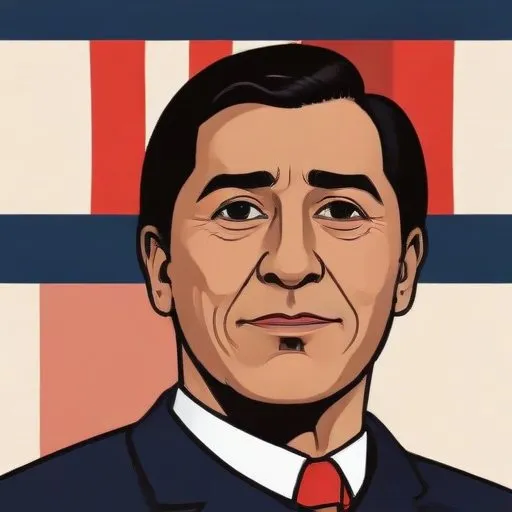
A Chilean general and politician who led the country's struggle for independence from Spain and later became a prominent figure in the country's early years. He's known for his military victories and shaping Chile's early government.
José Miguel Carrera, a brilliant military strategist and unrelenting patriot, is renowned for his pivotal role in the Chilean War of Independence, earning him the reverence of a national hero. As a prominent leader of the Patria Vieja, or Old Republic, Carrera fearlessly battled against the Spanish Reconquista, refusing to surrender even in the face of exile and defeat.
Born on October 15, 1785, in Santiago, Chile, Carrera descended from a prominent Basque family. His parents, Ignacio de la Carrera y Cuevas and Francisca de Paula Verdugo Fernández de Valdivieso y Herrera, raised him alongside his siblings, Juan José and Javiera. Carrera's academic pursuits took him to the esteemed Convictorio Carolino, the country's premier educational institution at the time.
Carrera's military prowess and unwavering dedication to Chilean independence propelled him to the forefront of the country's struggle against Spanish rule. As a member of the Carrera family, he was part of a powerful and influential clan, which further solidified his position as a leader in the fight for independence.
During the period of the Patria Vieja, Carrera led the brave men and women of Chile in their quest for freedom, leveraging his military acumen to secure crucial victories against the Spanish forces. However, the tide of the war shifted with the Spanish Reconquista, and Carrera was forced to flee to Montevideo, where he continued to orchestrate resistance efforts from exile.
Undeterred by his circumstances, Carrera joined forces with Argentine federalists, defying the authority of San Martín and O'Higgins, the leaders of independent Argentina and Chile, respectively. From Montevideo, he masterminded a daring campaign to topple O'Higgins, Chile's Supreme Director, and liberate his beloved homeland once and for all.
Carrera's unwavering resolve led him to forge unlikely alliances with indigenous tribes, including the Ranquel, as he navigated the treacherous landscape of Argentine politics. His unrelenting determination ultimately proved to be his downfall, as he was captured and executed in Mendoza on September 4, 1821, after being betrayed by one of his Argentine allies.
José Miguel Carrera's unyielding commitment to Chilean independence resonates deeply in the hearts of his countrymen. His bravery, strategic brilliance, and unwavering dedication to the cause of freedom have cemented his status as one of the founders of independent Chile.
Carrera's influence extends beyond the realm of politics, inspiring generations of Chileans to strive for greatness. His legacy serves as a testament to the power of perseverance, even in the face of overwhelming adversity.
José Miguel Carrera's remarkable life serves as a beacon of hope and inspiration, reminding us that even in the darkest of times, the human spirit can overcome even the most daunting challenges.
Born in 1778
Led Chile's struggle for independence from Spain, becoming a national hero and symbol of freedom. He's revered for his bravery, strategic thinking, and vision for a unified Chile.
Born in 1778
Led the successful fight for independence in Argentina, Chile, and Peru, and is revered as a national hero in these countries. He's also credited with creating the Army of the Andes, a crucial force in the Latin American wars of independence.
Born in 1783
Led the Latin American wars of independence against Spanish rule, unifying several countries under the Gran Colombia republic. He's revered as a national hero and symbol of freedom.
Born in 1795
Led the Latin American wars of independence against Spain, and later became the president of Bolivia, playing a key role in the country's early development. He's revered as a national hero in Bolivia and Venezuela.
Born in 1770
A key figure in Argentina's struggle for independence, he created the country's flag and played a crucial role in its early development.
Born in 1753
A Mexican priest who sparked the country's war for independence from Spain with his famous "Grito de Dolores" cry for freedom, leading a rebellion against colonial rule.
Born in 1783
Mexican royalist turned insurgent who led the country to independence and became its first emperor, known for uniting the country and establishing the Mexican Empire. He played a crucial role in shaping Mexico's early history.
Born in 1781
A leading figure in Latin American literature and philosophy, known for his influential poetry and essays that shaped the region's cultural identity. He's also credited with creating the modern Spanish language grammar rules.
