


The Battle of Plassey, fought on a sweltering June day in 1757, is a pivot point in history, marking the beginning of British dominance in India. This decisive battle saw a vastly outnumbered force of 3,000 British troops, led by the cunning Robert Clive, defeat a 50,000-strong Indian army under Siraj ud-Daulah, paving the way for East India Company rule in the subcontinent.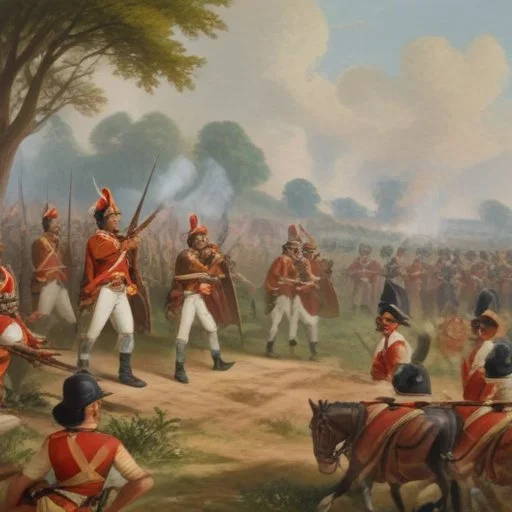
As the sun rose over the fields of Plassey, the fate of India hung in the balance. Behind the scenes, intrigue and deceit had been brewing. Siraj ud-Daulah, the young and ambitious Nawab of Bengal, had grown wary of British East India Company's expanding influence in his territory. Tensions simmered, and the stage was set for a confrontation.
The Indian army, boasting an impressive 50,000 soldiers, stretched across the plains, a seemingly impenetrable wall of armor and steel. Clive's forces, grossly outnumbered, relied on their superior artillery and discipline to hold the line. As the battle raged on, Clive's clever tactics, including the use of the River Bhagirathi to outflank the Indian army, began to tell. The Indian lines wavered, and Siraj ud-Daulah's command began to crumble.
The Battle of Plassey proved a decisive victory for the British. Siraj ud-Daulah fled, and Clive claimed victory. The East India Company's dominance in India was cemented, and the seeds of British rule were sown. The consequences of this battle would echo for centuries, shaping the course of Indian history.
The Battle of Plassey marked a turning point in Indian and British history, ushering in an era of colonial rule that would last for nearly two centuries. Today, the battle serves as a poignant reminder of the complexities of cultural exchange and the human cost of imperial ambition.
The Battle of Plassey holds a complex place in Indian and British cultural heritage. It represents both the triumph of strategic cunning and the usurpation of power, serving as a poignant reminder of the intricate dance between cultures and the delicate balance of power.
The Battle of Plassey has been extensively studied by historians, offering valuable insights into the complexities of colonialism, cultural exchange, and the human cost of imperial ambition. The battle serves as a powerful teaching tool, encouraging critical thinking and empathy in understanding the intricate tapestry of global history.
The events leading up to the Battle of Plassey were shaped by the complex web of alliances and rivalries between the British East India Company and the Indian kingdoms. The Company's growing influence in Bengal, particularly in the aftermath of the Nawab's decision to grant them trading rights, had created tensions with Siraj ud-Daulah. The British exploited these tensions, secretly forming alliances with disaffected nobles and merchants who were opposed to the young Nawab's rule.
The British also took advantage of the internal divisions within the Indian army, which was composed of disparate groups with competing interests. The army's lack of cohesion and discipline would ultimately prove decisive in the battle.

Siraj ud-Daulah's Inexperience
Siraj ud-Daulah, the Nawab of Bengal, was only 23 years old when he faced Robert Clive at the Battle of Plassey. His youth and inexperience would prove to be a significant liability in the battle. Despite his bravery, Siraj ud-Daulah was outmaneuvered by Clive's cunning tactics and failed to capitalize on his numerical superiority.
In contrast, Robert Clive was a seasoned military strategist who had honed his skills in previous battles. His experience and tactical genius would ultimately prove decisive in the battle.
The Battle of Plassey is often compared to the Battle of Panipat, another pivotal conflict in Indian history. While both battles marked significant turning points in the subcontinent's history, they were fought under different circumstances and had distinct outcomes.
Unlike the Battle of Panipat, which was fought between two Indian kingdoms, the Battle of Plassey was a clash between a European power and an Indian kingdom. The British East India Company's victory at Plassey marked the beginning of European colonial rule in India, while the Battle of Panipat had more limited consequences for the subcontinent.

The Battle of Plassey had far-reaching cultural significance, marking the beginning of a new era of cultural exchange and influence between India and Europe. The British East India Company's victory opened up India to European ideas, customs, and values, which would have a profound impact on the subcontinent's cultural landscape.
The battle also led to the development of a new hybrid culture, as Indian and European influences blended together. This cultural fusion would shape Indian art, literature, and architecture for centuries to come.
The Battle of Plassey was fought against the backdrop of a rapidly changing geopolitical landscape. The decline of the Mughal Empire had created a power vacuum in India, which European powers were eager to fill.
The British East India Company's victory at Plassey marked a significant shift in the balance of power in India, as European powers began to assert their dominance over the subcontinent. The battle was a key moment in the "Great Game" of European imperialism, as rival powers jostled for influence and control in Asia.