


The Battle of Poitiers is remembered as one of the most decisive victories of the Hundred Years' War, a pivotal moment in which the English army, led by Edward, the Black Prince, defeated the French forces and captured King John II, altering the course of European history.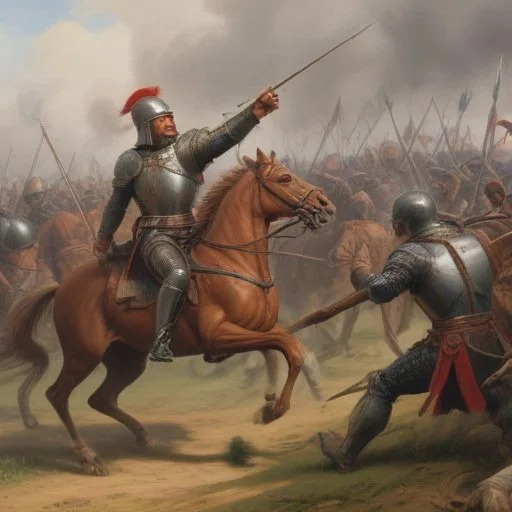
In the midst of the Hundred Years' War, a complex web of alliances and rivalries had formed between the English and French monarchies. As tensions escalated, the stage was set for a major confrontation. In September 1356, the English army, bolstered by a contingent of Gascon nobles, marched towards the city of Poitiers, intent on defeating the French forces and securing a crucial victory.
The English army, numbering around 6,000-8,000 men, was a battle-hardened force, comprising seasoned veterans of the war. Led by the Black Prince, they were a well-oiled machine, with a strong cavalry, agile infantry, and a devastating longbow corps.
In contrast, the French army, estimated to be around 14,000-16,000 strong, was a behemoth of heavy cavalry, disorganized and slow to respond. Despite their numerical superiority, they were plagued by internal divisions and poor communication, which would ultimately prove their downfall.
The battle commenced on September 19, 1356, as the English army emerged from the forest of Nouaillé, catching the French off guard. The English longbowmen unleashed a hail of arrows, decimating the French cavalry and disrupting their formation. As the French regrouped, the Black Prince led a daring cavalry charge, exploiting the gaps in the French lines and sending their opponents into disarray.
The French, despite their valiant efforts, were unable to recover from the initial onslaught. Their king, John II, fought bravely, but was eventually forced to surrender, along with several prominent nobles, including the Constable of France, the Count of Dammartin, and the Marshal of Champagne.
The capture of King John II sent shockwaves throughout Europe, as the French monarchy was forced to confront the reality of their defeat. The ransom demanded for the king's release, a staggering 3 million écus, placed a significant burden on the French economy and further weakened their position.
The English, on the other hand, basked in the glory of their victory, which cemented the Black Prince's reputation as a military genius. The triumph at Poitiers paved the way for future English successes, including the Treaty of Brétigny, which granted England significant territorial gains and recognition as a major power.
The Battle of Poitiers marked a significant shift in the paradigm of medieval warfare, as the English longbowmen and infantry proved their superiority over the traditional heavy cavalry of the French. This transformation would influence the development of military tactics for centuries to come.
The code of chivalry, too, was forever altered, as the Black Prince's conduct during the battle earned him widespread admiration. His decision to spare the life of King John II, despite having the upper hand, solidified his reputation as a just and honorable leader.
In the aftermath of the battle, the Black Prince commissioned a grand tomb for himself in Canterbury Cathedral, featuring a magnificent effigy in armor, surrounded by the symbols of his victories, including the arms of King John II. This monument stands as a testament to his enduring legacy, a reminder of the valor and strategic brilliance that defined his life.
The Battle of Poitiers was a clash of titans, a meeting of two mighty armies that would decide the fate of a continent. In the end, it was the English army, led by the incomparable Black Prince, that emerged victorious, forever etching their names in the annals of history. As we reflect on this pivotal moment, we are reminded of the enduring power of courage, honor, and strategic genius to shape the course of human events.
The Black Prince: A Chivalrous Leader
The Black Prince, Edward of Woodstock, was the eldest son of King Edward III of England. He earned his nickname due to his black armor and his reputation as a skilled and chivalrous knight. The Black Prince was known for his bravery, martial skills, and sense of justice, which earned him the respect of his contemporaries and later generations. His leadership during the Battle of Poitiers showcased his tactical genius and his ability to inspire his troops.
Despite his military prowess, the Black Prince was also a patron of the arts and a devoted husband. He married Joan, the Countess of Kent, and had two sons with her. His legacy extended beyond the battlefield, as he played a significant role in promoting chivalry and knighthood in medieval England.

The Background of the Hundred Years' War
The Hundred Years' War was a complex and multifaceted conflict that spanned over a century, involving various factions and dynasties. The war was sparked by the succession crisis in the Kingdom of France, with Edward III of England claiming the French throne. The conflict was fueled by a mix of feudal, dynastic, and nationalist tensions, which ultimately led to the outbreak of war in 1337.
The war was characterized by a series of battles, sieges, and skirmishes, with both sides experiencing periods of victory and defeat. The English monarchy, however, had a distinct advantage due to their stronger military organization, better logistics, and more effective longbowmen. The Battle of Poitiers was a pivotal moment in the conflict, as it showcased the English military prowess and led to the capture of King John II of France.
The Impact of Poitiers on Chivalry and Knighthood
The Battle of Poitiers had a profound impact on the code of chivalry and the institution of knighthood in medieval Europe. The chivalrous conduct of the Black Prince during the battle, particularly his decision to spare the life of King John II, set a new standard for knightly behavior. The battle also highlighted the importance of honor, loyalty, and mercy in warfare.
The Poitiers episode inspired a new wave of chivalric literature and art, with the Black Prince becoming a symbol of idealized knighthood. The battle also led to the establishment of new chivalric orders, such as the Order of the Garter, which emphasized the values of honor, loyalty, and martial prowess.

The Economic Consequences of Poitiers
The capture of King John II and the subsequent ransom demands had significant economic implications for France. The heavy ransom of 3 million écus placed a substantial burden on the French economy, leading to increased taxation, inflation, and economic stagnation.
The English, on the other hand, benefited from the spoils of war, including the ransom and the territorial gains following the Treaty of Brétigny. The English economy experienced a boost, with trade and commerce flourishing in the aftermath of the battle.
The Geopolitical Significance of Poitiers
The Battle of Poitiers had far-reaching geopolitical consequences, as it marked a significant shift in the balance of power between England and France. The English victory paved the way for future expansion and consolidation of English territories in France.
The battle also had implications for the broader European political landscape, as it demonstrated the military prowess of the English monarchy and its ability to challenge the dominance of the French crown. The Treaty of Brétigny, which followed the battle, recognized English sovereignty over significant territories in France, establishing a new order in Western Europe.