


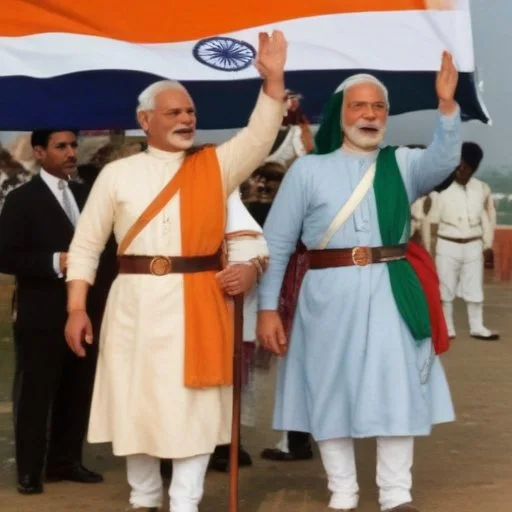
The Cabinet Mission's visit to India in 1946 was not the first attempt by the British government to negotiate the transfer of power to Indian leaders. In 1942, Sir Stafford Cripps, who was a member of the Cabinet Mission, had led a previous mission to India to discuss the possibility of Indian independence. However, the Cripps Mission, as it came to be known, ultimately failed to achieve its objectives due to the outbreak of World War II.
The failure of the Cripps Mission led to widespread protests and unrest in India, with many Indians feeling that the British government was not committed to granting India independence. The Cabinet Mission's visit in 1946 was seen as a renewed effort by the British government to negotiate a peaceful transfer of power, and it was closely watched by Indians and Britons alike.
Archival records reveal that the Cabinet Mission's negotiations were not limited to Indian leaders alone. The mission also held talks with representatives of the princely states, who were concerned about their future role in an independent India. These talks were crucial, as the princely states comprised over a third of India's territory and population, and their cooperation was essential for a smooth transition to independence.
Jawaharlal Nehru, one of the key Indian leaders who negotiated with the Cabinet Mission, was a charismatic figure who played a crucial role in India's struggle for independence. Born in 1889, Nehru was educated at Cambridge University and was drawn to politics at an early age. He was deeply influenced by Gandhian ideals of non-violent resistance and was a strong advocate for Indian independence.
Nehru's involvement in the negotiations with the Cabinet Mission marked a significant shift in his approach to the British government. Until then, he had been a vocal critic of British rule and had been imprisoned several times for his participation in anti-British protests. However, during the negotiations, he adopted a more conciliatory tone, recognizing the need for cooperation and collaboration to achieve India's independence.
In his autobiography, Nehru wrote extensively about the Cabinet Mission's visit and its significance in India's struggle for independence. He described the mission's leaders as "friendly and sympathetic" and praised their willingness to listen to Indian concerns and aspirations.
The Cabinet Mission's visit had a profound impact on Indian culture and society. The mission's negotiations marked a significant shift in the country's psyche, as Indians began to take charge of their own destiny. The transfer of power from the British to Indian leaders was seen as a symbol of Indian self-respect and dignity.
The mission's visit also had a profound impact on Indian art and literature. Many Indian artists and writers saw the Cabinet Mission's visit as a symbol of hope and freedom, and their works reflected this sentiment. For example, the Indian poet and writer, Rabindranath Tagore, wrote extensively about the Cabinet Mission's visit and its significance in Indian history.
Indian newspapers of the time reported extensively on the Cabinet Mission's visit, with many editors and journalists welcoming the mission as a significant step towards Indian independence.
The Cabinet Mission's negotiations with Indian leaders were characterized by a complex web of alliances and rivalries. The Indian National Congress, led by Nehru and Gandhi, was the dominant force in Indian politics, but it faced challenges from other parties, including the Muslim League, which represented India's Muslim minority.
The Muslim League's leader, Muhammad Ali Jinnah, was a key figure in the negotiations, and his demands for a separate homeland for Indian Muslims posed significant challenges to the Cabinet Mission. Jinnah's demands were seen as a threat to Indian unity, and the Cabinet Mission struggled to find a solution that would satisfy both the Congress and the Muslim League.
The negotiations were further complicated by the presence of other parties, including the Sikh League and the Communist Party of India, which had their own agendas and demands.