


Madame Ngo Dinh Nhu, the fiery and outspoken First Lady of South Vietnam, set the stage ablaze with her controversial speaking tour in the United States, further straining the already frayed relations between Washington and Saigon. Her biting criticism of the Kennedy administration's interference in her country's internal affairs sparked heated debates and captivated the American public.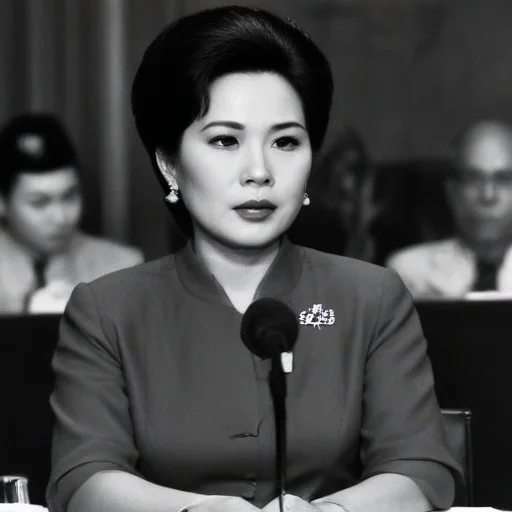
In the midst of the Buddhist crisis, which saw widespread protests and self-immolations by Buddhist monks against the Catholic-dominated South Vietnamese government, Madame Nhu's arrival in the US was met with both curiosity and apprehension. Her sharp tongue and unapologetic style only added fuel to the fire, as she launched a series of scathing attacks on the Kennedy administration's policies towards Vietnam.
Madame Ngo Dinh Nhu, the outspoken and charismatic First Lady of South Vietnam, was the central figure in this controversy. Her sharp wit and unapologetic style made her a formidable opponent, earning her both admiration and scorn from the American public.
President John F. Kennedy, whose administration was under fire from Madame Nhu's criticism, struggled to navigate the complex web of US-Vietnam relations, trying to balance support for the South Vietnamese government with the need to address the growing Buddhist crisis.
The Buddhist crisis, exacerbated by Madame Nhu's speaking tour, had far-reaching consequences for US-Vietnam relations. The controversy led to a significant shift in US policy, with the Kennedy administration increasingly critical of the South Vietnamese government's handling of the crisis.
The episode also marked a turning point in the US's involvement in Vietnam, as the Johnson administration began to escalate its military presence in the region.
Madame Nhu's speaking tour and the Buddhist crisis it sparked had a profound impact on American public opinion. The controversy highlighted the complexity and nuance of US-Vietnam relations, forcing Americans to confront the harsh realities of war and political upheaval.
The crisis also inspired a wave of protests and activism, as Americans began to question the role of their country in world affairs.
"The [Kennedy] administration is trying to overthrow our government... They are the ones who are causing the trouble in our country." - Madame Ngo Dinh Nhu
"The Buddhist crisis is a symptom of a deeper problem - the failure of the South Vietnamese government to address the needs and aspirations of its people." - A US State Department official
Madame Nhu's speaking tour was marked by controversy and drama, with the First Lady often clashing with American journalists and officials. One memorable exchange saw her accusing a reporter of being "a communist agent" - a claim that sparked outrage and disbelief.
Despite the turmoil, Madame Nhu remained defiant, refusing to back down from her criticism of the Kennedy administration. Her unwavering conviction earned her both admiration and scorn, cementing her place as one of the most polarizing figures of the era.
The Buddhist Crisis and Madame Nhu's speaking tour have been subject to varying interpretations by historians over the years. Some have viewed her as a shrewd politician who exploited the crisis to curry favor with the American public, while others have seen her as a genuine champion of South Vietnamese sovereignty.
Recent scholarship has emphasized the importance of understanding the crisis within the broader context of US-Vietnam relations, highlighting the complex web of interests and alliances that shaped the Kennedy administration's response to the crisis.
President John F. Kennedy played a crucial role in shaping the US response to the Buddhist Crisis. His administration's policies towards South Vietnam were marked by a mix of idealism and pragmatism, as he sought to balance the need to support a key ally with the growing public concern about the conflict.
Kennedy's leadership style has been characterized as decisive yet cautious, reflecting his awareness of the complexities of the crisis and the need to avoid escalation.
The Buddhist Crisis and Madame Nhu's speaking tour helped galvanize anti-war sentiment in the United States, as Americans began to question the country's involvement in the conflict.
The crisis sparked a wave of protests and activism, with students, clergy, and civil rights leaders joining forces to demand an end to US military involvement in Vietnam.
The crisis also inspired a new generation of musicians and artists to create works that reflected the growing unease about the war.
The Buddhist Crisis unfolded against the backdrop of the Cold War, with the United States and the Soviet Union vying for influence in Southeast Asia.
The crisis was seen as a key battleground in the global ideological struggle, with the US government viewing the conflict as a crucial test of its commitment to containing communism.
The crisis highlighted the complexities of geopolitics in the region, with the US, the Soviet Union, and China all jockeying for position.The Buddhist Crisis marked a significant turning point in US-Vietnam relations, as the Kennedy administration began to reassess its support for the South Vietnamese government.
The crisis exposed the weaknesses of the South Vietnamese government and highlighted the need for the US to re-evaluate its strategy in the region.
The crisis also led to a shift in the US approach to counterinsurgency, with a greater emphasis on winning the hearts and minds of the South Vietnamese people.