Columbus' Massive Fleet Departs for the New World
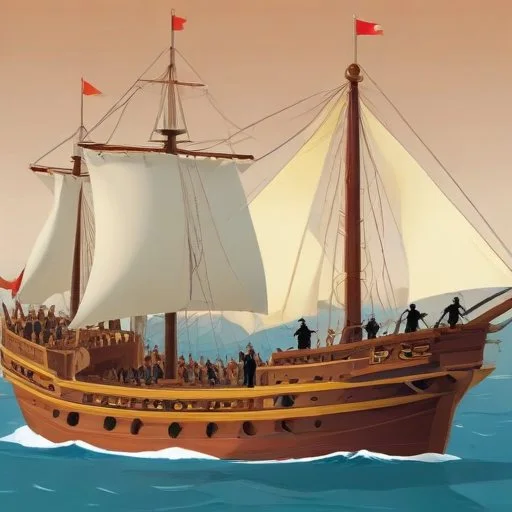
Christopher Columbus, the fearless explorer, sets sail from Cadiz, Spain, at the helm of an astonishing 17 ships, accompanied by a massive crew of 1,200 men. This second voyage marks a significant escalation in his quest to uncover the secrets of the New World, with a fleet many times the size of his first expedition. As the sails unfurl, Columbus is determined to establish a permanent settlement, spread Christianity, and uncover the riches of the Caribbean. The fate of the indigenous people, the success of the expedition, and the course of world history hang in the balance.
The Ambitious Second Voyage of Christopher Columbus
On September 25, 1493, Christopher Columbus set sail from Cadiz, Spain, at the helm of an unprecedented 17-ship fleet, accompanied by a massive crew of 1,200 men. This second voyage marked a significant escalation in his quest to uncover the secrets of the New World, with a fleet many times the size of his first expedition.
The Quest for a Permanent Settlement
Columbus's primary objective was to establish a permanent settlement in the Caribbean, which would serve as a strategic base for further exploration and a stronghold for the Spanish Crown. He was convinced that the riches of the New World would soon flow into the coffers of his patron, King
Ferdinand II of Aragon.
The Fleet and Its Composition
The 17 ships that comprised Columbus's fleet were a testament to his persuasive abilities and the resources at his disposal. The fleet included:
- Three large nao ships, each carrying over 100 men
- Twelve caravels, smaller but more maneuverable vessels
- Two supply ships, carrying livestock, tools, and provisions
The Role of Christianity
Columbus's second voyage was also motivated by a desire to spread Christianity to the indigenous populations of the New World. He believed that converting the native people to Catholicism would not only save their souls but also ensure their loyalty to the Spanish Crown.
The Fate of the Indigenous People
The arrival of Columbus's fleet marked the beginning of a tumultuous period for the indigenous people of the Caribbean. Disease, violence, and displacement would soon become a harsh reality for the native populations, who were largely unprepared to resist the colonizing forces.
Major Outcomes and Impacts
Columbus's second voyage had far-reaching consequences, including:
- The establishment of the first permanent Spanish settlement in the New World, La Isabela, in modern-day Haiti
- The discovery of several islands in the Caribbean, including Puerto Rico and the Virgin Islands
- The enslavement and exploitation of indigenous people, which would become a hallmark of European colonialism
A New Era of Exploration
Columbus's second voyage marked the beginning of a new era of exploration and colonization, as European powers began to stake their claims in the Americas. The consequences of this voyage would be felt for centuries to come, shaping the course of world history in profound and often devastating ways.
Historiographical Analysis
Historians have long debated the motivations behind Columbus's second voyage, with some arguing that he was driven by a desire for personal wealth and power, while others see him as a visionary who truly believed in the potential of the New World to bring riches and glory to the Spanish Crown.
A closer examination of Columbus's writings and the accounts of his contemporaries suggests that the truth lies somewhere in between.
While Columbus was certainly driven by self-interest, he was also deeply committed to his patrons, King Ferdinand and Queen Isabella, and believed that his discoveries would bring them great benefit.
Detailed Character Insight
Christopher Columbus: A Complex Figure
Columbus was a man of contradictions, driven by both altruism and ambition.
On the one hand, he was a skilled navigator and cartographer who was driven by a desire to explore and discover new lands.
On the other hand, he was a product of his time, shaped by the prejudices and biases of a Europe dominated by the Catholic Church.
Full Geopolitical Analysis
The geopolitical context of Columbus's second voyage was marked by a complex web of alliances and rivalries between European powers.
The Spanish and Portuguese were engaged in a decades-long struggle for dominance of the seas, while the Italians and the French were vying for control of trade routes and colonies.
Against this backdrop, Columbus's voyage was seen as a bold move by the Spanish to stake their claim in the New World.
Analysis of Artifacts and Documents
The Diario de Colón, Columbus's own account of his voyages, provides a unique window into his thoughts and experiences during this period.
The diary is a rich source of information, offering insights into Columbus's navigation techniques, his encounters with indigenous peoples, and his struggles to establish a foothold in the New World.
One entry, dated November 1493, describes Columbus's arrival at the island of Hispaniola, where he would establish the first permanent Spanish settlement.
Comprehensive Environmental Influence Study
The environmental impact of Columbus's second voyage was profound and far-reaching.
The introduction of European livestock, crops, and diseases had a devastating effect on the native ecosystems of the Caribbean.
Furthermore, the exploitation of natural resources, including timber and gold, would have long-term consequences for the region's ecosystems.


