


On a fateful day in September 1492, Christopher Columbus, a determined Italian explorer, embarked on a journey that would etch his name in the annals of history. As he set sail from La Gomera, the smallest of the Canary Islands, he was about to pioneer a new route to Asia, a feat that would change the course of human history forever.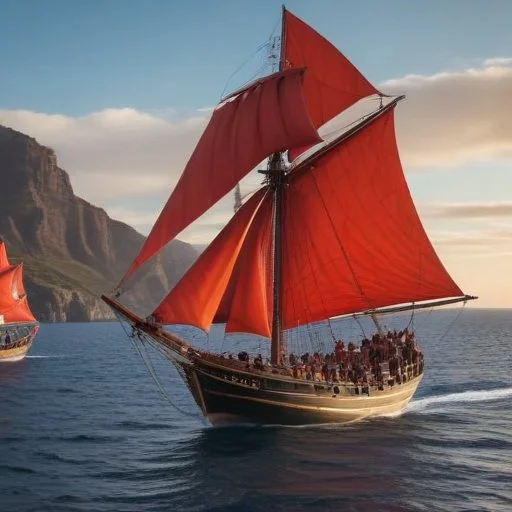
La Gomera, with its lush green landscape and volcanic mountains, proved to be an ideal stopover for Columbus and his crew. The island's strategic location, situated just off the northwest coast of Africa, offered a perfect vantage point for the explorer to gather his thoughts, replenish supplies, and fine-tune his navigational instruments.
The flotilla, comprising the Santa Maria, the Pinta, and the Niña, was a testament to Columbus's unyielding spirit. A hybrid crew of Italians, Spaniards, and Portuguese, numbering around 90 men, had gathered on the island, eager to embark on the perilous journey. The ships, though small, were sturdy vessels, designed to withstand the unforgiving Atlantic Ocean.
As Columbus navigated the treacherous waters of the Atlantic, he was driven by an unwavering conviction that the Earth was round and that Asia lay westward. His calculations, though incorrect, would ultimately lead him to the discovery of the Americas, changing the course of world history.
The historic departure from La Gomera marked the beginning of a new era of exploration and discovery. Columbus's voyage would facilitate the exchange of ideas, cultures, and goods between the Old and New Worlds, forever altering the trajectory of human civilization.
In the end, it was Columbus's unwavering determination, coupled with a dash of luck and circumstance, that led him to set sail from La Gomera, charting a course for the unknown and cementing his place in the annals of history.
The departure of Christopher Columbus from La Gomera in 1492 marks a pivotal moment in the historiography of exploration. Historians have long debated the significance of this event, with some viewing it as a triumph of human ingenuity and others criticizing its consequences for indigenous populations. This event has been contextualized within the broader narrative of European expansionism, imperialism, and the Age of Discovery.
Recent historiographical trends have sought to reevaluate the role of Columbus and the impact of his voyage on the Americas. Postcolonial and indigenous perspectives have challenged traditional narratives, highlighting the devastating consequences of European colonization for native populations.

Christopher Columbus, the Italian explorer, remains an enigmatic figure in history. While his voyage from La Gomera has been extensively documented, the man himself remains shrouded in mystery. Born in Genoa, Italy, circa 1451, Columbus's early life is poorly understood, with some historians suggesting he may have been born into a family of Jewish conversos.
Columbus's personality has been the subject of much speculation, with some portraying him as a visionary and others as a ruthless opportunist. His journal entries and letters reveal a man driven by a singular focus on his mission, yet also prone to outbursts of anger and frustration.
Despite his complexities, Columbus's determination and navigational skills ensured the success of his voyage, cementing his place in the annals of history.
The La Gomera stopover holds significant cultural importance, symbolizing the intersection of European, African, and indigenous cultures. During his stay, Columbus and his crew encountered the native Guanche people, marking the beginning of a complex and often fraught cultural exchange.
The Canaries, including La Gomera, played a crucial role in the development of transatlantic trade, facilitating the exchange of goods, ideas, and cultures between the Old and New Worlds. This cultural exchange had far-reaching consequences, influencing art, literature, and cuisine in the centuries that followed.
A trove of artifacts from La Gomera provides valuable insights into the island's rich cultural heritage. Archaeological excavations have unearthed ceramics, tools, and other relics from the indigenous Guanche people, offering a glimpse into their daily lives and traditions.
The island's museums house an array of artifacts from Columbus's era, including navigational instruments, maps, and documents. These artifacts serve as tangible links to the past, allowing us to reconstruct the events surrounding Columbus's departure and the cultural exchange that ensued.
La Gomera's strategic location in the Atlantic played a crucial role in Columbus's decision to stopover on the island. The island's proximity to the African coast and its position as a midpoint between Europe and the Americas made it an attractive haven for weary sailors.
The Canaries, including La Gomera, had long been a hub for maritime trade, with the Portuguese, Spanish, and Italians vying for control of the islands. This geopolitical context influenced Columbus's voyage, as he sought to secure funding and support from rival European powers.