


In the midst of the Cold War, a tense standoff unfolded on the Black Sea, as the U.S. missile cruiser USS Yorktown (CG-48) became the target of an intentional ramming by the Soviet frigate Bezzavetnyy in 1988. This provocative act sparked a heated diplomatic confrontation, pushing the limits of maritime law and testing the resolve of both superpowers.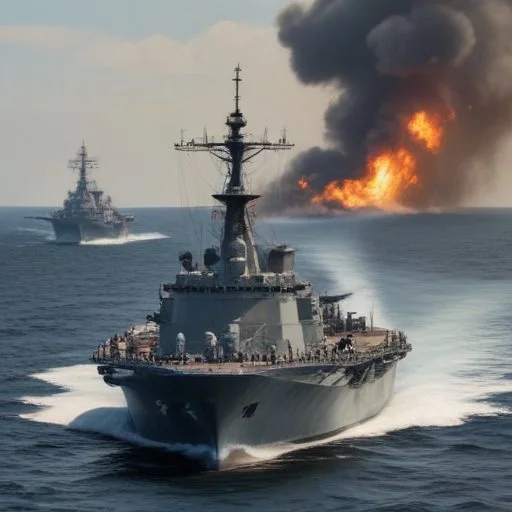
The late 1980s were marked by an easing of tensions between the United States and the Soviet Union, with Mikhail Gorbachev's reforms and Ronald Reagan's diplomatic efforts contributing to a thaw in the Cold War. However, the rivalry between the two nations still simmered beneath the surface, and the Black Sea incident would become a stark reminder of the lingering tensions.
On February 12, 1988, the USS Yorktown, under the command of Captain Jerry Flynn, was conducting a routine patrol in the Black Sea. As the American warship traversed international waters, it suddenly found itself confronted by the Soviet frigate Bezzavetnyy, which deliberately steered into the Yorktown's path. The collision occurred in an area claimed by the Soviet Union as its territorial waters, prompting a forceful response from the U.S. military.
The incident sparked a heated debate over the principles of innocent passage and territorial waters. The Soviet Union maintained that the Yorktown had violated its sovereignty by entering its waters without permission, while the United States argued that the warship was exercising its right to innocent passage, as guaranteed by international law.
The Black Sea incident triggered a rapid escalation of diplomatic tensions between the two superpowers. The United States lodged a formal protest, while the Soviet Union insisted on an apology and compensation for the damage to its frigate. The confrontation brought the world to the brink of a crisis, as both nations mobilized their militaries and rallied their allies.
In the face of escalating tensions, diplomacy intervened to prevent a catastrophe. U.S. Secretary of State George Shultz and Soviet Foreign Minister Eduard Shevardnadze engaged in a series of intense negotiations, which ultimately led to a calming of the situation. The two nations agreed to disagree on the matter, with the United States reiterating its commitment to innocent passage and the Soviet Union reasserting its claims to territorial waters.
The 1988 Black Sea bumping incident served as a stark reminder of the enduring rivalries and tensions of the Cold War era. The incident highlighted the importance of diplomacy in preventing conflict and underscored the need for clearer guidelines on maritime law and territorial waters. As the world continues to grapple with issues of sovereignty and international relations, the Black Sea incident remains a pivotal moment in the history of the Cold War.
The Black Sea incident stands as a testament to the enduring complexities of international relations and the power of diplomacy in preventing conflict. As the world continues to navigate the intricacies of global politics, the lessons of the 1988 Black Sea bumping incident remain as relevant today as they were nearly three decades ago.
The Black Sea incident was not an isolated event in the context of Cold War tensions. In the years leading up to the incident, there were several other close encounters between American and Soviet ships. One such incident occurred in 1976, when a Soviet destroyer came within 100 yards of the USS Belknap, a guided-missile cruiser. The proximity of the two ships was so close that the Belknap's radar dish was knocked off its mount.
Another notable incident took place in 1984, when a Soviet submarine collided with the USS McCloy, a destroyer, in the North Atlantic. These incidents, along with the Black Sea incident, highlight the dangers of naval confrontations during the Cold War era.
In fact, the Black Sea incident was part of a larger pattern of Soviet aggression in the region. In the months leading up to the incident, Soviet ships had been increasingly assertive in their interactions with American vessels, often sailing close to their counterparts and engaging in aggressive maneuvers.
Captain Jerry Flynn, the commander of the USS Yorktown, played a crucial role in de-escalating the situation following the collision. Flynn, a veteran of the Vietnam War, was known for his calm and composed demeanor under pressure.
Born in 1941, Flynn graduated from the United States Naval Academy and went on to serve in various capacities, including as a flight instructor and a destroyer squadron commander. At the time of the Black Sea incident, Flynn had already accumulated over 3,000 hours of flying time and had been awarded several decorations, including the Legion of Merit and the Bronze Star.
Flynn's leadership during the crisis was instrumental in preventing further escalation, as he carefully navigated the complex web of naval protocols and international law to ensure that the situation did not spiral out of control.
The Black Sea incident took place against the backdrop of a rapidly changing geopolitical landscape. In the late 1980s, the Soviet Union was undergoing a period of significant reform, led by Mikhail Gorbachev's policies of glasnost and perestroika.
As the Soviet Union began to open up to the West, the United States was presented with a unique opportunity to re-evaluate its foreign policy priorities. The Black Sea incident served as a stark reminder of the lingering tensions between the two superpowers, but it also offered a chance for diplomatic engagement and cooperation.
The incident highlighted the need for clear guidelines on maritime law and territorial waters, and it sparked a renewed focus on diplomatic efforts to address these issues. In the years that followed, the United States and the Soviet Union engaged in a series of talks aimed at reducing tensions and preventing future incidents.
The Black Sea incident shares several parallels with other maritime confrontations throughout history. One notable example is the 1962 Cuban Missile Crisis, during which the United States and the Soviet Union came to the brink of nuclear war over the presence of Soviet missile sites in Cuba.
Like the Black Sea incident, the Cuban Missile Crisis was marked by a series of tense confrontations between naval vessels from the two superpowers. In both cases, the situation was resolved through diplomatic engagement and a willingness to compromise.
Another notable comparison can be drawn with the 1975 Apollo-Soyuz Test Project, a joint space mission between the United States and the Soviet Union. While the Black Sea incident highlighted the dangers of naval confrontations, the Apollo-Soyuz mission demonstrated the potential for cooperation and collaboration between the two superpowers in areas of mutual interest.
The Black Sea incident had significant implications for American foreign policy in the late 1980s. The incident highlighted the need for clearer guidelines on maritime law and territorial waters, and it sparked a renewed focus on diplomatic efforts to address these issues.
In the aftermath of the incident, the United States continued to push for greater clarity on these issues, and it worked closely with its allies to develop a more cohesive response to Soviet aggression in the region.
The incident also had significant implications for the ongoing arms control talks between the United States and the Soviet Union. The Black Sea incident underscored the need for greater transparency and cooperation in areas such as naval deployments and military exercises, and it helped to galvanize efforts to reduce tensions and prevent future conflicts.