


In the aftermath of World War II, Europe lay in ruins, with economies shattered and infrastructure destroyed. In a historic move, U.S. President Harry S. Truman signed the Marshall Plan on April 3, 1948, allocating a staggering $5 billion in aid to 16 war-torn countries, marking a significant shift in the Cold War dynamics.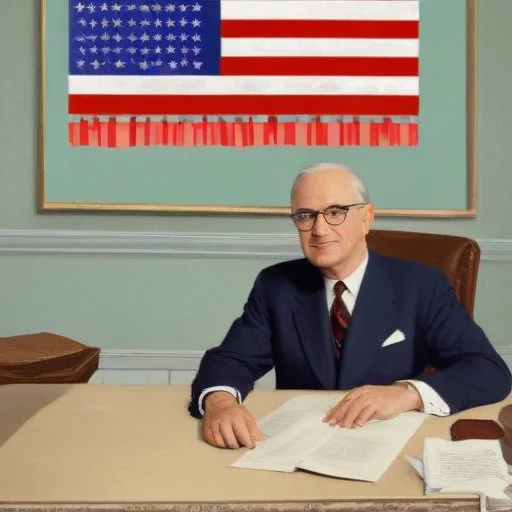
The end of World War II left Europe in a state of devastation, with millions displaced, cities destroyed, and economies on the brink of collapse. The Soviet Union, which had suffered heavily during the war, was eager to expand its influence in Eastern Europe, while the United States was determined to prevent the spread of communism.
In June 1947, U.S. Secretary of State George Marshall, a highly respected military leader and diplomat, delivered a speech at Harvard University, calling for a comprehensive program to rebuild Europe. Marshall's vision was to create a self-sustaining economic system that would curb the spread of communism and promote European stability.
Truman, who had been a vocal supporter of Marshall's idea, established the Committee on European Economic Cooperation (CEEC) to oversee the plan's implementation. The CEEC, comprising representatives from the 16 recipient countries, worked closely with the U.S. government to identify areas of need and allocate the aid.
The $5 billion aid package was distributed across the 16 countries, with the largest recipients being the United Kingdom, France, and Germany. The aid was utilized for a range of purposes, including:
The Marshall Plan had a profound impact on post-war Europe, leading to:
The Marshall Plan had far-reaching cultural and social implications, including:
The Marshall Plan was not without its critics, with some arguing that it:
Despite these criticisms, the Marshall Plan remains one of the most significant initiatives in U.S. foreign policy, marking a turning point in the Cold War and shaping the course of European history.
As Truman signed the Marshall Plan into law, he declared, "This is a turning point in our history, in the history of the world." These words would prove prophetic, as the plan paved the way for a new era of cooperation and growth in Europe.
The Marshall Plan served as a model for future U.S. foreign aid programs, including the Berlin Airlift and the Point Four Program. It also played a key role in shaping the North Atlantic Treaty Organization (NATO) and the European Union, both of which continue to play a vital role in global affairs.
In his memoirs, Truman recalled the day he signed the Marshall Plan, saying, "I felt a sense of pride and satisfaction, knowing that we were taking a bold step to rebuild a shattered world."
Did you know that the Marshall Plan was originally going to be called the "European Recovery Program," but was later renamed in honor of George Marshall?
The Marshall Plan was a testament to American leadership and generosity, marking a pivotal moment in the Cold War. As Truman so eloquently put it, "We are the leaders of the free world, and it is our duty to act."
The Marshall Plan was not the only post-war recovery initiative. The Soviet Union, led by Vyacheslav Molotov, introduced the Molotov Plan in 1947, which aimed to economically integrate Eastern European countries under Soviet influence.
Unlike the Marshall Plan, which focused on rebuilding Europe through economic assistance, the Molotov Plan sought to create a communist economic bloc, with the Soviet Union at its center. The plan was met with skepticism by Western European countries, which viewed it as an attempt to expand Soviet influence in the region.
The key differences between the two plans lay in their approaches to economic development and political ideology. The Marshall Plan promoted free market economics and democratic values, while the Molotov Plan emphasized state-controlled economies and communist ideology.
The Marshall Plan had significant political implications for the United States and Europe. By providing economic aid to war-torn countries, the United States emerged as a leader in European affairs, challenging Soviet influence in the region.
The plan marked a shift in U.S. foreign policy, as the country transitioned from isolationism to international engagement. It also led to the formation of the North Atlantic Treaty Organization (NATO), a military alliance between the United States, Canada, and Western European countries.
The Marshall Plan served as a diplomatic tool, reinforcing the United States' commitment to European security and stability. It demonstrated the country's ability to provide economic aid and military assistance, while promoting democracy and countering communist expansion.
The Marshall Plan had a profound impact on European culture, as American influence extended beyond economics to arts, entertainment, and education.
European cities, once devastated by war, were revitalized by American-style diners, movie theaters, and jazz clubs. The plan facilitated cultural exchanges, as American artists, writers, and musicians traveled to Europe, influencing local artistic expression.
The Marshall Plan helped to create a new generation of European leaders, educated in the United States and influenced by American values. This cultural exchange contributed to the growth of a more integrated and interconnected Europe.
The Marshall Plan has been subject to various historical interpretations, with some viewing it as a generous act of American benevolence, while others see it as a calculated move to expand U.S. influence in Europe.
Historians have debated the plan's role in the Cold War, with some arguing that it was a key factor in containing Soviet expansion, while others contend that it exacerbated tensions between the United States and the Soviet Union.
Recent scholarship has highlighted the plan's significance in shaping European identity and fostering economic integration. As historians continue to reexamine the Marshall Plan, its legacy as a turning point in post-war European history remains uncontested.
The Marshall Plan had a transformative effect on Germany's economy, which was struggling to recover from the devastation of World War II.
The plan provided critical funding for the reconstruction of German infrastructure, including roads, bridges, and ports. This investment enabled Germany to rapidly rebuild its industrial base, becoming one of the leading economic powers in Europe.
The Marshall Plan's support for German economic recovery helped to foster a new era of cooperation between Germany and its European neighbors. This cooperation laid the foundation for European economic integration, culminating in the formation of the European Union.