


A duel that would shake the foundations of American history took place on July 11, 1804, when Vice President Aaron Burr mortally wounded former Secretary of the Treasury Alexander Hamilton. This fateful encounter, which would become one of the most infamous duels in American history, was the culmination of a long-standing feud between two of the nation's most prominent figures.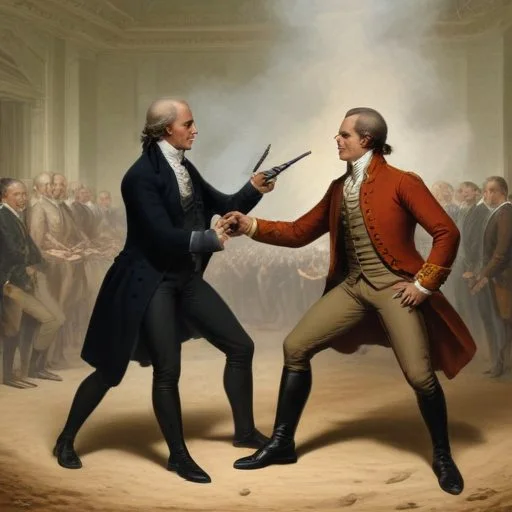
The seeds of discord between Burr and Hamilton were sown years before the duel. The two men had a history of disagreements, with Hamilton openly criticizing Burr's character and politics. Burr, on the other hand, resented Hamilton's influence and perceived arrogance. The tension between them continued to escalate, with Hamilton making public remarks about Burr's candidacy for governor of New York.
The final straw came when Hamilton allegedly made a disparaging remark about Burr at a dinner party. Burr, feeling his honor had been impugned, demanded an explanation and an apology. When Hamilton refused, Burr issued a challenge to a duel, which Hamilton accepted.
On a sweltering summer morning, Burr and Hamilton faced off on the dueling grounds in Weehawken, New Jersey. The atmosphere was tense, with the two men standing 10 paces apart. Burr, cool and calculating, took aim and fired, striking Hamilton in the abdomen. Hamilton, mortally wounded, died the next day at the age of 47.
The repercussions of the duel were far-reaching and devastating. Hamilton's death sent shockwaves through the nation, sparking widespread outrage and grief. Burr, now a fugitive, fled to the South and eventually returned to Washington, D.C., where he was met with public scorn and ridicule.
Burr was later tried for murder in New Jersey and New York, but was acquitted on both counts. Although he was cleared of criminal charges, his reputation was irreparably damaged, and he spent the remainder of his life in relative obscurity.
The duel between Burr and Hamilton had a profound impact on American politics and society. It highlighted the flaws in the dueling system, which was eventually outlawed in many states. The tragedy also underscored the importance of civility and decorum in public discourse, serving as a cautionary tale about the dangers of unchecked ambition and pride.
"In the duel, Hamilton fell, and with him fell the pride and pomp of the Federal party." — The Albany Register, July 17, 1804
The Burr-Hamilton duel remains one of the most significant events in American history, with its effects still resonating today. It serves as a reminder of the importance of statesmanship, honor, and responsibility, and stands as a testament to the enduring legacy of two men who shaped the course of American politics.
Aaron Burr's early life was marked by tragedy, with both his parents dying before he was two years old. He was raised by his grandparents and later went on to study law at Princeton University. Despite his tumultuous childhood, Burr proved to be a skilled lawyer and politician, earning the respect of his peers and eventually becoming the Vice President of the United States. However, his ego and ambition often led him to make reckless decisions, which ultimately contributed to his downfall.
Burr's personality was a complex mix of charm, intelligence, and recklessness. He was known for his good looks and charisma, which earned him many admirers and allies. However, his arrogance and willingness to take risks often put him at odds with his contemporaries. Despite his many flaws, Burr remained a fascinating figure, and his dueling skills were renowned in his time.

The duel between Burr and Hamilton had significant implications for American politics. At the time, the Federalist Party was struggling to maintain its influence, and Hamilton's death dealt a severe blow to the party's leadership. The Democratic-Republicans, led by Thomas Jefferson, seized the opportunity to consolidate their power and push their own agenda.
The duel also highlighted the deep-seated rivalries and personal animosities that existed between prominent politicians. The event served as a wake-up call, prompting many to re-examine the importance of civility and decorum in public discourse. In the years that followed, efforts were made to promote a more respectful and conciliatory political atmosphere, which eventually led to the decline of the dueling culture.
The Burr-Hamilton duel had a profound impact on American culture, influencing literature, art, and music for generations to come. The duel was often depicted in paintings, poems, and songs, serving as a symbol of the nation's struggle to balance individual honor with civic responsibility.
The duel also inspired numerous literary works, including novels, plays, and essays. Many writers and artists saw the duel as a representation of the American psyche, with its themes of pride, ambition, and tragedy resonating deeply with the public.

The events leading up to the duel were shaped by the complex web of alliances and rivalries that existed among the Founding Fathers. The rivalry between Hamilton and Burr was fueled by their differing views on politics, economics, and society. Hamilton, a staunch Federalist, believed in a strong central government and a national bank, while Burr, a Democratic-Republican, advocated for states' rights and limited government intervention.
The duel was also influenced by the political climate of the time, which was marked by intense partisanship and personal animosity. The feud between Hamilton and Burr was just one example of the many bitter rivalries that existed among prominent politicians, and it ultimately contributed to the development of the two-party system in the United States.
The Burr-Hamilton duel has been the subject of much historical debate and speculation over the years. Many historians have questioned the accuracy of accounts surrounding the duel, particularly with regards to Hamilton's final moments. Some have argued that Hamilton's death was not instantaneous, as previously thought, but rather the result of a prolonged and agonizing period of suffering.
Other historians have re-examined the duel as a symbol of the American Enlightenment, highlighting the tensions between reason and passion, as well as the contradictions inherent in the ideal of liberty. The duel has also been seen as a manifestation of the darker aspects of American politics, underscoring the importance of power struggles and personal ambition in shaping the nation's history.