


The Easter Rising of 1916 was a bold and daring rebellion that shook the foundations of British rule in Ireland, marking a pivotal moment in the country's quest for independence. Led by two visionary leaders, Patrick Pearse and James Connolly, a group of brave Irish republicans, socialists, and nationalists took up arms against their colonial oppressors, sparking a week-long standoff that would forever change the course of Irish history.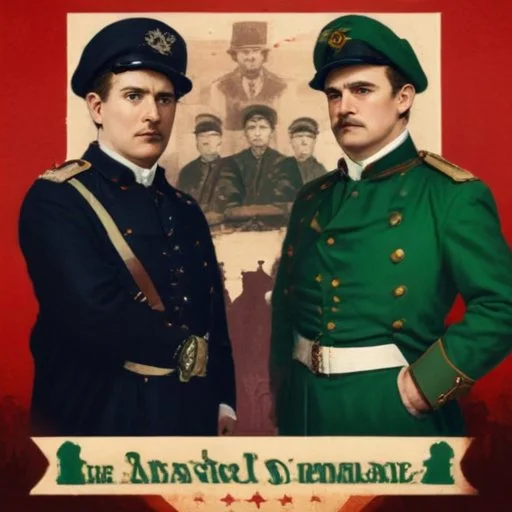
For centuries, Ireland had been under British rule, with its own language, culture, and identity slowly being eroded. The Irish people had been denied their basic human rights, forced to live under oppressive laws, and subjected to poverty, famine, and discrimination. It was against this backdrop of injustice that a group of courageous individuals decided to take a stand and fight for their nation's freedom.
Patrick Pearse, a poet, writer, and educator, was a charismatic leader who had become disillusioned with the slow pace of reform in Ireland. He was determined to take drastic action to free his country from British rule. James Connolly, a socialist and trade union leader, shared Pearse's vision and was instrumental in mobilizing the working class to join the rebellion.
On Easter Monday, April 24, 1916, around 1,500 rebels, mostly young men and women, seized key locations in Dublin, including the General Post Office, which became their headquarters. The rebels, armed with rifles and pistols, were determined to hold out against the British army, which was several times their size. The British government, caught off guard by the sudden uprising, responded with brutal force, shelling the city and imposing martial law.
On the steps of the General Post Office, Pearse read out the Proclamation of the Irish Republic, declaring Ireland an independent nation, free from British rule. This historic document, signed by the leaders of the rebellion, asserted the right of the Irish people to self-determination and pledged to establish a democratic, socialist republic.
The Easter Rising was crushed by the British army after a week of fierce fighting, with many rebels killed or captured. The leaders of the rebellion, including Pearse and Connolly, were executed by firing squad in the days that followed. However, the sacrifice of these brave men and women did not go in vain. The rebellion sparked a wave of national unrest, and public opinion in Ireland shifted decisively against British rule.
The Easter Rising marked a turning point in Ireland's struggle for independence, paving the way for the Anglo-Irish Treaty of 1921 and the eventual establishment of the Irish Free State in 1922. Today, the rebellion is remembered as a symbol of courage, sacrifice, and determination, inspiring generations of Irish people to continue fighting for their freedom and rights.
In the words of Patrick Pearse, "There is no greater glory than to give one's life for one's country."
The Easter Rising of 1916 was a beacon of hope for a nation longing to be free, and its legacy continues to inspire people around the world to fight for justice, equality, and democracy.
The Easter Rising was not an isolated event, but rather the culmination of a long history of Irish rebellion against British rule. The Irish Republican Brotherhood (IRB), a secret organization founded in the late 19th century, had been planning a rebellion for years. The IRB saw the opportunity to strike during World War I, when Britain's attention was diverted to the war effort. They formed an alliance with the Irish Volunteers, a militant group founded in 1913, and began to prepare for the rising.
The rebels were also influenced by the ideas of Irish republicanism, which emphasized the need for an independent Irish state. This ideology was shaped by figures such as Wolfe Tone, who led a rebellion against British rule in 1798. The rebels of 1916 saw themselves as part of a long tradition of Irish martyrs who had fought for independence.

Patrick Pearse was a complex figure, driven by a deep sense of patriotic duty and a passion for Irish culture. He was a skilled writer and educator, and his fascination with Irish mythology and folklore is reflected in his poetry and plays. Pearse was also a strong believer in the importance of education, and he founded St. Enda's School, a bilingual school that taught both Irish and English.
James Connolly, on the other hand, was a socialist and trade union leader who saw the rising as an opportunity to challenge the capitalist system. He was a skilled organizer and strategist, and he played a crucial role in mobilizing the working class to join the rebellion. Together, Pearse and Connolly formed a powerful partnership that drove the rising forward.
The Easter Rising had a profound impact on Irish culture, inspiring a new generation of writers, artists, and musicians. The rebellion's emphasis on Irish identity and self-determination helped to galvanize a cultural revival, as artists sought to express the Irish experience through their work. The writer W.B. Yeats, for example, was inspired by the rising to write some of his most famous poems, including "Easter 1916."
The rising also had an impact on Irish literature, as writers such as Sean O'Casey and Liam O'Flaherty drew on the event for inspiration. The rebellion's themes of heroism, sacrifice, and national pride have continued to resonate in Irish culture to this day.

The Proclamation of the Irish Republic, read out by Patrick Pearse on the steps of the General Post Office, is one of the most important documents in Irish history. The proclamation asserted the right of the Irish people to self-determination and declared Ireland an independent nation. It was signed by the leaders of the rebellion, including Pearse and Connolly, and has since become a symbol of Irish independence.
The proclamation's language is notable for its emphasis on democracy, equality, and human rights. It guaranteed religious and civil liberty, equal rights and opportunities for all citizens, and the protection of minority rights. The document's vision of a democratic, socialist republic has continued to inspire Irish people to this day.
The Easter Rising took place in a complex geopolitical context, with Europe torn apart by World War I. The rising was seen by many as an opportunity to strike a blow against British rule and to assert Ireland's independence. The rebellion was also influenced by the Russian Revolution of 1915, which had inspired socialists and radical nationalists across Europe.
The rising's impact was felt far beyond Ireland's shores. It inspired nationalist movements across the world, including the Indian independence movement led by Mahatma Gandhi. The rebellion's emphasis on self-determination and national sovereignty helped to shape the post-war settlement, as nations argued for their right to self-governance at the Paris Peace Conference.